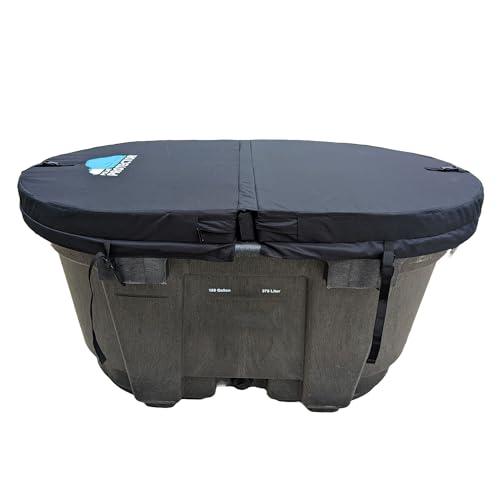
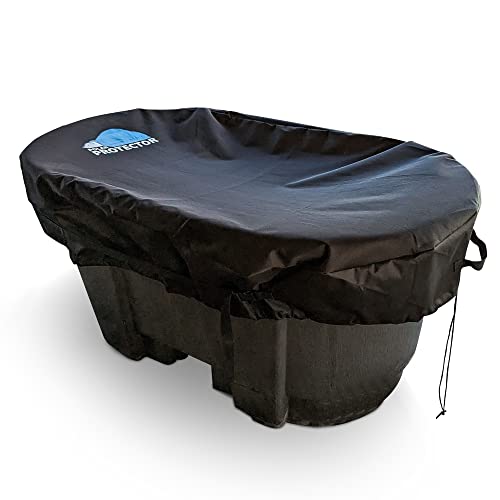
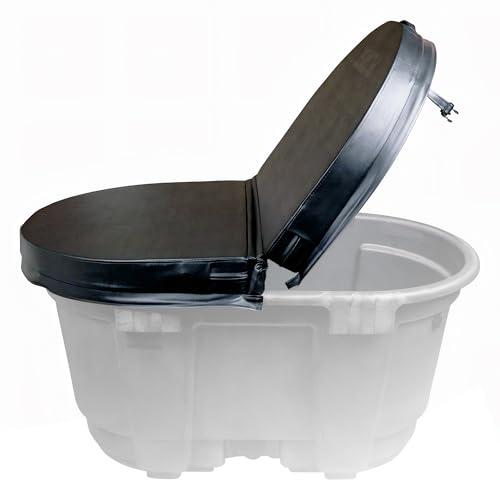
If you plunge with bagged ice a couple of times a week and the tub lives outdoors, buy the Polar Protector 600D canvas cover and stop reading — it costs about what two bags of ice do and it solves the problem you actually have, which is leaves, rain and sun. If you run a chiller, or you buy ice several times a week, buy the insulated Plunge Crafters lid instead: it is the only pick here built to hold temperature rather than just keep the water clean, and at that cadence it pays for itself. Everything else on this page is a fit question — round tub, oval tank, small tub — and we have sorted the picks by which shape they are cut for.
A cover and a lid are two different products
This is the distinction the whole category blurs, and it is the reason people buy the wrong thing. Nearly every listing in this space uses the word "insulated". Very few of them are.
A cover is fabric. It keeps leaves, rain, dust, pollen, snow and direct sun off the water. It will slow warming a little, because shading water and blocking wind does reduce heat gain, but it has no meaningful thermal resistance of its own. 600D canvas and 420D Oxford are covers, whatever the bullet points say.
A lid has an insulating core — rigid EPS foam, or an insulated panel under marine vinyl. That is a genuine thermal barrier, and it changes the arithmetic of running a plunge, because the dominant heat gain on an outdoor tub is through the open surface. The ASHRAE Handbook treatment of surface heat transfer is the formal version of a simple point: an open water surface exchanges heat with the air far faster than an insulated one.
So the honest buying rule is: if your problem is debris, buy a cover and spend as little as possible. If your problem is temperature — ice cost, or a chiller running longer than you would like — buy a lid and accept that it costs ten times more and weighs ten times more. Nobody needs both.
Why most of these are sized for a stock tank
You will notice that three of the five picks here name a Rubbermaid 100-gallon stock tank in their titles. That is not a coincidence, and it is worth understanding before you shop.
The most common home cold plunge in America is not a purpose-built tub at all — it is a livestock watering trough, because it is cheap, tough, food-safe and roughly the right size. Our DIY cold plunge page walks that build. Those tanks come in a handful of standard shapes and sizes, so an accessory industry grew up around them: covers cut to the exact footprint of a 100-gallon oval, with skirts and clips that locate on molded handles.
The consequence is that fit in this category is pass or fail rather than approximate. A cover cut for a 100-gallon oval will not adapt to a round inflatable tub, and a round cover rated to 35 inches will not stretch over a 53-inch oval. Measure your tub — length, width and how far down the side you want the cover to come — before you buy anything on this page.
One group who should probably not buy anything here: owners of the purpose-built inflatable plunges we recommend in best cold plunge tubs. Most of them ship with their own fitted cover or insulated lid already, and a generic replacement will fit worse than the one in the box. Buy from this page if your tub came bare, if the original cover has failed, or if you built your plunge out of a tank.
How we ranked them
Criteria first. Everything below is a judgment from documented research — the listings' own published dimensions, materials and attachment systems, plus aggregated owner reports. We have not put a thermometer under any of these lids, and our methodology says so in those words.
- Does it insulate, and does the listing say how?A named insulation material — EPS foam, an insulated core under marine vinyl — counts. "Internal insulating backing" with no material and no thickness does not, and we mark those picks down and say why on the card.
- How precisely is the fit specified?Published length, width and skirt depth beat "fits most tubs". A cover with exact dimensions is one you can check against a tape measure before you order; a vague one is a return.
- How does it stay on? Screw-in locking clips, then a multi-point hook-and-buckle system, then a buckle plus drawstring, then a drawstring alone. This matters more than it sounds: a cover that blows off in February is a cover that was not on the tub when it mattered.
- Will you actually use it every session? A 13-pound lid is a two-hand lift. A one-pound canvas cover goes on with one hand while you towel off. The lighter cover gets used; the heavier one sometimes leans against the fence all summer.
- Does it manage condensation? A sealed cover over warm, wet surfaces traps moisture, and that is how a tub starts to smell. Vents are a small feature that shows someone thought about the use case.
Which one is for you
- You have a 100-gallon Rubbermaid-style stock tank and you run a chiller: the Plunge Crafters insulated lid. Insulated core, marine vinyl, four clips that screw into the tank's molded handles.
- You have a 100-gallon OVAL tank and want insulation for less: the Polar Protector HARD. EPS foam, a six-point attachment system and a sealing skirt. Measure the tank first — the listing insists on it.
- Most people, most of the time — the budget pick: the Polar Protector 600D canvas cover. Keeps the water clean, weighs a pound and a half, costs a tenth of a lid.
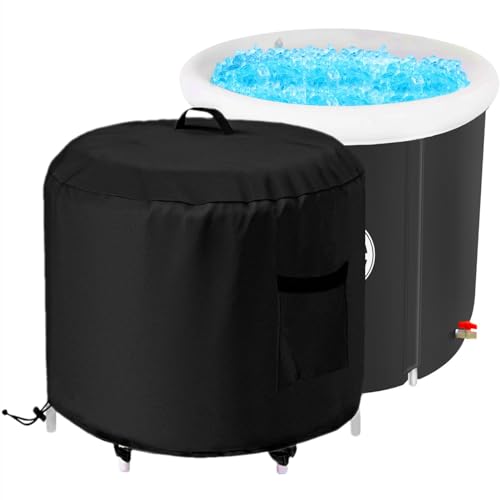
- Your tub is round and upright, not an oval trough: the GS Alderaul round cover, rated to 35 x 35 x 30 inches, with hidden vents so it does not sweat.
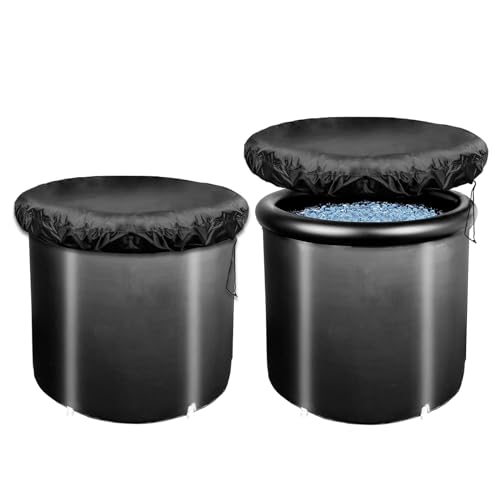
- Small tub, smallest possible spend: the NEAMVCT cover at 32 x 32 x 12 inches. It is a rain sheet, and it is priced like one.
- You do not own a plunge yet: start at best cold plunge tubs or best cold plunge tubs for beginners. Buy a tub whose cover is already included and skip this page entirely.
A cover is one of four things worth owning at the cheap end. The rest are on best cold plunge accessories under $50.
What a cover is worth in money
There are two ways a cover pays for itself, and which one applies to you decides how much you should spend.
If you plunge on ice, the cover saves bags. Ice melts because the tub gains heat from the air, the sun and the wind across its open surface. Shade and a wind break slow that; insulation slows it a great deal more. We are not going to invent a percentage — anyone quoting you one for a specific cover on a specific tub in your climate is guessing — but the direction is not in doubt, and the arithmetic is easy to do yourself: count the bags you buy in a normal week, then count again two weeks after fitting a cover. If a $20 canvas cover saves you one bag a week, it has paid for itself within a month.
If you run a chiller, the cover saves kilowatt-hours, and here an insulated lid is the better buy. A chiller does not run constantly; it cycles to hold a set point, and how often it cycles depends almost entirely on how fast the tub gains heat. Covered and insulated, the compressor runs less. At the U.S. average residential electricity rate published by the EIA, a chiller is not an expensive appliance to run — but it is an appliance with a compressor, and every hour it does not run is an hour it is not wearing out. That is the real argument for a lid over a cover on a chilled tub. See best cold plunge chillers for the hardware and tubs with chillers for the matched setups.
And there is a third benefit that is not about money at all: a covered tub stays usable. An uncovered outdoor plunge collects leaves, pollen, insects, bird droppings and rain, which means more water changes, more filter cleaning and a shorter interval before the water is unpleasant. The CDC's Healthy Swimming guidance is written for pools, but the principle carries: contamination control is mostly about keeping things out in the first place.
Measuring your tub properly
Three numbers, and a fourth that people forget.
Length and width at the rim. Not at the base — stock tanks and most plunge tubs taper, and the cover sits on the widest part. A 100-gallon Rubbermaid oval is commonly quoted around 53 x 32 inches at the rim, which is exactly why the lid and the canvas cover here are cut at 53 x 32.5 and 55 x 35 inches respectively.
Height, if the cover wraps. A fitted round cover like the GS Alderaul is rated to a tub height (30 inches in its case) because the skirt has to reach. A flat lid does not care about height; a wrapping cover does.
Skirt depth you want. A 7-inch skirt grips the rim and sheds rain off the side. A 12-inch one wraps further and holds better in wind. A flat panel with no skirt relies entirely on its clips.
And the thing people forget: where the hoses go. If you run a chiller, two hoses cross the rim. A hard lid that seals perfectly against a bare tank does not necessarily seal around two insulated hoses, and forcing it will kink them. Check how your cover handles the penetration — some owners cut a notch, which is a one-way decision. Plan it before you order.
Hygiene, condensation and the off-season
A cover introduces one problem while solving another: it traps moisture. A wet tub under a sealed cover in warm weather is a humid, dark, still environment, which is the exact condition biofilm likes. Three habits fix it.
First, prefer a cover with vents if your climate is warm — the GS Alderaul's hidden air vents exist for this reason. Second, take the cover off for a while after a session rather than clamping it straight onto a tub you have just been sweating into; let the surface dry. Third, keep up the normal water care — filtration, ozone or a sanitizer appropriate to a cold tub, and a water change on a schedule rather than when it looks bad. Our cold plunge temperature page covers the set-point side, and the chiller roundups cover filters and ozone modules.
In winter, the cover does a different job: it keeps snow and freezing rain out, and on a tub you are not using it keeps the water from becoming a block of ice with leaves in it. If you are draining for the season, dry the cover fully before you fold it away — a damp 600D canvas cover put into a shed in November comes out mildewed in March.
Where this fits in a sauna-and-plunge setup
If the plunge sits next to a sauna — which is how most of this site's readers use one — the cover earns its keep differently. A contrast session means the tub sits open while you are in the heat, then open again between rounds, and all of that is surface heat gain at the worst possible moment. Putting the lid back on for the fifteen minutes you are in the sauna is the single cheapest way to keep the plunge genuinely cold for the third round.
That is the one habit we would push hardest on this page, and it costs nothing. Our contrast therapy guide covers the protocol and sauna and cold plunge combo covers pairing the two bits of hardware. If you are weighing the plunge side at all, the evidence and the practicalities are in cold plunge benefits.