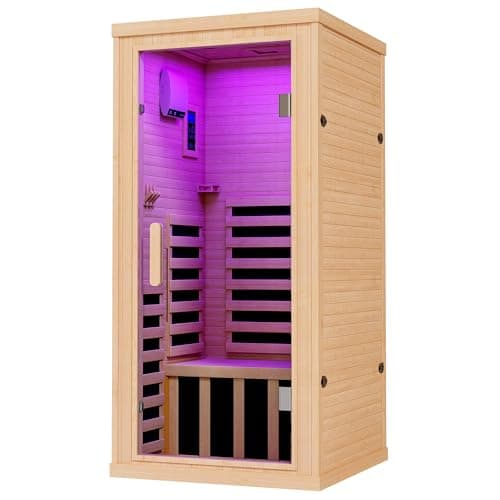
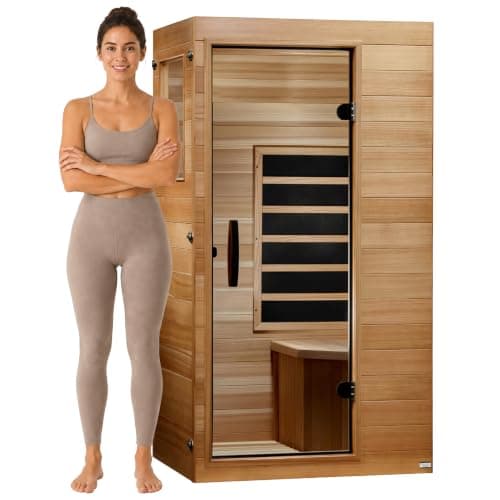
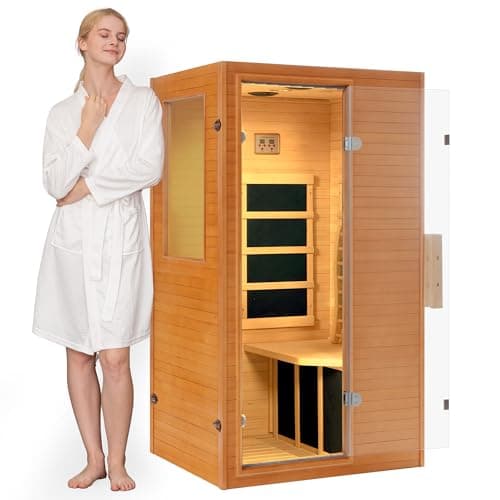
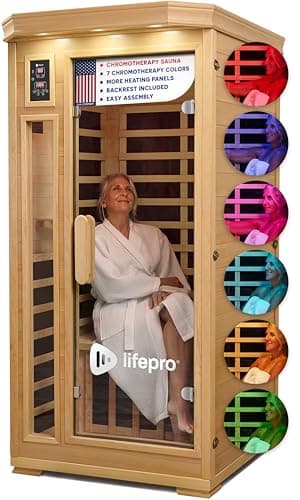
The LifePro Rejuvacure is the compact cabin to buy — modern styling, a roomy-single footprint, and standard 120V plug-in, so it drops into a bedroom corner or small office without an electrician. If you want a true, best-value single, the Albott is the pick; for a mainstream-brand single the Dynamic Elite; and for the smallest budget the Real Relax.
Small-space buying is a measuring problem first
In an apartment, condo or spare room, the sauna that fits beats the sauna that's "best" on paper. Before you compare heaters or brands, measure your spot properly — and measure more than the floor rectangle. A compact infrared cabin needs the footprint itself (most 1-person cabins are roughly 36-40 inches square), plus clearance for the door to swing open, plus a few inches of airflow gap behind and around so the panels aren't pressed against a wall. Miss the door swing or the airflow clearance and a cabin that technically fits the floor still won't work in the room.
The good news is that everything on this page plugs into a standard 120V outlet, so "does my room have the wiring?" is a question you don't have to ask — there's no electrician and no dedicated circuit. That's exactly why compact infrared is the realistic home sauna for renters and small-condo owners. If your constraint is budget more than square footage, the same cabins are ranked by price in our best infrared saunas under $2,000 guide.
"1-2 person" versus a true single
The single most useful thing to understand in this category is that capacity labels are optimistic. A "1-2 person" cabin like the LifePro Rejuvacure is genuinely a roomy single — one adult with space to move, or two only if they're slim and friendly. A true 1-person cabin like the Albott or the Dynamic Elite is honest about being one upright seat. For a small space this is usually a feature, not a limitation: you rarely want to give up floor area to a bigger cabin you'll use alone anyway. Decide up front whether you ever genuinely need room for two, and if the answer is no, a true single is both smaller and cheaper.
Weight, assembly and where these actually fit
Compact cabins still weigh real money in panels — the carbon-panel walls are heavy, and assembly is a two-person job even on a small unit, so plan for a helper and a clear afternoon. Once built, these cabins slot into the places a full 2-person box can't: a bedroom corner, a home-office nook, a small basement, the end of a hallway. Because they run cool and vent gently, they don't demand the ventilation a hot traditional sauna does — but they still want that airflow gap, so don't wedge one into a closet.
Start with ceiling height, not just the floor
Small-space buyers obsess over floor area and forget the ceiling. Most 1-person infrared cabins stand around six feet tall, and you need clearance above the roof for the vent and for the panel connections at the top — a cabin that fits a low-ceilinged basement or an attic room on the floor plan can still foul the ceiling once it's upright. Measure your ceiling height and compare it against the cabin's stated height plus a couple of inches. If you're installing under a slope or a bulkhead, check the height at the exact spot the cabin will stand, not the highest point in the room.
Airflow and the wall behind the cabin
A compact cabin doesn't need the aggressive ventilation a hot traditional sauna does, but it does need to breathe. Leave a few inches of gap behind and beside it so warm air can move and the electronics aren't baking against drywall, and keep it clear of soft furnishings and curtains. Pushing a cabin flush into a corner to save space is the most common way people turn a well-designed compact into a stuffy one. Treat the airflow gap as part of the footprint, not an optional extra — it's the difference between a cabin that heats evenly and one that feels boxed in.
Getting it through the door and up the stairs
The cabin has to reach the room before it can fit in it. Compact infrared cabins ship as flat panels, which helps, but those panels are heavy and some are wide — so measure your doorways, hallway turns and stair widths before you order, especially for a basement or an upstairs room. A panel that clears the front door but not the turn at the top of the stairs is a genuine problem, and it's far cheaper to catch on a tape measure than on delivery day. Plan the route in, not just the destination.
Compact doesn't have to feel cheap
There's a lingering assumption that small means basic, and it isn't true anymore. The LifePro Rejuvacure in particular was drawn to look good in a living space — cleaner lines than the boxy older cabins — and the mainstream-brand Dynamic Elite carries the same ultra-low-EMF heaters as its bigger siblings. Buying compact is a choice about footprint, not a step down in quality, so don't let the small size push you toward the cheapest listing by default. Judge these the way you would any cabin: heater rating, EMF disclosure, brand support, and honest capacity.
Noise, light and living alongside it
In a small home the sauna often shares a room with something else — a bed, a desk, a treadmill — so the small stuff matters. These cabins are quiet in use, but the controller and any Bluetooth or chromotherapy lighting will glow, which is worth knowing if it's going in a bedroom. Think about where the cord reaches your outlet without a trailing extension lead, and whether the door swings toward or away from the rest of the room. Getting these details right up front is what turns a compact cabin into something you actually use daily rather than a fixture you tiptoe around.
Condo and apartment realities: rules, neighbors, moving out
Renters and condo owners have a couple of extra checks worth doing. Skim your lease or HOA rules for anything about heavy appliances, alterations or electrical use — a plug-in cabin rarely breaches anything, but it's better to know before a pallet arrives. Because these run on a standard outlet and bolt together without modifying the building, they're about as landlord-friendly as a home sauna gets, and they come apart into flat panels again when you move, which a built-in never does. Think, too, about shared walls and floors: the cabin itself is quiet, but a heavy unit and your comings and goings sit above or beside a neighbor, so a corner over a solid floor beats one over a creaky bedroom. Chosen with those realities in mind, a compact cabin is one of the few genuine saunas that fits a rented life rather than fighting it.
The picks, in short
The LifePro Rejuvacure wins for the small-space buyer who wants the cabin to look good in a living space: cleaner, more contemporary styling than the older mid-market boxes, a roomy-single footprint, and plug-in operation. The Albott is the best-value true single — seven carbon panels plus a separate foot-heating zone, in Canadian hemlock, at a genuinely low price. The Dynamic Saunas Elite is the mainstream-brand single, ultra-low-EMF rated and backed by the largest support network in the category. The Real Relax is the cheapest real wood cabin, with the thinner support a budget brand implies.
Fitting a sauna into a small room
Measure the spot, not just the floor
Write down four numbers before you shop: the width and depth of the floor area, the ceiling height, and the swing radius of the cabin door. Add a clearance allowance of a few inches behind and beside the cabin for airflow, and confirm the door can open fully without hitting a bed, desk or wall. Then check those against the exact footprint on the listing — every cabin publishes it. This one habit prevents the most common small-space return.
Single versus "1-2 person": pick on honesty
If you'll almost always sauna alone, a true 1-person cabin — the Albott or the Dynamic Elite — is smaller, cheaper and completely sufficient. Only reach for a "1-2 person" cabin like the LifePro if you genuinely want the extra shoulder room or occasional company, and go in knowing it's a roomy single rather than a real two-seater. Buying the honest size keeps both your floor space and your money.
Plug-in is the whole appeal — keep it that way
Every compact cabin here runs on a standard 120V outlet, which is precisely why it suits a rental or a small condo: no electrician, no dedicated circuit, no landlord conversation. Don't undo that by eyeing a bigger cabin that needs 240V — in a small space, the plug-in single is both the practical answer and the one that fits. It's also cheap to run; our running-cost guide shows a compact cabin costs cents per session.
Protect the floor underneath
These cabins are heavy and they run warm at the base, so think about what's under them. On carpet, a hard mat or board spreads the weight and stops the feet from crushing the pile; on hardwood or laminate, a mat guards against scuffs and the odd bit of warmth. It's a small, cheap step that protects a deposit in a rental or a nice floor in a condo — and it makes the cabin easier to shuffle a few inches if you need to adjust the airflow gap after living with it for a week.
Plan where you'll cool down
A sauna session includes the part where you step out and cool off, and in a small home that's easy to overlook. Leave yourself somewhere to sit, a spot for a towel and a glass of water, and ideally a short path to a shower. You don't need much — but a compact cabin crammed into a corner with nowhere to land afterwards is one you'll use less. Designing the cool-down into the layout, even in a tight room, is part of what makes the habit stick.
Confirm the outlet can spare the load
A compact cabin on 120V still pulls a real load while it's heating, so plug it straight into a wall outlet on a circuit that isn't already carrying a space heater, microwave or hair dryer. Avoid daisy-chaining it through a light-duty extension lead or a crowded power strip. In an older apartment especially, it's worth a moment to confirm the outlet you plan to use has some headroom on its circuit — that keeps the breaker from tripping mid-session and is simply good practice with any heating appliance.
When a sauna blanket is the smarter small-space buy
If even a compact cabin won't fit — a studio, a shared room, a place you'll move out of soon — consider an infrared sauna blanket instead. It has essentially no standing footprint, folds into a closet between uses, and delivers far-infrared heat lying down for one person. You give up the sit-up cabin experience and the room to move, but you gain the smallest footprint in the whole category. Our best sauna blanketsguide covers the options when a cabin simply can't fit.