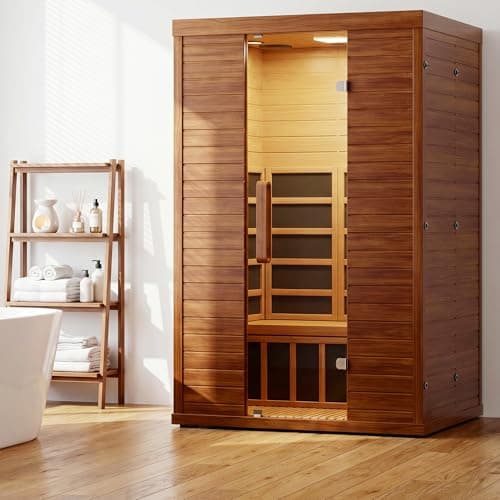
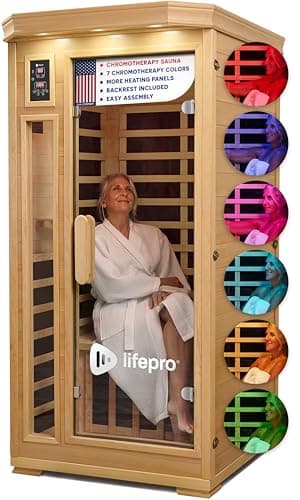
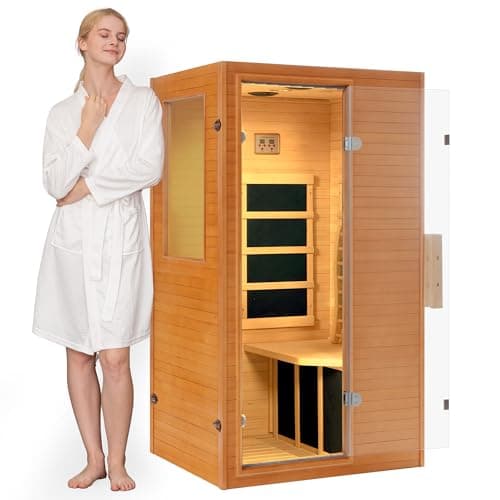
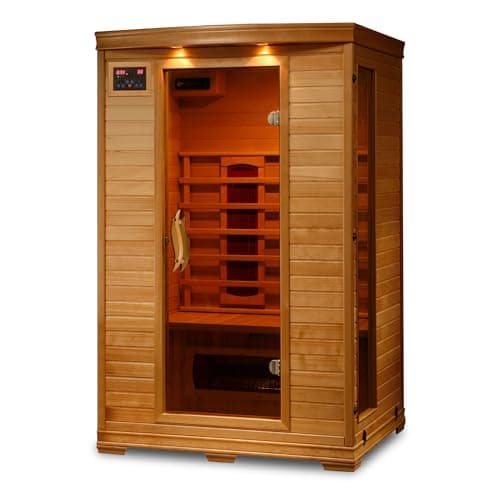
Buy the HeatWave Coronado. It's the best-documented infrared cabin under $2,000 — a genuine 2-person hemlock box with five to six carbon emitters, from the long-running Radiant Saunas line. The other three earn their place for specific reasons: the EASYHAWK if you want a real 2-person cabin for the least money, the LifePro Rejuvacure if you want the most modern-looking compact cabin, and the Real Relax if you just want the cheapest real wood cabin there is.
What the sub-$2,000 tier actually looks like
The budget end of the infrared market is more coherent than it first appears. It's built almost entirely from two shapes: 2-person far-infrared hemlock cabins that plug into a normal wall outlet, and smaller 1-person hemlock boxes at the very bottom of the range. Everything in this tier heats you with carbon or carbon-fiber panels rather than a rock stove, runs cooler than a traditional sauna (roughly 120-140F), and — this is the whole point of buying here — needs no electrician and no dedicated circuit. You unbox it, bolt the panels together, and plug it in.
What you are really shopping for at this price is honesty: a cabin whose "2-person" label is true, whose "low EMF" claim comes with an actual rating, and whose brand will still be around to sell you a replacement heater in three years. The HeatWave Coronado clears all three bars, which is why it wins. If you want to see how these same cabins stack up against the pricier defaults, our full best-infrared ranking puts them side by side.
What you give up versus a $3-4k cabin
Spending under $2,000 is a fair trade, not a compromise you'll regret — as long as you know exactly what the extra money buys higher up. Three things separate this tier from the premium one:
- Wood.Almost every cabin here is Canadian hemlock, the budget-to-mid default. Premium cabins move to red cedar, which is aromatic and naturally rot-resistant. Cedar is lovely, but it's a comfort-and-longevity upgrade, not a heat upgrade — hemlock gets just as hot.
- Full-spectrum heat. The sub-$2,000 cabins are far-infrared only. Full-spectrum adds near- and mid-infrared for red-light-adjacent skin claims, but those cabins cost more and usually need a 240V circuit. If far-infrared is all you want — and for the classic sauna sweat, it is — you lose nothing by staying here.
- The deepest brand support.The very biggest support networks and dealer presence sit with the mainstream premium brands. In this tier, HeatWave is the exception: a long-running Radiant Saunas line with wide retail availability, which is a big part of why it's the pick over the budget-brand alternatives.
How to avoid false economy
The trap at this price is buying the cheapest listing and discovering the savings came out of the parts you actually use. A budget brand with a thin support network can leave you stranded when a heater fails outside a short warranty; an over-generous "1-2 person" label can turn out to seat one adult in comfort and two only if they're very friendly. The way through is to spend at the top of your budget on the cabin that's honestly specced — which is why the Coronado, with its named hemlock build and a line that has been on shelves for years, beats a slightly cheaper undocumented box. If space rather than money is your real constraint, our best compact infrared saunas guide ranks the same tier by footprint instead of price.
Far-infrared and hemlock are not a downgrade
It's worth saying plainly, because the premium marketing implies otherwise: a far-infrared hemlock cabin is not a watered-down sauna. Far-infrared is the band that produces the deep, penetrating sweat people buy a sauna for, and it does that whether the box cost you a little or a lot. Hemlock heats to the same temperature as cedar, and in a dry indoor room its one real weakness — less natural rot resistance — never actually comes into play. What you genuinely don't get at this price is cedar's aroma and the near-infrared band. Both are nice; both are extras. Frame the budget tier as the same core sauna minus the garnish and you'll buy it with the right expectations rather than a nagging sense that you settled for less.
The budget tier is cheap to run, not just to buy
One figure barely moves across this whole tier: the cost to run. A 2-person far-infrared cabin draws roughly 1.6-1.8kW, and at the U.S. average residential electricity rate a typical 30-40 minute session lands somewhere around a couple of dimes; the 1-person boxes draw less again. That makes these cabins inexpensive to live with, not only to buy — closer to running a hair dryer for half an hour than anything you'd have to budget around. It also means running cost isn't a useful way to separate these four, because they're all cheap to operate. Spend your attention on build, EMF rating and support instead, and if you want the arithmetic laid out, our home-sauna cost guide works it through step by step.
What the four picks trade against each other
These four don't simply line up by price — each makes a different trade. The HeatWave Coronado spends its budget on raw heater count and a track record, wrapping you in warmth faster and more evenly, at the cost of dated cabin styling. The EASYHAWK spends it on size and cover: a genuinely roomy 47-inch 2-person cabin with six low-EMF panels and a 5-year limited warranty, at the cost of a listing that never names its wood. The LifePro Rejuvacure spends it on looks and a compact modern shape, which is exactly why it reads as a roomy single rather than a true two-seater. The Real Relax spends nothing it doesn't have to: it's the cheapest genuine wood cabin here, and those savings show up as 950W of heat and a thinner support network. Decide which of those trades sits easiest with you and the ranking mostly sorts itself out.
Who should skip the budget tier entirely
Honesty cuts both ways: some buyers shouldn't shop here at all. If aromatic red cedar is non-negotiable, if you specifically want near-infrared for red-light-adjacent skin goals, or if you need a genuine three-to-four-person cabin, no amount of clever budget shopping gets you there — those wants live one tier up, usually on a 240V circuit or a much larger footprint. Recognizing that early saves you from buying a sub-$2,000 cabin and then feeling short-changed by the very features it was never going to include. For everyone whose goal is a real, plug-in far-infrared sweat for one or two people, though, this is precisely the right place to spend your money.
The picks, in short
The HeatWave Coronado is the one most people here should buy — five to six emitters wrap heat around you for a fast, even warm-up, in a proven if dated-looking cabin from a line with real retail presence. The EASYHAWK is the value winner: six low-EMF panels, 1,500W and a 5-year limited warranty in a full-size 2-person cabin, for well under everything else here. The LifePro Rejuvacure is the modern-styling budget compact — cleaner lines than the older mid-market boxes, best treated as a roomy single. The Real Relax is the absolute cheapest way into a real wood cabin rather than a fabric tent, with the budget-brand caveats that price implies.
How to buy in the budget tier without regret
Stay on 120V — it's the reason to buy here at all
Every cabin on this page runs on a standard 120V household outlet. That is the single biggest advantage of the budget tier and you should protect it. The moment you're tempted by a 3-4 person cabin or a full-spectrum model, you're usually into a dedicated 240V circuit and an electrician — several hundred dollars and, often, a permit. If keeping the install to "plug it in" matters to you, treat 120V as a hard line and don't cross it for a cabin you'll half-fill.
Far-infrared is more than enough at this budget
Far-infrared is the long-wavelength band that produces the deep, sweaty heat people buy a sauna for. Full-spectrum adds near-infrared for skin and recovery marketing, but at this price point it simply isn't on the menu — and that's fine, because far-infrared does the core job completely. Don't let the absence of full-spectrum make a budget cabin feel second-rate; the sweat is the same.
Take the EMF rating seriously, but read it as a claim
Infrared heaters produce electromagnetic fields, and modern low-EMF carbon panels are a real improvement on old ceramic rods. But "low EMF" is a marketing phrase with no single standard behind it, so the signal that matters is whether the brand publishes an actual rating. Dynamic and Maxxus publish figures you can hold them to; most of the cabins in this tier, the EASYHAWK and Real Relax included, print "low EMF" with no number behind it. Our EMF explainer walks through how to read the numbers.
Hemlock is the reality here — and that's okay
Expect Canadian hemlock in this tier. It's a light, stable, perfectly good sauna wood that lacks cedar's aroma and natural rot resistance. Since these are indoor plug-in cabins in dry rooms, rot resistance barely matters, so the practical loss versus cedar is mostly the smell. If aromatic cedar is a must-have, that's a signal you belong one tier up, not that any cabin here is flawed.
Budget for the parts nobody puts on the listing
The sticker price isn't the whole cost. Factor in freight for a heavy, palletized cabin, a second pair of hands for assembly, and a mat if you're standing it on carpet or a finished floor. None of these is large on its own, but they're real and easy to forget when you're comparing two listings that are only a few dollars apart. Build them into your budget up front so the cheapest-looking cabin doesn't quietly become the most expensive one once it's actually in the room.
Check the warranty and parts pipeline before the trim
In a tier where the heaters and the controller are the parts most likely to fail, the length of the warranty and the ease of getting a replacement matter far more than any single spec line. This is the concrete reason the HeatWave Coronado outranks the very cheapest boxes: a long-running line with wide retail availability has a real parts pipeline, where a bargain-brand cabin can leave you hunting for a heater nobody stocks. Read the warranty terms before you're swayed by a Bluetooth speaker or a color-changing light.
Don't overreach on capacity
The most common budget mistake is buying more cabin than you'll fill. A true 2-person cabin like the Coronado or the EASYHAWK is the sweet spot: it seats a couple, or a single person who wants to stretch out, and still runs on your existing outlet. A "1-2 person" cabin such as the LifePro is really a roomy single — great if you sauna alone, tight for two. Buy the size you'll actually use most sessions, keep it plug-in, and don't pay to heat empty bench. Before you commit, it's worth running the numbers on ownership too; our home-sauna cost guide lays out the upfront and running math so the budget cabin stays a budget decision.
If this budget is still too high, the tier below it changes what you are shopping for rather than just which cabin: best infrared saunas under $1,000 covers the one-person cabins, blankets and tents that compete for that money, and is explicit that no real two-person wood cabin lands there.