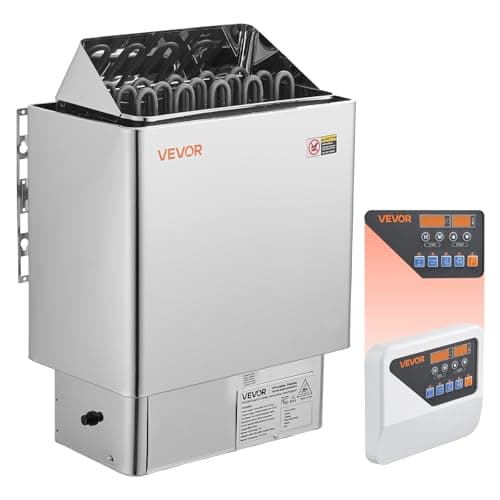
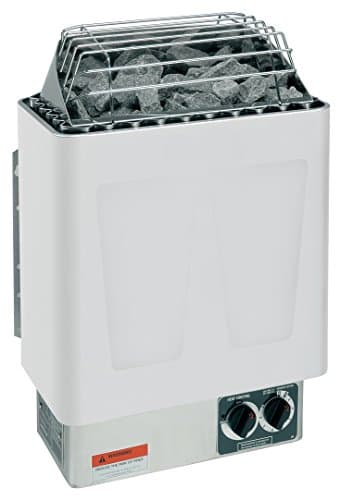
Buy the Harvia if you want a heater you keep for a decade; buy the VEVOR when budget rules and you accept the trade-offs. Harvia is the reference Finnish stove — better build, stones in the box, and the deepest parts and replacement-stone network in the category. VEVOR is the budget line: the lowest price at a given kW, honest about being a buy-cheap stove.
First, an honest word about these two units
The two heaters on this page are deliberately different sizes, and it matters that we say so up front. The Harvia here is the KIP 4.5kW, a small-room stove suited to roughly a 2-person cabin (~200-250 cubic feet). The VEVOR is the 9kW, a large-room stove for ~450-550 cubic feet. We picked them because each shows its brand at its most typical: Harvia's value proposition is a beautifully built small stove that ships complete, and VEVOR's is a huge amount of heat for the least money. What this is not is a heat-output contest — a 9kW heater will always out-heat a 4.5kW one, so comparing their temperatures would be meaningless.
So read this as a comparison of philosophy, not power. The real decision isn't "4.5kW or 9kW" — it's "buy for build and support, or buy for price, at whatever kW my room actually needs." That means you size the heater to the room before you choose the brand. A too-small Harvia and a too-big VEVOR will both disappoint, and no amount of build quality or bargain pricing fixes the wrong kW. Do the cubic-feet math on the sauna heater size guide first, land on your number, and then use the rest of this page to decide how you want that number built. Both brands make heaters across the range, so whichever philosophy wins, you can get it in the size you need.
The difference in one table
| Factor | Harvia (KIP) | VEVOR |
|---|
| Brand | The reference Finnish residential stove | Budget line — lowest price at a given kW |
| Build | First-rate; made to outlast a decade of hard use | Basic; longevity is the trade-off for the price |
| Stones | Included in the box | Often not included — budget a separate bag |
| Controls | Built-in knob and timer on the heater body | External digital controller — set temp and timer outside the hot room |
| Support | Deep parts and replacement-stone network | Basic support and a thinner parts pipeline |
| Philosophy | Buy once | Buy cheap |
What you're actually paying for with Harvia
At a given kW, Harvia costs more than VEVOR — and the extra money buys longevity, not more heat. Harvia is the brand professional installers reach for because the elements, the casing and the stone cage are built to survive years of thermal cycling and the corrosive burst of steam every time you throw water. Just as important as the metal is the network behind it: when an element eventually tires or the stones crumble after years of use, Harvia parts and genuine replacement stones are easy to find, so the stove gets a second life instead of a trip to the tip. That is the whole meaning of "buy once" — not that a Harvia never wears, but that it's worth keeping when it does.
Two smaller things round out the value. The KIP ships with its stones, so what you order is what you can run — there's no separate bag to price in before the first session. And it's a genuinely simple stove: the temperature knob and timer live on the heater body, so there's no external controller to mount and wire. The honest catch is that a built-in knob means you set the sauna from insidethe room, and you can't pre-heat from the hallway the way an external controller lets you.
What VEVOR gets right for the money
VEVOR earns its place by being straightforwardly the cheapest way to a given kW, and it doesn't pretend otherwise. The 9kW model is the clearest example: it delivers big-room heat for a fraction of a premium stove, and — the nice surprise — it comes with an external digital controller. You mount that outside the sauna, set a target temperature and a start timer, and walk in to a room that's already hot without ever opening the door on a cold cabin. That's a feature the built-in-knob Harvia doesn't offer, and it's the daily-use upside of the budget stove.
The trade-offs are exactly what you'd expect and worth saying plainly. The build is basic, so longevity and support are the price you pay for the price you pay — this is a stove you buy knowing it may not be a decade-long keeper. Stones are frequently not included, so the sticker isn't the whole cost until you've added a bag of sauna rocks it can actually heat. And if something fails down the line, the parts pipeline is thinner than Harvia's. None of that makes VEVOR a bad buy — it makes it a clear-eyed one.
Controls: built-in knob vs external digital
This is the one place the cheaper stove can feel nicer to live with. A built-in knob (Harvia) is simple and there's nothing extra to wire, but you adjust it from inside the hot room. An external digital controller (the VEVOR 9kW) mounts on the wall outside, so you set the temperature and a start timer from the hallway and let the room come up before you step in. If pre-heating hands-free matters to you, that's a real point for VEVOR — just remember it doesn't change how long the stove behind it will last.
Longevity: the buy-once vs buy-cheap math
The phrases "buy once" and "buy cheap" aren't just slogans — they describe two ways of spending money over time. With Harvia you pay more up front and, in return, get a stove built to resist years of heat cycling and the corrosive burst of loyly steam, plus a supply of genuine parts and replacement stones that let you refresh it rather than bin it. Spread across a decade of regular sessions, the higher sticker can work out to less per year than a cheaper stove you replace sooner. With VEVOR you pay the least today and accept that the stove may not go the distance; if it outlives your expectations, treat that as a bonus rather than the plan. Neither approach is wrong — they simply suit different budgets and different intentions for how long the sauna will be part of the house.
The honest way to choose between them is to ask how permanent this sauna is. A built-in fixture you expect to use several times a week for years rewards the Harvia's durability and its support. A sauna you're trying out, kitting out on a tight budget, or expect to change before long is a fair match for the VEVOR's low entry price. Match the spend to the plan, not to the badge — and remember that a stove you keep for ten years quietly justifies a premium that looks steep on day one.
Warranty and support, realistically
Beyond the metal, what really separates these two is what happens after the sale. Harvia is the brand installers and owners lean on precisely because the support behind it is deep: parts are cataloged, genuine replacement stones are easy to source, and there's a long track record of stoves being kept in service rather than scrapped at the first fault. Always confirm the specific warranty terms on the listing you actually buy from — coverage varies by seller and region, and it's not a number to trust from memory — but the broader point holds: a well-supported stove is one you can keep running. VEVOR's support is more basic and its parts pipeline thinner, which is a large part of why the total picture, not just the sticker, favors Harvia for a keeper and VEVOR for a budget build. When you weigh the two, weigh the support as seriously as the price — for a heater you intend to own for years, it's often the deciding factor.
Which should you buy?
Buy the Harvia if…
…you want a heater you fit once and forget — a stove that survives years of hard sauna use and is worth repairing rather than replacing when it finally wears. You're paying for build, the stones in the box, and a parts-and-stone network that keeps it running long-term. If your sauna is a fixture of the house rather than an experiment, the premium is the sensible money. Just size it correctly first: the KIP comes in a range of kW, so match it to your room on the size guiderather than defaulting to the 4.5kW because that's the one we showed here.
Buy the VEVOR if…
…budget is the deciding factor and you accept the trade-offs with open eyes. You get working heat at the lowest price, plus the convenience of an external digital controller, in exchange for a basic build, a thinner support network, and — usually — buying stones separately. If you're outfitting a big room and the numbers only work at the budget end, or you simply don't need the stove to last a decade, VEVOR does the job honestly. For the large-room options in particular, weigh it against the value and premium picks in the best heaters for large saunas roundup.
The size decision comes before the brand decision
It's worth repeating because it's the mistake that costs people a good sauna: neither brand can save an undersized or oversized heater. An underpowered stove runs flat out and never reaches a proper 175-190F; an overpowered one overshoots and wastes energy. Measure your room, do the cubic-feet math, adjust up for a glass door or cold walls, and lock in the kW. Only then does "Harvia or VEVOR" become the right question — and at that point it's simply buy-once versus buy-cheap. See the full ranking across every brand and size on the best sauna heaters page.
Plan the 240V install either way
Whichever you choose, both are 240V single-phase stoves that need a dedicated circuit and, realistically, a licensed electrician — this is not a plug-in appliance, and the wiring is a licensed-electrician job, not a DIY one. The bigger the kW, the heavier the circuit, so a 9kW VEVOR is a more demanding hookup than a 4.5kW Harvia. Confirm your panel can spare the load before you order, and fold the electrician into the budget for both brands.