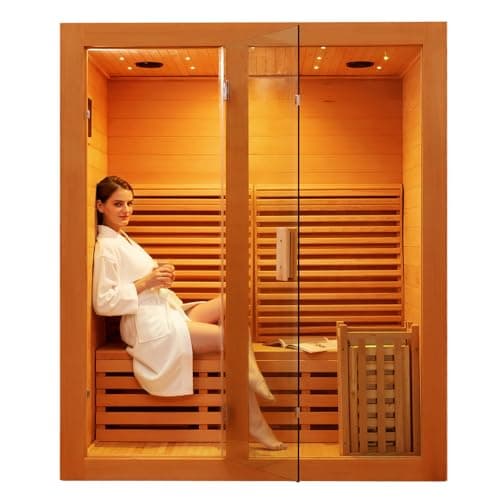
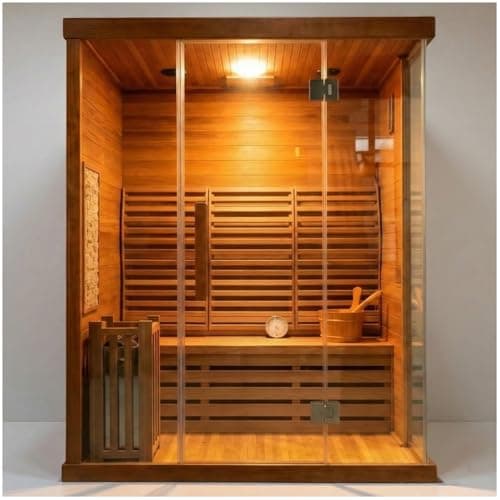
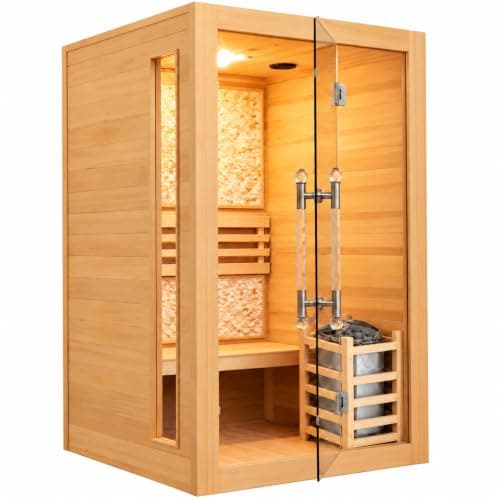
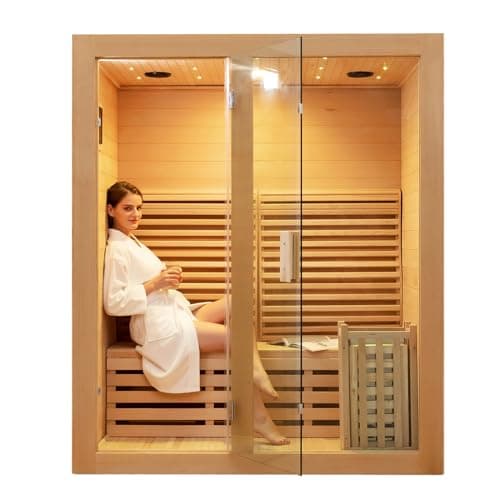
A 2-person indoor cabin is the sweet spot for real loyly at home. It is big enough for a couple, small enough to fit a basement corner or spare room, and — unlike an infrared cabin — it is built around a genuine Harvia rock stove, so you can throw water on hot stones for the burst of steam that makes a sauna a sauna. Our top pick, the hemlock ZONEMEL, delivers that experience for far less than a premium traditional kit. The rest of the list covers the cedar upgrade and the honest cases for sizing up or down.
Why traditional, and why two people
The reason to buy a traditional indoor cabin over an infrared one is loyly — the water-on-rocks steam that infrared physically cannot produce, and the hotter 170-190F heat that most sauna traditions are built around (Finnish Sauna Society). If that ritual is what you want, an infrared cabin will always feel like a compromise; if it is not, infrared is the easier install. Our infrared vs traditional guide is the full comparison — this page assumes you have decided on traditional.
Two people is the size that fits the most homes without becoming an install project. A 2-person cabin drops into a basement, garage or spare room, and its smaller heater draws less power than a 3-person-plus room. It is worth being clear-eyed, though: even a compact traditional cabin needs a dedicated 240V circuit and, realistically, an electrician — a rock stove is not a plug-in appliance. That is the price of real loyly, and it is the same for every cabin here.
The picks, and how they differ
The two cabins to focus on are the ZONEMEL hemlock and cedar 2-person models — same real-Harvia formula, same compact footprint, differing mainly in wood. The hemlock is our top pick on value: it delivers genuine loyly at the lowest honest price for a traditional cabin, and hemlock is a perfectly good sauna wood. The red cedar version is the upgrade for aroma and long-term rot resistance — a comfort choice, not a performance one, since both run the same 3.5kW stove. Which you pick comes down to how much the cedar aroma is worth to you; our cedar vs hemlock guide lays out the trade squarely.
The other two picks exist to catch the buyers a strict 2-person list would fail. If two feels like it might be too tight — you want to actually recline, or a third person joins sometimes — the 3-person cedar ZONEMEL with its bigger 6kW Harvia is the honest size-up, at the cost of a heavier circuit. And if you only ever sit alone but want the hottest room of the four, the AURGOD in Canadian hemlock is the small cabin with the biggest stove — one or two seats, a full 6kW Harvia, and the stones, bucket, scoop and hourglass in the box. Size to the sessions you will actually have, not to the biggest number you can fit.
The install is the real commitment
Buying the cabin is the easy part; powering and ventilating it is the project. Every cabin here needs a 240V circuit sized to its Harvia stove (Harvia publishes the room-size and heater guidance), and a hot, humid room indoors needs proper ventilation and a moisture-tolerant location. Before you fall for a bigger cabin, confirm your panel can supply the circuit and your room can handle the heat and steam — our how to install a home sauna and electrical requirements guides walk through both. Match the cabin to your wiring first; everything else follows from that.
Buying a 2-person indoor sauna
Confirm the 240V circuit first
This is the gate every traditional cabin has to pass. A 3.5kW stove needs a dedicated 240V circuit; the larger 6kW needs a heavier one. Before you shortlist, find out what your electrical panel can spare and where the circuit would run — an undersized supply is a non-starter, not a fixable detail. Talk to an electrician early; the cabin is the cheap part of the decision.
Measure for the cabin and its clearances
A 2-person cabin has a modest footprint, but you still need clearance to open the door, to ventilate, and to keep the required distance around the stove. Measure the room, then subtract for all of that. Our 2-person sauna dimensions page has the bench depth, ceiling height and door-swing numbers to measure against. Basements and garages are the classic spots; our basement and garage guides cover the room-specific gotchas, and we rank the cabins that suit each room in best saunas for a basement and best saunas for a garage.
Choose wood by how much aroma is worth
Hemlock and cedar heat identically here — the stove is the same. Cedar buys you aroma and better rot resistance in a humid room; hemlock buys you a lower price. Neither is wrong. Decide which buyer you are before you pay the cedar premium.
Plan ventilation, not just wiring
A traditional sauna runs hot and wet, and indoors that moisture has to go somewhere. Proper intake and exhaust ventilation keeps the room comfortable and protects the surrounding structure from trapped humidity. Do not treat it as optional — it is part of installing a traditional cabin indoors, per general building practice (NFPA).
Don't oversize for the odd guest
The temptation is to buy the 3-person for the occasional third person. Resist it unless the third person is regular: a bigger cabin costs more to buy, needs a heavier circuit, and heats empty bench most sessions. Buy for your normal evening, not your busiest one.
Two companion pages answer the questions this one raises most. If you are weighing the step up in size, best 3-person indoor saunas covers the two cabins that genuinely seat three and why the field is so thin. If the question is the total, what a 2-person sauna costs breaks out the cabin, the wiring, the power and the accessories separately.
One brand turns up repeatedly in this category because it fits genuine Harvia rock stoves to affordable cabins: the best ZONEMEL saunas compares all five of its models, from the 3.5kW indoor hemlock up to the 6kW cedar.