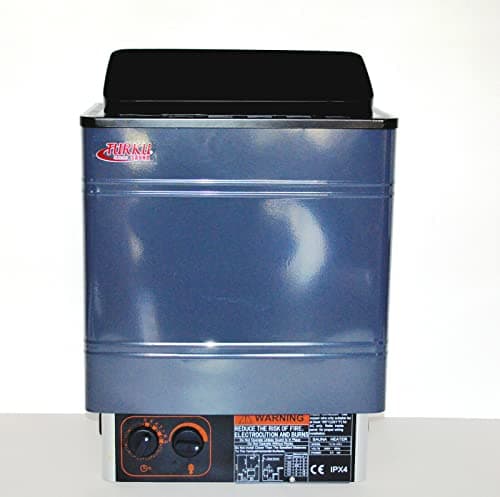
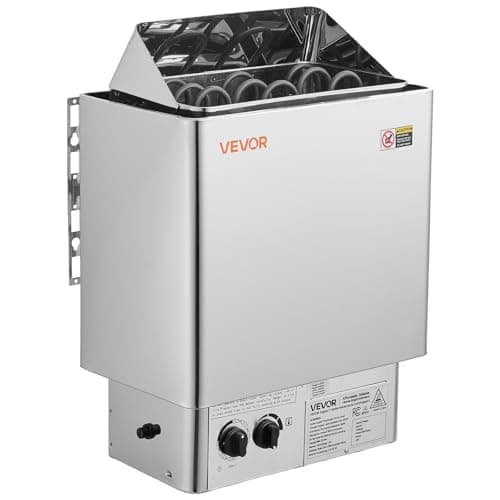
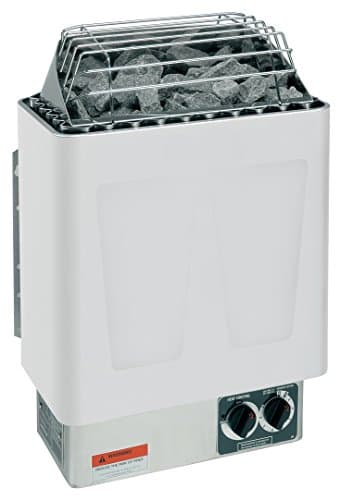
For a small sauna, the goal is the right heater, not the biggest one. A 2-3 person room wants roughly 4.5-6kW — enough to reach a proper 170-190F, not so much that it overshoots and cooks the room. Our top pick, the Harvia KIP 4.5kW, is the buy-once stove for a compact cabin: benchmark build, stones included, correctly sized. Below it, the Turku and VEVOR show how much less you can spend if you accept a shorter track record. First, get the size right — it is the decision that matters most.
The sizing rule that prevents the classic mistake
The most common heater error in a small sauna is buying too much power. The rough rule is about 1kW per 45 cubic feet of well-insulated room, nudged up for glass doors, cold outside walls or uninsulated surfaces (Harvia publishes room-size charts per heater). A typical 2-person cabin lands around 200-250 cubic feet, which is squarely 4.5kW territory; a slightly larger 3-person room pushes toward 6kW. An oversized stove does not make a better sauna — it overshoots the thermostat, wastes energy, and can make the room uncomfortable before the benches and stones have properly soaked up heat. Our sauna heater size guide has the full calculator; this roundup assumes you have measured your room and landed in the small-heater band.
The picks, from buy-once to buy-cheap
The three heaters here map cleanly onto three budgets and three attitudes to longevity. The Harvia KIP 4.5kW is the reference: Harvia is the benchmark sauna-heater brand, the build and stones are first-rate, and 4.5kW is exactly right for a 2-person room. It is the heater to buy if you want to install it once and forget it — the parts and stones supply chain will still be there in a decade. The Turku 4.5kWis the value play: it covers the same room for less, is wet/dry rated so you can throw water for loyly, and asks only that you accept a thinner parts network than Harvia's. The VEVOR 4.5kW is the budget option at the same power — the cheapest way to heat a compact room, with the honest trade-off that budget build means budget longevity and support.
Note that all three sit at 4.5kW, which is the power a true 2-person cabin wants. Harvia and Turku both rate theirs for roughly 200 to 250 cubic feet; VEVOR rates its own for 105 to 210. Match the kW to your cubic feet, not to the price you want to pay — if yours is nearer a 3-person 6kW room, size up rather than squeezing one of these three into it. If your room is genuinely large, you are on the wrong page — see our heaters for large saunas instead.
Controls, stones and the install
Two practical details decide daily happiness. Controls: all three here use built-in knobs — simple and reliable, but mounted on the heater body, so you set them from inside the hot room and wait. If you want to pre-heat from outside, none of these three does it. Stones:the Harvia includes them, the VEVOR explicitly does not, so factor a bag of proper sauna rock into a cheaper heater's price. Every heater here is a 240V appliance that needs a dedicated circuit and, for most people, a licensed electrician — the same install regardless of which you pick, so do not let the sticker gap fool you into thinking the cheaper stove is a cheaper project. Our electrical requirements guide covers the circuit; the loyly you get out of it — throwing water on hot stones — is the whole reason to run a traditional heater at all (Finnish Sauna Society).
Buying a heater for a small sauna
Measure the room and size to it
Calculate the cubic footage (length x width x height) and apply roughly 1kW per 45 cubic feet, adding for glass and cold walls. Land on 4.5kW for a typical 2-person cabin, 6kW for a 3-4 person room. This one step prevents the overbuying that makes small saunas uncomfortable and wasteful. The size guide does the arithmetic for you.
Decide how long you want it to last
This is really the Harvia-versus-budget question. If the heater has to outlast a decade of hard use with easy access to replacement stones and parts, the Harvia is the buy-once answer. If you want the lowest price and accept that a budget stove is a buy-cheap proposition, the Turku or VEVOR save real money. Both are honest choices — just know which you are making.
Check whether stones are included
Proper sauna rock stores and releases heat and gives you something to throw water on. The Harvia includes stones; budget heaters frequently do not. If a cheaper heater omits them, add the cost of a bag of real olivine-diabase rock to its price before you compare.
Pick your controls: knob or external
Built-in knobs are simple and reliable and sit on the heater itself, which is what all three stoves here use. An external digital controller lets you set the temperature and a timer from outside the room and pre-heat before you get in — a genuine convenience, but it means looking at a different stove, such as the VEVOR 9kW on our under-$500 list.
Budget the same 240V install for all three
Every stove here needs a dedicated 240V circuit and, for most homes, a licensed electrician. The install cost is roughly fixed across the three heaters, so compare them on the heater alone — the electrical work does not get cheaper because the stove did.