For almost everyone, a far-infrared cabin is the right buy: it produces the heat you want, runs on a standard outlet, and costs less. Full-spectrum is worth it only if near-infrared's red-light-adjacent claims are specifically what you're after — and you're fine adding a 240V circuit.
The difference in one table
| Factor | Far infrared | Full spectrum |
|---|
| Heat bands | Far only | Near + mid + far |
| What it's marketed for | Deep sweat, relaxation | Sweat + red-light/skin claims |
| Typical wiring | Standard 120V outlet | Dedicated 240V circuit |
| Relative price | Lower | Higher |
| Install | Plug in | Usually needs an electrician |
What near-infrared actually adds
Far-infrared is the long-wavelength band that penetrates and produces the deep, sweaty heat. Near-infrared is a shorter wavelength associated in marketing with skin and recovery benefits — the same territory as red-light therapy. The evidence for near-infrared-specific benefits in a sauna is far thinner than the marketing implies, so treat it as a "nice if you want it", not a reason the far-infrared cabins are somehow incomplete.
The short answer
Quick picks
#ad · Live prices from the Amazon Creators API, as of Sep 25, 2026. Where we have no verified live price, we show none — we would rather leave a gap than print a number that has rotted.
In detail
The picks, in full
Buyers who want full-spectrum + cedar
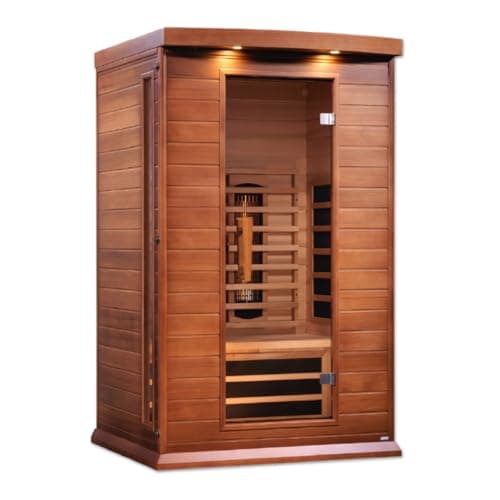
Maxxus MX-M206-01 Full Spectrum (Red Cedar)
2-personFull spectrum (near/mid/far)Red cedarLow EMF (rated)240V
The full-spectrum, red-cedar upgrade. Near-, mid- and far-infrared plus real cedar — the model to buy if far-infrared alone isn't the goal.
- Capacity
- 8
- Heat & comfort
- 9
- Low-EMF
- 8
- Build & wood
- 9
- Value
- 7
Pros
- +Full-spectrum heaters add near-infrared, the band associated with red-light/skin claims — the far-infrared-only cabins can't do this
- +Red cedar is the premium sauna wood: aromatic, naturally rot-resistant, and it looks the part
- +Same well-supported Golden Designs platform
Cons
- −Full-spectrum heaters typically need a 240V dedicated circuit — check before you buy, this can mean an electrician
- −Meaningfully more expensive than the far-infrared Andora/Seattle
Don't buy this if…
…you only have a standard outlet and don't want to add a 240V circuit. Full-spectrum cabins draw more — a far-infrared model plugs into the wall you already have.
Most people buying their first 2-person cabin
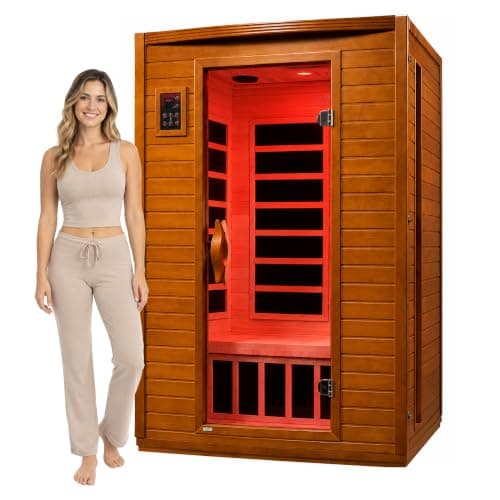
Dynamic Andora (2-Person Low EMF FAR)
2-personFar infraredRed-light therapyLow EMF (rated)120V outlet
The default 2-person infrared cabin. Low-EMF far-infrared heaters plus built-in red-light therapy, Canadian hemlock, and the widest support network in the category.
- Capacity
- 8
- Heat & comfort
- 8
- Low-EMF
- 8
- Build & wood
- 7
- Value
- 8
Pros
- +Runs on a standard 120V household outlet — no electrician, no dedicated circuit
- +Dynamic/Golden Designs is the largest mid-market brand, so parts, manuals and third-party reviews are everywhere
- +Carbon far-infrared panels rated low-EMF, plus red-light therapy LEDs built in
Cons
- −The heaters are far-infrared, not full-spectrum — no near- or mid-infrared HEAT like the pricier Maxxus models
- −Hemlock is the budget-to-mid wood; it lacks cedar's natural aroma and rot resistance
Don't buy this if…
…you want full-spectrum infrared HEAT (near, mid and far). The Andora's heating is far-infrared with red-light LEDs — step up to the full-spectrum Maxxus if near-infrared heat is the point.
Which should you buy?
Buy far infrared if…
…you want the classic sauna sweat, the simplest possible install, and the lowest price. That describes most buyers. The Dynamic Andora is the default far-infrared pick and it plugs into the wall.
Buy full spectrum if…
…near-infrared/red-light claims are specifically why you want a sauna, you want real red cedar, and you're comfortable adding a 240V circuit. The Maxxus MX-M206 is the full-spectrum, cedar pick — just budget for the electrical work.
The wiring is the real deciding factor
More than the heat bands, the thing that should decide this is your electrical situation. If you only have a standard outlet and don't want to pay an electrician, that alone points you at far-infrared. Sort out what your room can supply first, then choose the heat.
How we picked
We do not run a testing lab
We researched published manufacturer specifications, listing data and aggregated owner reviews, then scored each product against a published rubric. The scores are judgments from documented research — they are not measurements we took, because we don't have a lab and we're not going to pretend we do. Prices come live from the Amazon Creators API; where a spec came from a manufacturer we say so and link it in Sources.
Questions
Frequently asked
Is full spectrum infrared worth it?+
Only if near-infrared's skin/recovery claims are specifically why you're buying, and you're fine adding a 240V circuit. For the classic sauna sweat, a far-infrared cabin does the job on a standard outlet for less money.
Does full spectrum infrared need 240V?+
Usually, yes. Full-spectrum cabins draw more than far-infrared models, so most need a dedicated 240V circuit and an electrician, where a 1-2 person far-infrared cabin plugs into a standard 120V outlet.
Is near infrared the same as red light therapy?+
They overlap. Near-infrared and red light sit in adjacent wavelength ranges, and full-spectrum saunas lean on that in their marketing. The benefits attributed specifically to near-infrared in a sauna are less well-established than the marketing suggests — treat it as an optional extra, not a necessity.
Receipts
Sources
We do not run a testing lab, and we do not pretend to. Product specs are transcribed from the manufacturer's own listing and cited as claims; health figures come from peer-reviewed studies, named and linked. Where we could not verify something, we say so on the page rather than quietly leaving it out. Read our full method.