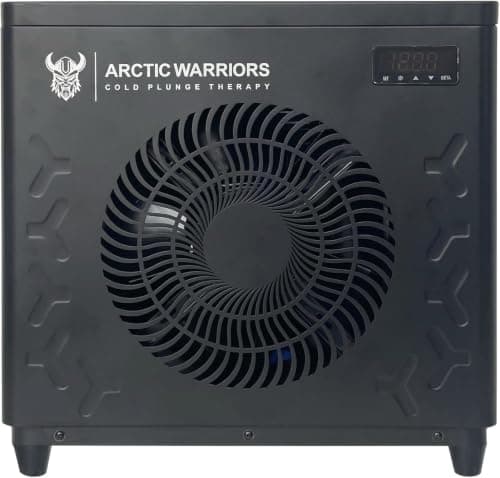
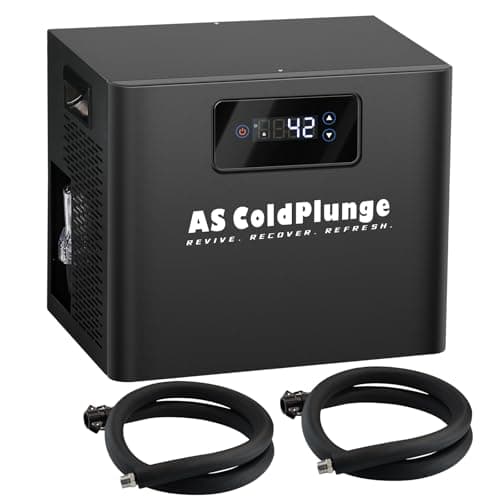
Match the horsepower to your gallons and almost everything else sorts itself out. Under roughly 80 gallons, a 1/3 HP unit with the pump already in the box is the right buy. Over about 100 gallons — which is most insulated plunge tubs sold next to a sauna — you want half a horsepower, and buying 1/3 HP anyway is the single most common and most expensive mistake in this category. If you do not own a tub yet, buy a matched chiller-and-tub set and skip the fittings problem entirely. Everything below is ranked against that one rule.
Informational only, not medical advice. Cold-water immersion and rapid hot-cold swings put real stress on the heart and circulation. If you have a heart or blood-pressure condition, are pregnant, or are unsure, talk to your doctor before plunging — and never plunge alone. Our
sauna safety guide has the full list of who should be cautious.
What a chiller actually is, and what it is not
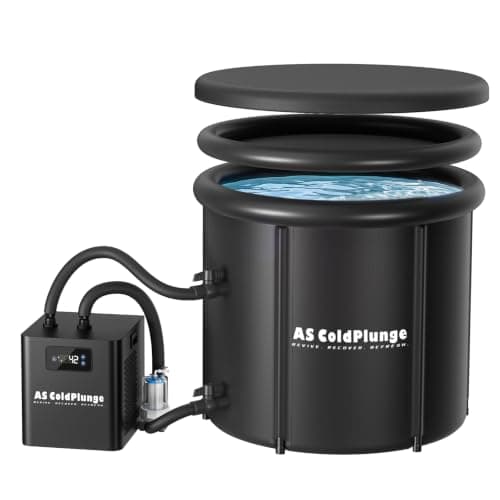
A cold plunge chiller is a refrigeration unit plumbed into a loop of water. A pump pulls water out of your tub, pushes it through a heat exchanger inside the chiller where a compressor and refrigerant strip heat out of it, and returns it colder. Run that loop long enough and the whole tub comes down to whatever you set the thermostat to; leave it running and the tub stays there. That is the entire proposition, and it is worth being plain about what it replaces: not the cold itself, but the errand. Bagged ice makes water cold perfectly well. What it cannot do is make the water cold on a Tuesday evening when you did not plan ahead.
What a chiller is not is a device that makes a tub colder than ice does. Most of these units bottom out somewhere in the high 30s to low 40s Fahrenheit, which is below anything anybody needs and well above what a bathtub full of ice can hit. If you are shopping for a chiller to get colder, you are shopping for the wrong reason. You buy one to get consistent — and to stop a plunge habit from dying of inconvenience, which is how most of them die. What to set it to is in our cold plunge temperature guide, and if the habit is not established yet, start with the beginner tubs and bagged ice before you buy a compressor.
Our criteria, in the order that matters
We ranked on five things, and the first one outweighs the rest combined:
- Horsepower against your gallons. Cooling capacity is the spec. A chiller rated for 40-92 gallons put on a 148-gallon tub does not cool it slowly — in warm weather it may never reach the set point at all, because it cannot remove heat faster than the tub gains it. Published gallon ranges are the most useful numbers in this category and the ones most listings omit.
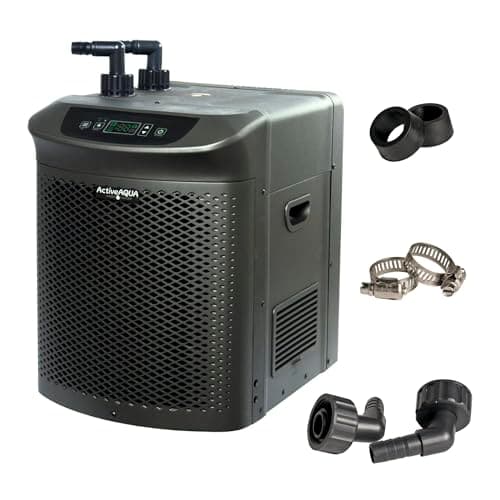
- Whether a pump is included. Half the chillers sold for cold plunge started life as hydroponics or aquarium hardware, where the grower already owns a pump. Those listings quote a chiller price that is not the price of a working system. A plunge-specific kit with the pump, filter, insulated hoses and fittings in the box can be cheaper all-in than a "cheaper" bare chiller.
- Heat-exchanger material. This is the longevity spec. Titanium shrugs off chlorinated, ozonated and salt-dosed water; cheaper plated exchangers are the part that fails first. Nothing else about the unit matters if the exchanger pits.
- Set point and control. A real digital thermostat with automatic start/stop holds a temperature. A unit that only runs while powered means you are managing it manually, and you will overshoot.
- Water care. A chilled tub is a closed loop of body-temperature-adjacent water sitting outdoors. Filtration and an ozone or UV module are the difference between changing the water weekly and changing it monthly.
Why the 1/3 HP unit ranks above the cheaper, bigger one
Worth being explicit about this, because the prices above will show you the apparent contradiction. Our number two pick is frequently listed below our number one while carrying a higher horsepower and a higher published BTU rating. On pure specs-per-dollar it wins outright, and if that is how you buy, buy it — we would rather say so than bury it.
It ranks second on one thing only: track record. A chiller is a sealed refrigeration circuit, and the failure modes that matter are the ones that show up in year three, not week one. The chillers with hydroponics and plunge-specific lineage have years of owner reports behind them; the newest high-value entrants do not yet, and on a four-hundred-dollar compressor whose warranty is the only backstop, that is worth something real. If you want the most cooling per dollar, our number two is the buy. If you want the most-documented hardware, our number one is. Both are defensible and we are not going to pretend the gap is larger than it is.
Scores are judgments from documented research — published specs, listing data and aggregated owner reports — not lab measurements. We say so plainly on our methodology page, and we do not own a calorimeter any more than we own a plunge tub.
The sizing rule, with the arithmetic
Here is the part most roundups skip. Cooling capacity is quoted in BTU per hour, and the reason it matters is that your tub is gaining heat constantly: from the air, from the sun, from the pump motor, and from you. A chiller only wins the race if it removes heat faster than the tub collects it, and the bigger the tub, the more surface area it has to collect through.
The published numbers give you a usable ladder. A 0.25 HP unit is rated around 3,000 BTU/h and a 40-92 gallon system. A 0.5 HP unit roughly doubles that and is rated for 90-172 gallons. A 1/3 HP plunge-specific unit typically lands in between, with manufacturers quoting somewhere around 79 gallons at a mid-40s set point. Notice that those ranges are quoted for an insulated system in moderate ambient conditions. An uninsulated tub in Phoenix in July is a different problem, and the honest adjustment is to size up one step rather than hope.
So: under 80 gallons, 1/3 HP. Between 80 and 120, 1/3 HP if the tub is insulated and you live somewhere temperate, 0.5 HP otherwise. Over 120 gallons, 0.5 HP, full stop. If you are choosing a tub at the same time, read our cold plunge tub roundup first — the tub volume you pick determines the chiller you have to buy, not the other way round.
What it costs to run
Less than people expect, and the reason is insulation rather than efficiency. A fractional- horsepower compressor draws a few hundred watts when it runs, and on a lidded, insulated tub it does not run most of the time — it cycles to hold a set point, the same way a fridge does. Priced at the national average residential rate published by the U.S. EIA, that is a modest monthly line item rather than a shock. Take the lid off, or run an uninsulated tub in direct sun, and the compressor runs nearly continuously — at which point you are paying to refrigerate the neighborhood. The insulated cover is not an accessory on a chilled tub. It is the thing that makes the chiller affordable.
Against that, bagged ice has no running cost and a real per-session cost. The crossover is a frequency question, not a budget one: at one or two plunges a week ice is cheaper and there is nothing to maintain; at three or more a chiller pays for itself in ice you do not buy and, far more importantly, in sessions you do not skip. We worked that arithmetic through in more detail in the tub roundup, and nothing we have seen since has moved the line.
Siting and electrical, before you click buy
Three practical constraints kill more chiller purchases than any spec does.
It needs an outdoor-rated outlet in reach. A chiller is a compressor and it wants a dedicated, GFCI-protected receptacle it is not sharing with the sauna. If your barrel sauna already has a hardwired circuit out there, do not assume there is headroom on it — the sauna heater is likely the largest load on the property. Our sauna electrical requirements guide covers how to think about that, and anything you are unsure of is a question for an electrician, not a forum.
It needs airflow and a level, protected spot. A chiller rejects the heat it pulls out of your water into the air around it. Boxed into a cabinet or shoved against a fence, it fights its own exhaust. Give it clearance on the vented sides, keep it out of standing water and leaf litter, and put it somewhere you can reach to clean the filter.
The hose run should be short and insulated. Every foot of uninsulated hose between the chiller and the tub is a radiator working against you. The kits that ship with insulated lines ship with them for a reason; if you are assembling from parts, insulate the run.
How a chiller changes the sauna routine
This is the part that justifies the spend, and it is behavioral rather than technical. Contrast bathing works when the cold is there — when you walk out of the hot room and into the water without a decision in between. The contrast therapy protocol assumes multiple rounds, and multiple rounds assume the tub is already at temperature when round one ends. Ice cannot do that reliably and a chiller can, which is why people who own one plunge several times more often than people who do not.
Worth keeping the evidence straight while you spend the money, though. The sauna half of this practice has genuinely strong observational support — a 20-year Finnish cohort in JAMA Internal Medicine linked frequent sauna bathing to substantially lower all-cause mortality versus once-weekly use. The cold half is a much newer and much thinner literature, and the combined hot-cold practice thinner still. Buy a chiller because it makes a ritual you enjoy sustainable. Do not buy one because a headline attached a number to the cold, because there is not a reliable one to cite.
Reading a chiller listing without getting fooled
The chiller aisle on Amazon is one of the least honest product categories we cover, and the dishonesty is specific and repeatable. Here is what to look for.
"Cools to 37F" is not a capacity claim
Almost every listing leads with a minimum temperature. It is close to meaningless on its own, because the question is not how cold the refrigerant can get — it is how many gallons the unit can hold at that temperature, and how fast it gets there. A 1/10 HP chiller and a 1 HP chiller may both claim 37F. One will hold a 40-gallon tub there and the other will hold 170. Find the gallon range or the BTU/h figure; if the listing publishes neither, assume the number is the smallest one that flatters the unit.
Check whether the price includes a pump
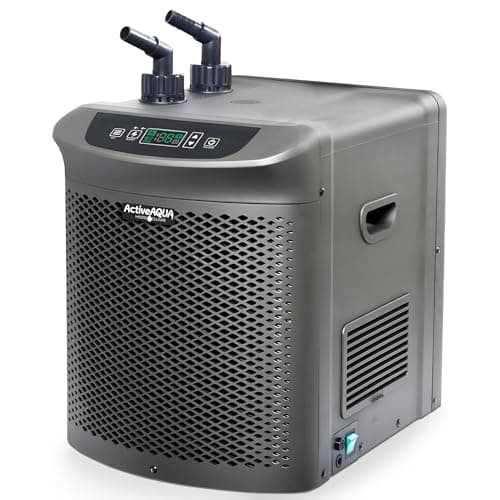
This is where the real money hides. Horticulture-lineage chillers like the Active Aqua line quote a chiller price and expect you to supply a circulation pump matched to their published flow range — in that brand's case, 396-925 GPH. Add a pump, hoses and fittings and a bare chiller that looked cheaper than a plunge-specific kit often is not. We have ranked accordingly: the kits that arrive complete score better on install even where the raw hardware is less impressive.
Horsepower is a proxy, BTU/h is the spec
Horsepower describes the compressor; BTU per hour describes what it removes. They correlate but not perfectly, and between two units of the same nominal HP the one that publishes a BTU figure is usually the one that can defend it. Where both numbers exist, use BTU/h.
Titanium or nothing, if you intend to keep it
A plunge loop is a hostile little environment: warm water from a body, then cold, cycling daily, often chlorinated or ozone-dosed. Titanium exchangers tolerate that indefinitely. Plated ones pit, and a pitted exchanger is a dead chiller rather than a repairable one. If a listing does not say what the exchanger is made of, it is not titanium.
Noise is real, and nobody publishes it
A chiller is an outdoor compressor; it sounds roughly like a small air conditioner when it cycles. Virtually no listing publishes a decibel figure, which means we cannot responsibly rank on it. What we can tell you is the structural point: a correctly sized chiller on an insulated tub cycles occasionally, and an undersized one runs constantly. Sizing up is also the noise fix.
The upgrade path that does not waste money
If you are starting from nothing, the cheapest route to a sustainable setup is not the cheapest chiller. It is this, in order:
- Buy the insulated, chiller-compatible tub first and run it on bagged ice for a season. You will learn whether you actually plunge three times a week or twice a month, and the answer decides everything downstream. The tub roundup flags which shells take a chiller later.
- If the habit sticks, add the chiller sized to that tub — not to a tub you might buy later. Retrofit chillers exist precisely for this step and the good ones ship with the fittings the common tubs use.
- If you already know you are in, buy the matched set. A chiller-and-tub bundle costs less than the two bought separately and eliminates the one failure mode a retrofit genuinely has, which is a fittings or flow mismatch you discover after delivery.
And the sequencing point that applies to this whole site: the hot half comes first. A sauna with no plunge is a complete and well-evidenced thing; a plunge with no sauna is a cold tub. If you are still choosing the hot room, start with our sauna buying guide and come back to the cold side once that is settled.