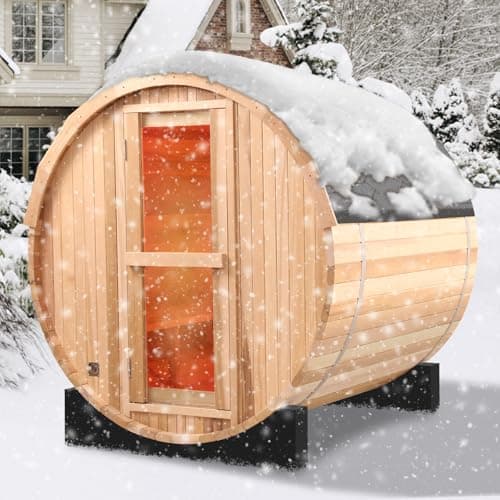
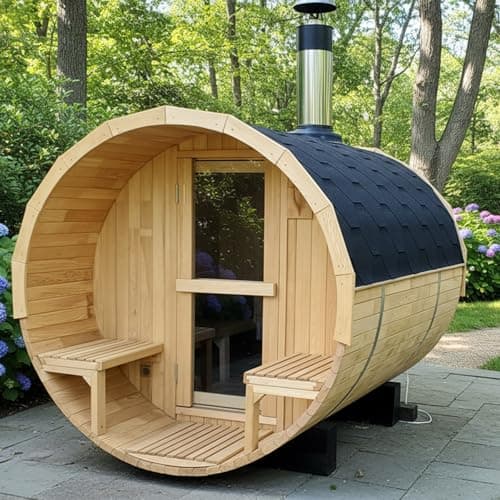
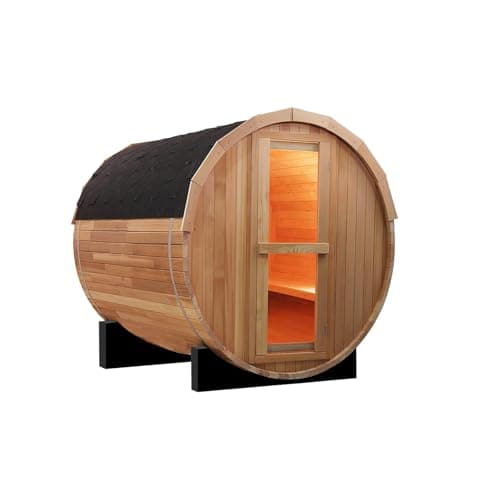
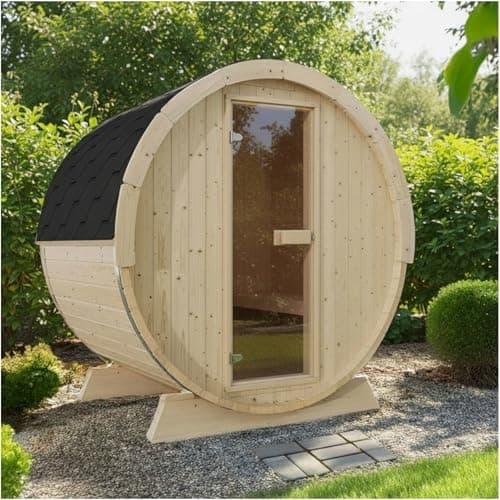
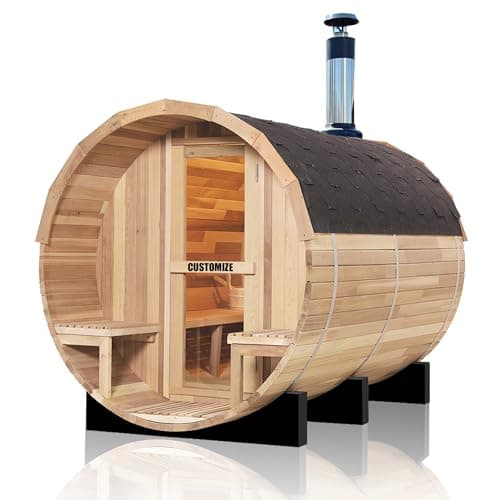
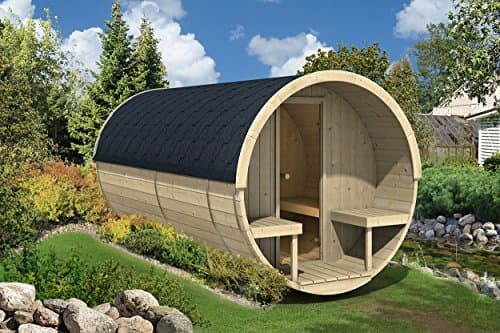
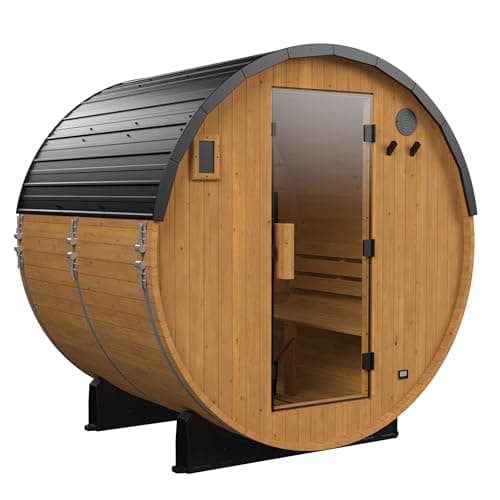
Update: the Backyard Discovery Paxton 4-6 has read "Currently unavailable" on Amazon at every price check since September 9, 2026. We have removed its buy link rather than send you to a dead page. The smaller Paxton 2-4 is still available — the same tongue-and-groove cedar build, 9kW heater and 5-year component warranty in a shorter tube — and it now leads this ranking. The 4-6 person cedar slot is filled by the TaTalife red cedar barrel, a different brand's factory kit with its own trade-offs, covered in the 4-6 person section below.
Buy the Backyard Discovery Paxton 2-4 if you want the best-built barrel and two to four seats are enough, the Smartmak if you want four to six seats and a genuine Harvia heater, or the AURGOD if your yard has no power. Those three cover almost every barrel buyer — build quality, a brand-name stove, and off-grid.
Why a barrel, and what the shape actually does
The round profile isn't only a look. A barrel encloses less air than a square cabin of the same seating, so it heats faster and uses less energy, and the curved ceiling rolls heat back down onto the bench instead of stacking it dead against a flat roof. Barrels are also built to live outside: staves banded like a wine barrel shed rain, and the whole thing sits on cradles off the ground. That's why the barrel is the default outdoor sauna — it's an efficient shape that survives the weather.
What Amazon's barrel shelf really looks like
Be clear-eyed about the selection: it's real, but shallow. There is essentially one finished, fully warrantied cedar line — the Backyard Discovery Paxton, sold complete with its own heater and a warranty behind every part, and on Amazon today only in its 2-4 person size. Then there is a field of factory kits that differ mostly by wood, which heater they bundle and how big the tube is — Canadian hemlock, Nordic wood or an unnamed timber, plus one red-cedar kit in the TaTalife. That's not a knock; a good hemlock kit with a Harvia stove is a lot of sauna for the money. It just means the honest job of a ranking here is to separate the one finished, fully equipped barrel from the kits, and to tell you which kit bundles a heater — or a wood — worth having.
The picks, in short
The Backyard Discovery Paxton 2-4 is the best-overall — tongue-and-groove cedar, a 9kW heater with stones, a galvanized steel roof and a 5-year warranty on every component, in a 64-inch tube that suits a couple or a smaller yard. The Smartmak is the value electric barrel: a hemlock body, but it ships with a genuine 6kW Harvia, and the brand-name stove is the story. The AURGOD is the wood-burning pick, stove and chimney included, so it needs no electrical work and runs anywhere you can safely burn wood. The TaTalife is the cedar pick at 4-6 person size — Canadian red cedar and a 6kW TOULE heater, with no warranty terms in its listing and a 4-5 week lead time; the ZONEMEL 2-person is the cheapest honest way into a real rock-stove barrel; the Benovo lets you configure wood-or-electric and a size up to eight; and the Allwood 400-EHP is the big-group tube, seating up to eight with its own Harvia. Cedar or hemlock, electric or wood — those two choices decide most of it, and the electric-vs-wood comparison is the place to settle the second one.
Ranked by size, because that's the decision you actually make
Barrel shopping goes wrong when people buy for the best weekend of the year rather than for Tuesday. Capacity drives the heater kW, the heater kW drives the electrical job, and the electrical job is usually the biggest hidden cost — so size is the first fork, not the last. Here is the field grouped the way you should read it.
2-person barrels: the smallest real sauna
A 2-person barrel is a short tube with two facing benches — two adults sitting upright, and no room to lie down. It is also the cheapest way into a genuine rock-stove sauna, and it asks the least of your house: the ZONEMEL 2-person runs a 4.5kW heater, the smallest real stove here, which needs a lighter 240V circuit than the 6kW and 9kW barrels above it. It arrives with volcanic stones, shingles, a waterproof tarp and a rubber base, which is more weather kit than most barrels at this price. The honest catch is that its listing never names the timber species. If cedar matters to you at this size, the Paxton 2-4 — our overall pick — is the step up: tongue-and-groove cedar, a 9kW heater with stones and a 5-year warranty on every component, in a 64-inch tube that seats two to four.
Buy at this size if it is one or two of you most nights. A couple who sauna regularly is far better served by a 2-person barrel they heat quickly than by a 6-person barrel they pay to warm half-empty. If you are torn between a small barrel and the squared-off alternative, barrel sauna vs cube sauna puts the two shapes side by side at exactly this size.
4-6 person barrels: the mainstream size
This is where most of the market sits, and where the best value is. With the Paxton 4-6 unavailable, the cedar option at this size is the TaTalife red cedar barrel — a 71 x 71 x 71 inch Canadian red cedar barrel rated for four to six people seated, with a 6kW TOULE heater and volcanic stones, asphalt shingles over a tarp lining, 304 stainless steel bands and an EPDM rubber base that keeps the staves off wet ground. The honest caveats: its listing publishes no warranty terms, it usually ships in 4 to 5 weeks, and TOULE is a less established heater name than Harvia. The Smartmak is the value electric answer at the same seat count: a hemlock body with a genuine 6kW Harvia, so the brand-name stove is what you are paying for rather than the wood. And the wood-fired AURGOD seats four with its stove and chimney in the box, which makes it the only barrel here that needs no electrician at all.
6-8 person barrels: group tubes
At the top end the Benovo lets you configure heater type and a size up to eight, and the Allwood 400-EHP is a genuine 8-seat tube with a 6kW Harvia. Both are serious installs with large footprints, and both cost real money to bring to temperature every session — there is a lot more air and a lot more timber to heat. Buy here only if groups are the normal use rather than the exception; the trade-offs are laid out in best large barrel saunas.
How to actually choose a barrel sauna
Cedar vs hemlock
Wood is the first fork. Red cedar is the premium sauna stave: it's aromatic, it's naturally rot-resistant, and that resistance matters a lot for wood that lives outdoors in rain and snow. Hemlock is the value wood — clean-looking and perfectly serviceable, but with less aroma and less natural defense against moisture, so it leans harder on you keeping it sealed and dry. Here that split is also a brand split: Backyard Discovery builds the Paxton 2-4 in cedar and TaTalife's 4-6 person kit is Canadian red cedar, while the Smartmak, AURGOD, Benovo and Allwood are hemlock-or-Nordic factory kits. Pay for cedar if longevity and smell matter; take hemlock if you want the most barrel for the money.
Electric vs wood-burning
The second fork decides your whole install. An electric heater is thermostatic and set-and-forget — but it wants a dedicated 240V circuit and, realistically, an electrician. A wood stove needs no wiring at all, gives you the crackle-and-smoke ritual purists love, and works off-grid — but you tend it every session and it's bound by local fire codes and clearances. Convenience points to electric; ambiance and a powerless yard point to wood. The full breakdown is in electric vs wood-burning.
Capacity, honestly
A barrel's "person" count assumes people sitting upright, shoulder to shoulder. A 4-person barrel seats four for a chat; it does not let four people stretch out. Size to your real, regular use — a couple who sauna together most nights is better served by a 2-person ZONEMEL or a 2-4 person Paxton than by an 8-person Allwood they heat half-empty and pay to run. Bigger tubes are more wood and more air to bring to temperature every single time, and the extra kW they need is the thing that pushes the electrical job up a bracket.
The 240V reality
This is the line the listings gloss over. Every electric barrel here — the Paxton 2-4, the TaTalife (its listing says 220V), the ZONEMEL, the Smartmak and the Allwood — runs on 240V, which for most homes means an electrician pulling a dedicated circuit from the panel out to the yard, plus a permit in many places. That's real money on top of the sticker, and it's the single most common surprise. The heater's kW rating decides how big that job is: the ZONEMEL's 4.5kW is the lightest here, while the Paxton 2-4 listing specifies a 240V/50A connection and professional installation. If you want to skip it entirely, the wood-burning AURGOD is the way. We put numbers on all of it in the barrel cost guide, and the questions to ask before you order are in the buying checklist.
Foundation and pad
A barrel is heavy and it must sit dead level, or the door binds and the staves stress unevenly. It cannot go straight onto grass or soft dirt. Plan on a firm, level base — pavers, a gravel pad, or a small concrete slab — sized to the cradles. It's not a big job, but it's not optional, and it belongs in your budget from the start.