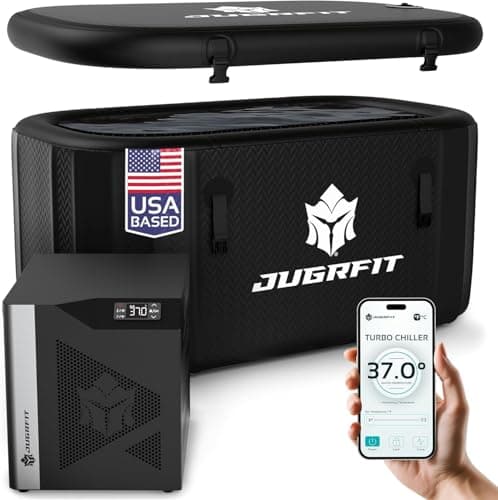
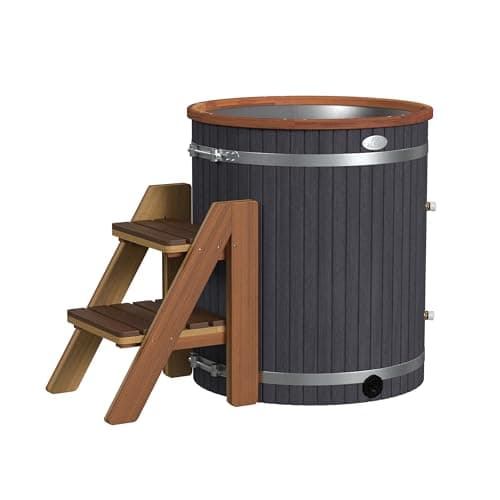
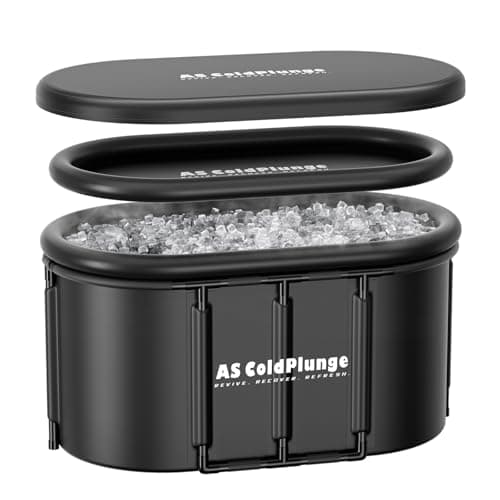
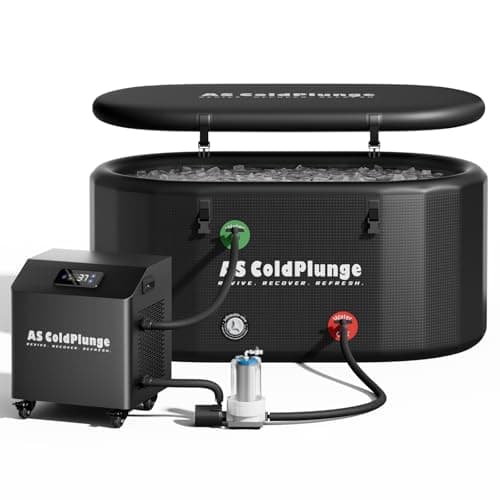
If you want a cold plunge pool rather than a cold plunge tub, buy the AS ColdPlunge 1 HP chiller and 216-gallon insulated tub as a bundle. It is the only setup here that gives you all three things the word "pool" implies — enough water to sit in properly, a chiller holding a temperature you choose, and a pump-and-filter loop so the water is circulated rather than dumped. If you would rather have one sealed appliance that lives outdoors and needs no fittings decisions, the JUGRFIT 121-gallon with its built-in chiller does the same job in a single box for more money. And if what you actually want is the look and feel of a built-in plunge — step in, sit upright, lift a cover off — the rigid ALEKO 118-gallon is the one, with the honest catch that it has no chiller at all.
Informational only, not medical advice. Cold-water immersion and rapid hot-cold swings put real stress on the heart and circulation. If you have a heart or blood-pressure condition, are pregnant, or are unsure, talk to your doctor before plunging — and never plunge alone. Our
sauna safety guide has the full list of who should be cautious.
First, the honest part: nobody sells a "cold plunge pool"
Search for a cold plunge pool and you will find three completely different things wearing the same name. There is the real article — a small, excavated or shipping-container pool, plumbed, chilled and built on site, which is a construction project with a contractor, a permit conversation and a five-figure budget. There is the DTC hard-shell plunge, a chest freezer's worth of acrylic and insulation with a chiller bolted underneath. And there is the pool-scale tub: 120 to 220 gallons of insulated fabric that stays where you put it, with a chiller and a filter loop added so you stop thinking of it as something you fill and empty.
This page is about the third category, because it is the only one you can order, receive and use in the same week without a trade. Everything on it is a real, currently listed product. If you are after the first category, your next call is a pool builder, not a buying guide — and if you are after the second, read the cons on the JUGRFIT carefully, because an integrated chiller is the part that turns a repair into a replacement.
We also want to be straight about what this is not: a lab test. We rank from published listing specs, manufacturer documentation and the patterns in owner reviews, against the rubric on our methodology page. Nobody here put a thermocouple in a 216-gallon tub.
What makes it a pool and not a tub: the four criteria
We ranked these five on the four things that actually change day to day. In that order — because the order is the point. People buy for the fourth and regret it over the first.
- 1. Water volume and shape. A plunge pool has to cover your shoulders while you sit normally, and let your legs out in front of you. That is roughly 120 gallons minimum for one adult, and the shape matters more than the number: 216 gallons in a 59-inch-long oval is a different experience from 216 gallons in a round tub you have to tuck into. Length beats gallons for anyone over about six feet.
- 2. Whether the cold is on demand. This is the dividing line. With bagged ice you decide to plunge roughly an hour in advance and after a trip to a store. With a chiller the water is simply at 48F whenever you walk outside. Cold on demand is what makes a plunge a habit rather than an event, and it is the single biggest predictor of whether a setup still gets used next spring.
- 3. Circulation and filtration. Water you never drain needs to move and be strained, or it goes cloudy in a week. A pump-and-filter loop is why a pool holds water for a month and a tub gets emptied every few days — and it is also the thing people forget to budget for. The CDC's healthy-swimming guidance exists because standing water used by people needs managing, and a 216-gallon plunge is standing water used by people.
- 4. Permanence: shell, cover and siting. A rigid shell with steps and a lid reads as furniture and gets used; a fabric tub reads as equipment and gets packed away. But permanence has a weight: 216 gallons is around 1,800 pounds of water, so a deck or an upper floor is a structural question. On the ground, firm and level beats pretty every time.
Two things we deliberately did not rank on: brand-claimed temperature floors, because almost no listing in this category publishes a pull-down rate you could check, and "ozone" or sanitizing add-ons, which vary too much between listings to compare honestly.
The five, side by side
| Pick | Volume | Chiller | Filtration | Shell | Who it is for |
|---|
| AS ColdPlunge 1 HP + 216 Gal | 216 gallons | 1 HP, included | External pump + filter | Insulated fabric | A real plunge pool setup, bought in one box |
| JUGRFIT 121-Gallon | 121 gallons | 1,050 W, built in | Built in | Weatherproof unit (listed) | One appliance, outdoors, no decisions |
| ALEKO 118 Gal with Steps | 118 gallons | None | None published | Rigid freestanding | The built-in look, ice-fed |
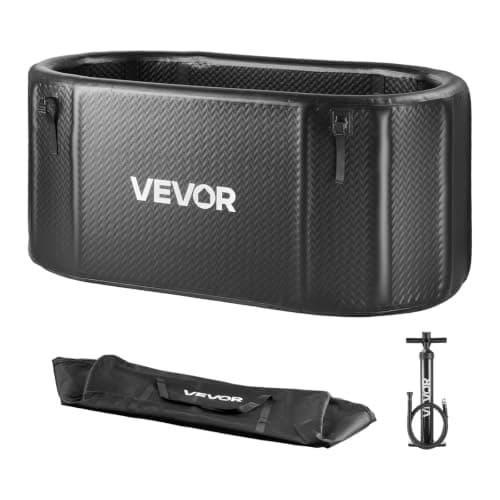
| VEVOR 216 Gallon | 216 gallons | Compatible, not included | Via chiller you add | Insulated inflatable | Pool-scale water on a tub budget |
| AS ColdPlunge XXL Oval | 148 gallons | Compatible, not included | Via chiller you add | Insulated fabric, oval | The compromise beside a sauna |
Those are published listing figures, not measurements of ours. Capacity ratings in this category are brim-full numbers — plan on filling to a few inches below the rim, which is why we treat 120 gallons as the practical floor for one adult rather than the 88- and 105-gallon tubs that dominate our cold plunge tub roundup.
The chiller is the purchase; the tub is the accessory
If you take one thing from this page: at pool scale, the expensive and consequential decision is the compressor, not the shell. A 216-gallon tub is a couple of hundred dollars. The chiller that keeps 216 gallons at a set temperature through a hot August is several times that, and it is the component that decides whether you plunge in week 30.
The sizing rule that matters: compressor capacity has to match water volume and ambient heat, and the 1/3 HP units that dominate the category are rated for tubs well under 100 gallons. That is why the 1 HP bundle leads this page and why a 1/3 HP chiller on a 216-gallon tub is a mismatch that shows up as a plunge that never quite gets cold in summer. If you already own a tub and are shopping the appliance on its own, our cold plunge chiller roundup works through the HP-to-gallons math in detail.
Running cost is smaller than people fear and bigger than zero. A plunge chiller is a refrigeration compressor that cycles rather than runs flat out, and residential electricity prices vary enough by state that a single national number would be misleading. The honest comparison is against what you are doing now: if you are buying several bags of ice a week in summer, a chiller usually wins on cost inside a season, and it always wins on friction. Count your ice spend for four weeks before you decide.
Siting a plunge pool: the five minutes that save a year
Put it where the heat is. A plunge that lives more than a few steps from the sauna door gets used in July and ignored in November. The entire argument for contrast therapy falls apart if the cold involves walking across a wet lawn in the dark. If you have an outdoor barrel sauna, the plunge belongs within a hose length of it.
Decide where the water goes before you fill it. Even a filtered plunge gets drained eventually, and 216 gallons has to end up somewhere that is not your neighbor's basement. Check for a drain hose, and check it is long enough to reach something that drains.
Firm, level and off the deck. Paving slabs, a compacted gravel pad or a concrete patio. A rigid shell concentrates its load on a small footprint; a fabric tub spreads it but still weighs the same. If a deck or balcony is the only option, that is a question for someone who can price out the joists, not a guess.
Power it properly. A chiller needs an outdoor-rated, GFCI-protected outlet within reach — not an extension cord snaked under a door. This is the same discipline as the sauna side of the setup, which we cover in the sauna electrical requirements guide.
Plan for winter. In a freezing climate a chiller and its plumbing need winterizing, and ironically a plunge is easiest in winter — the ambient air does the chiller's job for it. A lid is doing work in both seasons: keeping cold in during summer, keeping debris out all year.
What the research actually supports — and what it does not
A plunge pool is a comfort and consistency purchase, not a performance one, and the evidence is better described as promising-but-modest than settled. The 2025 PLOS ONE systematic review and meta-analysis of cold-water immersion and health found effects on stress and quality-of-life measures that were real but time-limited and based on a small, heterogeneous literature. On the athletic side, a 2026 umbrella review of 15 systematic reviews concludes that post-exercise immersion has a place, but a strategic one — and that timing it badly can cost you adaptations you trained for. We go through this in detail on our cold plunge benefits page, including the strength caveat that matters if you lift.
The practical translation for a buyer: do not spend four figures chasing a biological effect. Spend it if you have already found that you like plunging and the logistics are what stops you doing it three times a week. That is a logistics problem, and a chiller with a filter loop is a genuinely good solution to it. For how cold to actually set the thing, our cold plunge temperature guide has the ranges the research actually uses — they are warmer than the internet claims.
The cheaper route, if you are not there yet
Two honest off-ramps. The first is the VEVOR 216-gallon: pool-scale water for a small fraction of the bundle price, fed with ice until you are sure, with published chiller compatibility so the upgrade does not mean rebuying the shell. The second is building it yourself — a stock tank, a cover and a chiller is the classic route, and our DIY cold plunge guide covers what that actually involves. If you have not plunged regularly at all yet, start cheaper still: our beginner tub picks exist precisely so that finding out costs the price of a meal out rather than the price of an appliance.
And if you are choosing between spending this money on the cold or on the hot, spend it on the hot. That is not a throwaway line: the long-term cohort evidence is on the sauna side, the heat is the part most people keep doing for years, and a plunge beside a sauna is far better than a plunge on its own. We make that argument properly in sauna vs cold plunge.