Skip to content
Sauna & Slate

HUB / ACCESSORIES · Sauna Accessories

Ideal Sauna Humidity

Humidity is the second dial on a sauna and the one nobody reads. The number that matters is not a single percentage — it is the pairing of temperature and humidity you are aiming for.

By Stephen V.Reviewed How we research
#ad

We earn a commission when you buy through our Amazon links, at no extra cost to you. It never affects our rankings, and we say so when the cheaper product is the better buy. How this works.

A traditional Finnish sauna should sit at roughly 10-20% relative humidity between ladles of water, with short spikes well above that each time you throw loyly on the stones. A steam room runs the opposite way — near-saturated air at a much lower temperature. There is no single "ideal" percentage, because humidity only means something next to a temperature. The pairing is the setting: hot and dry with wet bursts, or warm and wet throughout. Everything else on this page is about hitting the pairing you want and knowing when you have.

The three pairings, and what they feel like

Dry Finnish sauna: 150-195F, around 10-20% RH. This is the Finnish convention — hot air that is dry enough for your sweat to evaporate, which is what makes 190F survivable and pleasant. The air has little absolute moisture in it; what feels like humidity is almost entirely the brief loyly spike. Our sauna temperature guide covers the other axis.

Loyly spikes: brief, and much higher. Throw a ladle of water on hot stones and the humidity in the room jumps for a minute or two, then falls back as the moisture is absorbed and vented. That spike is the entire point of a rock stove: the air does not get hotter, but your ability to shed heat drops, so you feel a wave of heat arrive. It is a transient, not a setting, and chasing a high steady-state number with constant water is how people end up uncomfortable rather than authentic. Our how to make loyly guide covers the technique.

Steam room: much cooler, near-saturated. A steam room or steam tent runs at something like 110-140F with humidity close to 100%, which is a fundamentally different physiological situation: your sweat cannot evaporate at all, so the heat has nowhere to go and you feel the load much sooner than the thermometer suggests. Neither is "better" — see sauna vs steam room — but confusing the two is the single most common reason people are disappointed by what they bought.

And infrared, which has no humidity setting at all. An infrared cabin warms your body directly at 120-150F with no water involved anywhere, so its humidity is whatever your house is, minus what the heat does to it. There is nothing to throw water on and no hygrometer reading worth chasing. If the humidity axis matters to you, you want a rock stove — infrared vs traditional sauna is the comparison.

Sauna typeTemperatureRelative humidityWhat it feels like
Finnish, between ladles150-195F~10-20%Hot, dry, sweat evaporates freely
Finnish, on loylyUnchangedBrief spike, then falls backA wave of heat; the reason for the stones
Steam room / steam tent~110-140FNear-saturatedWet, enveloping, heat load arrives early
Infrared cabin120-150FWhatever the room isDry radiant warmth; no humidity dial

How to actually hit the pairing you want

Water on stones, not on the floor. Loyly works because the stones are hot enough to flash the water to vapor instantly. A ladleful at a time, poured over the rocks, is the technique; a bucket emptied into the room just makes a wet floor and cools the stones. If the water sits and hisses slowly, the stones are not hot enough yet — wait.

Heat the stones properly before the first ladle. A stove that has only just hit its thermostat has a hot surface and cool stones. Give it the full heat-up the maker publishes; our heat-up guide has the realistic timings, and the rock guide covers stacking them so air can move between them.

Use the vents. Humidity management in a sauna is mostly airflow management. A closed room holds the spike longer and stays damp; an open outlet vent clears it faster and keeps the baseline dry. This is also what stops the room staying wet after the session, which is the real enemy of the woodwork — sauna ventilation is the detail.

Size the stove correctly. An underpowered heater in too large a room never gets the stones hot enough for good loyly, which is felt as "the steam does not do anything". Heater makers publish room-volume ratings — Harvia's range is the reference — and our heater size guide converts cubic feet to kilowatts.

Measuring it: what a hygrometer can and cannot tell you

You cannot manage either axis without reading both, which is why the standard sauna gauge is a 2-in-1 thermometer and hygrometer rather than a thermometer alone. Three honest caveats before you trust the needle.

First, analog hygrometers in a sauna are indicative, not laboratory instruments. They tell you whether you are in the dry band or the wet one and whether a loyly spike has decayed — which is all most people need — but a reading of 18% versus 22% is not a meaningful distinction. Second, where you hang it changes what it says: at bench height near the door reads differently from above the stove, and the useful place is roughly where your head is when you are sitting. Third, the needle lags. A loyly spike arrives and decays faster than a mechanical hygrometer can follow, so the peak you feel will always be higher than the peak it shows.

That is also why we rank these gauges on legibility and build rather than on accuracy claims: a 10-inch face you can read across a dim room beats a smaller, nominally more precise one you squint at. Our how to choose a sauna thermometer guide goes through the selection properly, and best sauna thermometers is the full ranking. The bucket and ladle below is on this page for the obvious reason: it is the instrument you change the humidity with.

The short answer

Quick picks

#SaunaBest forScorePrice
01
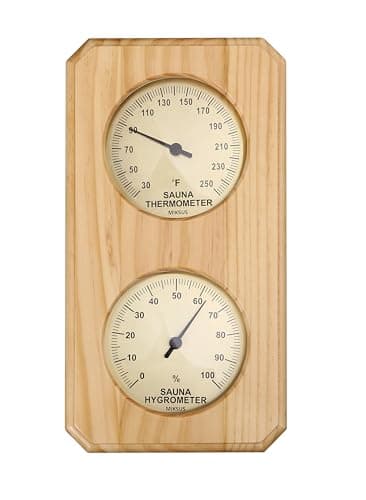
MIKSUS MIKSUS 10-inch 2-in-1 Thermometer & Hygrometer
MIKSUS 10-inch 2-in-1 Thermometer & Hygrometer

The one gauge to hang. A 10-inch wooden face reading both temperature and humidity, so you actually know your sauna's climate instead of guessing.

The best sauna thermometer
8.5
$31.99Amazon
02
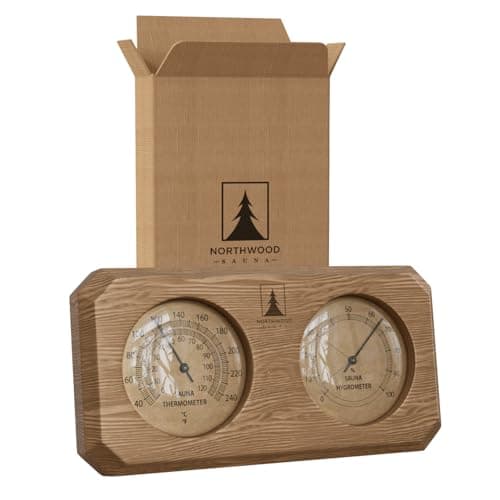
Northwood Sauna Northwood Sauna Cedar 2-in-1 Thermometer & Hygrometer
Northwood Sauna Cedar 2-in-1 Thermometer & Hygrometer

The craft option. Handmade Canadian red cedar with gold metal dials, from the same maker as our top bucket pick — the gauge you buy when the wall matters.

The best-looking gauge
8.3
$39.97Amazon
03
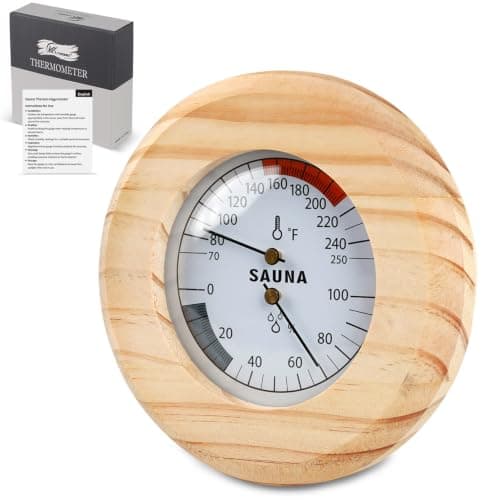
SPOROLWE SPOROLWE Round Wood Sauna Thermometer & Hygrometer
SPOROLWE Round Wood Sauna Thermometer & Hygrometer

The cheap-and-cheerful gauge. One round dial reading to 250F and 100% humidity for the price of a coffee — the no-brainer budget option.

The cheapest usable gauge
7.5
$14.95Amazon
04
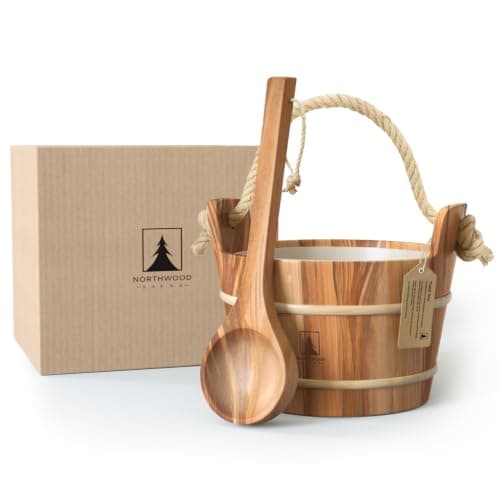
Northwood Northwood Sauna Cedar Bucket & Ladle Set (1 gal)
Northwood Sauna Cedar Bucket & Ladle Set (1 gal)

The loyly essential. A red-cedar bucket and ladle for throwing water on the stones — the tool that turns a hot room into a sauna.

The best bucket-and-ladle set
8.3
$89.97Amazon

#ad · Live prices from the Amazon Creators API, as of October 21, 2026. Where we have no verified live price, we show none — we would rather leave a gap than print a number that has rotted.

In detail

The picks, in full

01
MIKSUS MIKSUS 10-inch 2-in-1 Thermometer & Hygrometer

The best sauna thermometer

MIKSUS 10-inch 2-in-1 Thermometer & Hygrometer

Temp + humidity10-inch wood face50-250F / 0-100% RHRear calibration knobNo batteries
8.5/10

The one gauge to hang. A 10-inch wooden face reading both temperature and humidity, so you actually know your sauna's climate instead of guessing.

Quality
8
Authenticity
8
Usefulness
9
Value
9

Pros

  • Reads temperature and humidity together — the two numbers that define a session
  • Oversized dials on a 10-inch face you can read across a dim sauna
  • A rear knob lets you fine-tune the temperature dial yourself, and there are no batteries to fail in the heat

Cons

  • Analog accuracy is approximate, not lab-grade
  • Ten inches is a lot of wall to give up in a 1-person cabin

Don't buy this if…

…you need precise, calibrated readings. For that you'd want a digital probe — but for knowing your sauna's climate at a glance, this is plenty.

$31.99View on Amazon

Price as of October 21, 2026. Prices change — Amazon's is the one that counts.

#ad · we may earn a commission from this link to MIKSUS 10-inch 2-in-1 Thermometer & Hygrometer

02
Northwood Sauna Northwood Sauna Cedar 2-in-1 Thermometer & Hygrometer

The best-looking gauge

Northwood Sauna Cedar 2-in-1 Thermometer & Hygrometer

Temp + humidityCanadian red cedarFahrenheit + CelsiusRecalibratableNo batteries
8.3/10

The craft option. Handmade Canadian red cedar with gold metal dials, from the same maker as our top bucket pick — the gauge you buy when the wall matters.

Quality
9
Authenticity
9
Usefulness
8
Value
7

Pros

  • Handmade from knotless Canadian red cedar — the same wood and maker as our top bucket pick
  • Fahrenheit on the outer ring with Celsius inside, on waterproof gold metal dials
  • Calibrated during assembly and recalibratable at home, with instructions in the box

Cons

  • Priced above the ultra-budget gauges
  • Analog, so approximate

Don't buy this if…

…you're buying purely on price. The SPOROLWE does the same job for a quarter of the money — here you're paying for the cedar and the finish.

$39.97View on Amazon

Price as of October 21, 2026. Prices change — Amazon's is the one that counts.

#ad · we may earn a commission from this link to Northwood Sauna Cedar 2-in-1 Thermometer & Hygrometer

03
SPOROLWE SPOROLWE Round Wood Sauna Thermometer & Hygrometer

The cheapest usable gauge

SPOROLWE Round Wood Sauna Thermometer & Hygrometer

Temp + humidity70-250F / 0-100% RHSingle round dialPine frameNo batteries
7.5/10

The cheap-and-cheerful gauge. One round dial reading to 250F and 100% humidity for the price of a coffee — the no-brainer budget option.

Quality
6
Authenticity
7
Usefulness
8
Value
9

Pros

  • Reads to 250F, covering even a hot traditional sauna
  • About the lowest price anywhere for a temperature-and-humidity gauge
  • One 5.5-inch dial with color-coded comfort zones, a fog-resistant glass cover and a pre-drilled mounting hole

Cons

  • Very basic build — a small pine ring, not a crafted panel
  • Analog and ballpark, with no way to recalibrate it

Don't buy this if…

…you want a gauge that looks the part on the wall. The MIKSUS 10-inch face and the Northwood cedar panel both do; this one is pure function.

$14.95View on Amazon

Price as of October 21, 2026. Prices change — Amazon's is the one that counts.

#ad · we may earn a commission from this link to SPOROLWE Round Wood Sauna Thermometer & Hygrometer

04
Northwood Northwood Sauna Cedar Bucket & Ladle Set (1 gal)

The best bucket-and-ladle set

Northwood Sauna Cedar Bucket & Ladle Set (1 gal)

Red cedar1 gallonLadle includedPlastic liner
8.3/10

The loyly essential. A red-cedar bucket and ladle for throwing water on the stones — the tool that turns a hot room into a sauna.

Quality
8
Authenticity
9
Usefulness
8
Value
8

Pros

  • Real red cedar that ages well in a humid room
  • One-gallon size is right for a home session
  • Includes the ladle — a matched set, not a lone bucket

Cons

  • Cedar needs to be emptied and dried between uses to last
  • Plastic liner is functional, not beautiful

Don't buy this if…

…you only run an infrared cabin. Loyly needs a rock stove — there's nothing to throw water on in a dry infrared sauna.

$89.97View on Amazon

Price as of October 21, 2026. Prices change — Amazon's is the one that counts.

#ad · we may earn a commission from this link to Northwood Sauna Cedar Bucket & Ladle Set (1 gal)

Common humidity mistakes

  • Chasing a high steady humidity in a dry sauna. Constant water keeps the stones cool and the room merely damp. Loyly is meant to be intermittent — that is what makes each throw feel like something.
  • Reading the gauge as a target rather than a context. 10-20% at 190F and 100% at 120F are both correct. A percentage without a temperature next to it is not information.
  • Adding essential oil to the stones directly. Sauna essence goes in the water bucket, diluted, then onto the stones with the water. Neat oil on hot rock is a fire and fume risk, not a stronger scent — sauna aromatherapy guide covers doing it properly.
  • Sealing the room up to hold the moisture. It works, briefly, and then you have a wet sauna that never dries. Wood and humidity coexist only if the room dries between sessions — sauna maintenance and cleaning is the routine.
  • Expecting loyly from an infrared cabin. There are no stones. A pan of water in an infrared sauna raises the room's humidity slightly and produces nothing like a steam burst.

Humidity, heat tolerance and safety

The practical reason to care about humidity is that it changes how long you can comfortably stay in. In dry air your sweat evaporates and carries heat away, which is why 190F is tolerable for fifteen minutes. In near-saturated air at a much lower temperature, evaporation stops and the heat load builds quickly — so a steam room at 130F can feel more demanding than a sauna at 180F, and sessions should be shorter.

Two implications. First, if you are new to this, start at the dry end and shorter than you think — how long to stay in a sauna and best sauna for beginners are the pages for that. Second, drink water: you lose it either way, and more of it than you notice in humid heat where the sweat does not visibly evaporate. The CDC's hydration guidance is the baseline, and sauna and dehydration covers what a long session actually costs you. If you have a heart or blood-pressure condition or are pregnant, read sauna safety before changing how you use either type.

What to buy, in order

If you have a rock stove and no gauge, buy the gauge first — you are currently guessing at both axes. The MIKSUS 10-inch 2-in-1 is the default: oversized dials, a rear calibration knob and no batteries to die in the heat. The Northwood cedar panel is the one to buy if the wall matters as much as the reading, and the SPOROLWE does the same job for a fraction of the money with none of the charm.

Then buy the bucket and ladle, because that is the humidity control itself and a traditional sauna without one is just a hot room. Cedar ages well in a humid room; empty and dry it between sessions and it lasts — how to clean a sauna bucket is the five-minute version, and best sauna buckets and ladles is the full ranking. Beyond those two, the humidity axis needs nothing: stones you already have, water is free, and the vents are already in the wall.
How we picked

We do not run a testing lab

We researched published manufacturer specifications, listing data and aggregated owner reviews, then scored each product against a published rubric. The scores are judgments from documented research — they are not measurements we took, because we don't have a lab and we're not going to pretend we do. Prices come live from the Amazon Creators API; where a spec came from a manufacturer we say so and link it in Sources.

Questions

Frequently asked

What is the ideal humidity for a sauna?
For a traditional Finnish sauna, roughly 10-20% relative humidity at 150-195F between ladles of water, with brief spikes well above that each time you throw loyly on the stones. For a steam room the target is the opposite — near-saturated air at about 110-140F. Humidity only means something paired with a temperature.
Should a sauna be humid or dry?
Dry at baseline, humid in bursts. That pairing is what a rock stove exists to produce: hot dry air your sweat can evaporate into, interrupted by short loyly spikes that briefly stop it. A sauna held constantly humid is a steam room, and it runs much cooler for good physiological reasons.
Do you need a hygrometer in a sauna?
You need one more than you need a second thermometer. Humidity is half of what defines a session and it is the half nobody can estimate. The standard answer is a 2-in-1 gauge reading temperature and humidity on one face — treat the humidity needle as indicative rather than precise.
Why does my sauna feel hotter when I throw water on the rocks?
Because the humidity spike stops your sweat evaporating for a minute or two, so your body cannot shed heat as fast. The air temperature barely changes — the wave of heat you feel is your own cooling being interrupted. That is loyly, and it is the entire reason for a rock stove.
What humidity does an infrared sauna have?
Whatever your house has, slightly reduced by the heat. Infrared cabins warm the body directly at 120-150F with no water in the system and no stones to throw it on, so there is no humidity setting to manage and no useful hygrometer reading to chase.
Is high humidity in a sauna dangerous?
It is not dangerous in itself, but it shortens how long you should stay in, because saturated air blocks evaporative cooling and the heat load builds faster than the thermometer suggests. Start with shorter sessions in humid heat, drink water, and check the sauna safety guidance first if you have a heart or blood-pressure condition or are pregnant.

Keep reading

More in Sauna Accessories

All sauna accessories →

Receipts

Sources

We do not run a testing lab, and we do not pretend to. Product specs are transcribed from the manufacturer's own listing and cited as claims; health figures come from peer-reviewed studies, named and linked. Where we could not verify something, we say so on the page rather than quietly leaving it out. Read our full method.