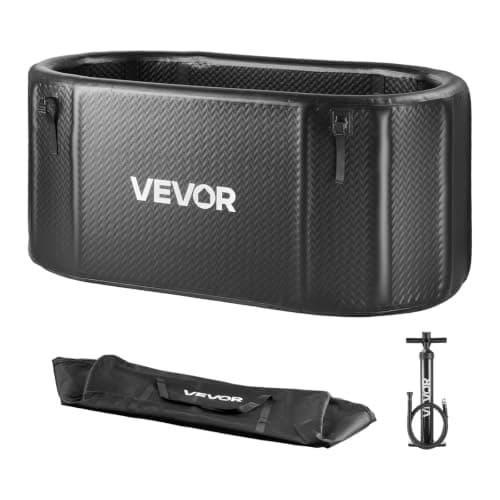
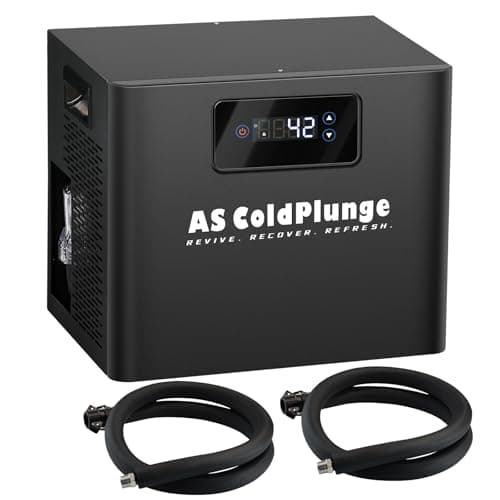
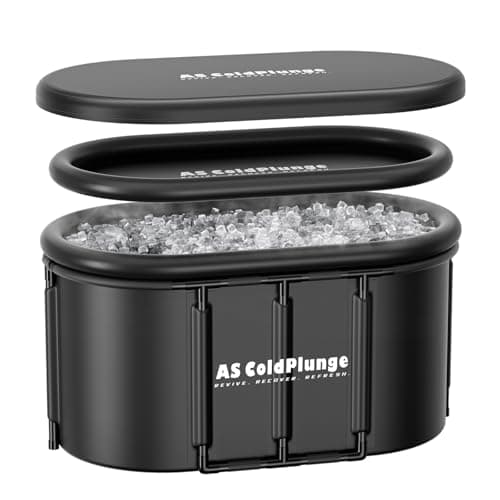
There is no technical line between a cold plunge and an ice bath — the terms describe the same immersion at different temperatures. In practice "ice bath" means the colder, icier, athletic-recovery end, and "cold plunge" means a dialed-in tub somewhere in the 40s or 50s that you can repeat daily. Colder is not automatically better, and the recovery research is the reason. For most home setups the right answer is an insulated tub you can run on ice now and chill later: the 148-gallon oval if you want room to sit, the 216-gallon VEVOR if you want length for the money, and the standalone chiller when the ice has stopped being charming.
What each term usually means
| "Ice bath" | "Cold plunge" |
|---|
| Typical temperature | Upper 30s to mid 40s F | Mid 40s to mid 50s F |
| Cold source | Bagged ice, added per session | A chiller holding a set point, or ice |
| Session length | Short — often a couple of minutes | Longer, more repeatable |
| Repeatability | Varies with how much ice you bought | The same number every time |
| Usual context | Post-training recovery, team settings | A daily or several-times-weekly habit |
That is a convention, not a definition, and plenty of people use the words interchangeably. The useful takeaway is that the only variable doing real work is water temperature, and the classic immersion study across temperatures shows how much the physiological response changes across exactly this range. Whatever you call it, know the number — see cold plunge temperature.
Is colder better? What the recovery research says
This is where the ice-bath tradition runs into trouble. A 2017 paper in the Journal of Physiology — titled, memorably, "Is the ice bath finally melting?" — found cold water immersion was no better than active recovery on local and systemic inflammatory cellular stress markers after exercise. A broader 2021 review of cryotherapy in injury and exercise recovery lands in a similar place: real short-term effects on soreness and perception, much less support for the mechanistic story, and a genuine concern that habitual post-training cold can blunt some training adaptations.
The 2025 systematic review and meta-analysis of cold water immersion across health and wellbeing outcomes finds signals with small samples and high heterogeneity. So: going from 50F to 38F costs you a great deal of ice and gets you a sharper experience, not a documented doubling of benefit. We cover this properly in cold plunge benefits and, for the training context, in sauna for muscle recovery.
What to look for in a setup
- Insulation and a lid, before capacity. Both decide how much ice you buy and how long a chiller has to run. An uninsulated tub with an open top is a machine for converting money into melted ice.
- Length and shape. Legs out beats knees up. A 59-inch tub or an oval is what lets you stay in long enough for the session to count.
- Published chiller ports. If there is any chance you will stop hauling ice, buy a shell that states its compatibility now. Best cold plunge tubs with chillers is the matched-set version.
- A thermometer, every session. An ice bath without a reading is an unknown dose that changes with every bag.
- Water care once it is chilled. Chilled water is kept, not dumped — filtration, circulation and the CDC healthy-swimming basics apply.
The real difference is who carries the ice
Run the arithmetic before you commit to the ice-bath route as a habit. Taking a 100-gallon tub from tap temperature down into the 30s takes a substantial quantity of bagged ice, every session, bought and carried. That is the cost that ends most ice-bath routines in the second month — not the cold.
A chiller changes the economics and the psychology: the water is already cold when you walk out there, so the session happens. If you plunge three or more times a week, the chiller comparison is the page to read next; the standalone unit above retrofits a tub that publishes its ports, and best cold plunge tubs ranks the shells on their own.
Which to choose
Choose the ice-bath end if you want short, sharp exposures for a specific athletic reason and you have accepted the logistics — and read the recovery caveat above first, then sauna before or after a workout for how heat and cold sit around training.
Choose the plunge end if you want a repeatable habit at a known temperature. This is the right answer for almost everyone at home, and it is the format that pairs with a sauna — our sauna and cold plunge combo guide covers siting both halves, and contrast therapy covers the alternation itself, which the Finnish tradition has been doing for centuries without a thermometer.
Choose neither yet if you have not tested the habit. A cold shower costs nothing and tells you a lot — cold plunge vs cold shower compares the doses, and a beginner tub is the low-commitment next step.
Safety at the colder end
The colder the water, the sharper the cold-shock response: an involuntary gasp, a spike in heart rate and blood pressure, and a real risk of inhaling water if your head goes under. Enter slowly, breathe out as you do, keep your head above the surface, never go in alone, and get out at the first sign of uncontrolled shivering, numbness or confusion rather than pushing through. Anyone with a heart condition, uncontrolled blood pressure or a pregnancy should have this conversation with a clinician first; sauna safety carries the same list for the hot half. And no alcohol in either direction — see sauna and alcohol.