Informational only, not medical advice. Fibromyalgia is a medical condition and this page is a summary of published research, not treatment guidance. Heat tolerance, autonomic symptoms, dizziness on standing and several common medications all change what sauna exposure means for an individual. Talk to the clinician who manages your fibromyalgia before adding sessions, and read our
sauna safety guide for who should be cautious about heat generally.
The honest summary: two small studies in fibromyalgia patients reported meaningful short-term reductions in pain when sauna-type heat was added to their care, the trials were small and unblinded, and nothing in this literature establishes an effect on the condition itself. If you want to try it, the format used in the relevant research was mild, controlled heat rather than a 190F Finnish session — which in a home setting points at an infrared cabin at a moderate temperature, and shorter sessions than a healthy person would take.
What has actually been studied
This is a genuinely small literature — a handful of papers, mostly from one research tradition — and the honest thing to do is name each one and say what it was.
Waon therapy in fibromyalgia (2008). A study in Internal Medicine examined Waon therapy — a Japanese clinical protocol of mild, evenly applied far-infrared heat followed by a period of insulated rest — in patients with fibromyalgia whose symptoms had not responded to other treatment. It reported reductions in pain scores that persisted across the treatment course. It is the single most-cited paper on this question, and it is a small, single-arm, unblinded clinical study rather than a randomized trial. That matters: in a condition with substantial symptom variability and a well-documented placebo response, an uncontrolled study showing improvement is a reason to look further, not a result you can lean on.
Sauna plus underwater exercise (2011). A study in Complementary Therapies in Clinical Practice combined sauna therapy with underwater exercise in fibromyalgia patients and reported improvements in pain and quality-of-life measures. The design has an obvious confound, and the authors are not hiding it: the intervention is two things at once, and exercise in warm water has its own independent evidence base in fibromyalgia. You cannot attribute the result to the sauna.
A 2023 overview. A review in Schmerz surveying integrative, naturopathic and complementary approaches to fibromyalgia syndrome places heat-based therapies among the non-pharmacological options used in routine practice. An overview of clinical experience is not evidence of efficacy; what it does tell you is that mild whole-body heat is an established part of how this condition is actually managed in some clinics, rather than a fringe idea.
Put those three together and the picture is consistent but weak: the direction of effect is favorable for symptoms, the mechanism is plausible, the trials are small, and nobody has run the large randomized study that would settle it. Anyone telling you a sauna treats fibromyalgia is going well beyond this evidence.
Why heat might help, mechanistically
Three mechanisms are routinely proposed, and they are worth separating because they differ in how well supported they are.
Muscle relaxation and pain gating. The least exotic and most likely explanation. Warm muscle is more compliant, and heat competes with pain signalling — which is why a hot bath has been the standard self-management advice for widespread pain for a very long time. It explains short-term relief well and lasting change not at all.
Autonomic and vascular effects. Passive heat raises heart rate and dilates vessels, and the Waon tradition explicitly frames its protocol as acting on vascular function. Fibromyalgia involves autonomic dysregulation in many patients, so a mechanism that nudges that system is at least coherent. This is a hypothesis, not an established pathway.
Sleep. Poor sleep and pain amplify each other in fibromyalgia, and passive heating in the evening is one of the better-supported non-drug sleep interventions in general. If a sauna habit improves your sleep, that is a plausible indirect route to feeling better that has nothing to do with the heat reaching the muscle at all — our sauna for sleep guide covers that literature on its own terms.
What this means in practice
If you and your clinician decide to try it, the research points at a specific kind of session rather than a traditional one. Mild heat, applied evenly, for a moderate period — not the Finnish pattern of 180-190F with loyly, which is a considerable physiological load and harder to tolerate if heat intolerance or autonomic symptoms are part of your picture.
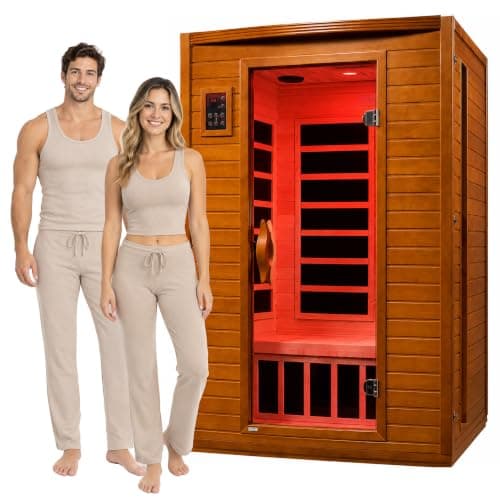
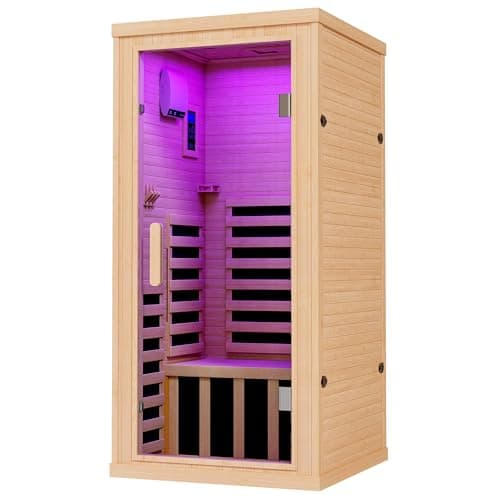
That has three implications for what to buy, which is why the picks below are what they are. An infrared cabin runs at 120-150F rather than 190F, which is the band the relevant studies worked in. It plugs into a normal outlet, so there is no 240V project between you and trying it. And the sessions are controllable: a thermostat, a timer and a door you can open at any time. Our infrared vs traditional sauna comparison sets out the difference, and infrared sauna temperature guide covers where to set it.
A blanket deserves a mention for a reason specific to this condition: you lie down. If standing in heat is a problem — and orthostatic symptoms are common in fibromyalgia — a format that has you horizontal from the start removes that risk entirely. The trade is that you are enclosed and cannot simply stand up and walk out, so it suits some people and not others.
How to start, if you start
- Clinician first, genuinely. Not a formality. Heat interacts with blood-pressure medication, anticholinergics, some antidepressants and anything affecting sweating or fluid balance — all of which are common in fibromyalgia care.
- Start low and short. The bottom of an infrared cabin's range and five to ten minutes, not the 20-30 a healthy user would take. You are establishing tolerance, and in a condition where overexertion can trigger a flare, that caution is the whole point. Our how long to stay in a sauna guide has the general ranges to scale down from.
- Keep it regular rather than intense. Every study here used a course of sessions, not one long one. If it helps you, it helps as a habit — how often should you use a sauna.
- Hydrate deliberately. You lose fluid in any heat session and feel it more if you are already fatigued. The CDC's hydration guidance is the baseline and sauna and dehydration covers the specifics.
- Cool down gently. Skip the cold plunge at first. Contrast therapy is a bigger autonomic swing than a warm session alone, and it is not what any of this research tested — how to cool down after a sauna covers the gentler options.
- Track it honestly. Fibromyalgia symptoms fluctuate on their own. A few weeks of simple before-and-after notes is the only way to tell whether sauna sessions are doing something for you specifically, which matters more here than any study average.
Who should be careful, and who should not do this
Independent of fibromyalgia, passive heat exposure is a cardiovascular load and is not for everyone. Pregnancy, uncontrolled blood pressure, unstable cardiac conditions, recent heart events and a history of heat intolerance or fainting are all reasons to clear it with a clinician first or avoid it. Alcohol and sauna heat are a bad combination for anybody. Our sauna safety guide is the full list and sauna and blood pressure covers the cardiovascular side properly.
Two fibromyalgia-specific cautions worth stating. If heat intolerance is one of your symptoms — and for a meaningful number of people it is — then this intervention may simply not suit you, and pushing through it is not a virtue. And if a session reliably triggers a flare, that is your answer; the evidence is not strong enough to justify tolerating harm in the hope of a benefit.
Related conditions and where to read next
The adjacent literature is worth knowing because it is a little stronger. For aching joints specifically, our sauna for arthritis and joint pain page covers the infrared pilot study in rheumatoid arthritis and ankylosing spondylitis. For post-exertion soreness, which is a different mechanism entirely, sauna for muscle recovery has the evidence. And sauna benefits is our general summary of what the broader sauna literature does and does not support — including the large Finnish cohort work that is the strongest thing in the field and says nothing about fibromyalgia.
One closing note on red light, because it comes up constantly in this context. Red-light therapy and infrared heat are different things with different evidence bases, and cabins that include red-light LEDs are not therefore better studied for pain conditions. Our infrared sauna vs red light therapy page keeps those separate, which is more than most marketing does.