Informational only, not medical advice. Inflammation is a symptom of many different conditions, and "lowering inflammation" is not a treatment plan. If you have a diagnosed inflammatory condition, or you take medication that affects blood pressure or fluid balance, talk to your clinician before adding heat sessions. Our
sauna safety guide lists who should be cautious about heat generally.
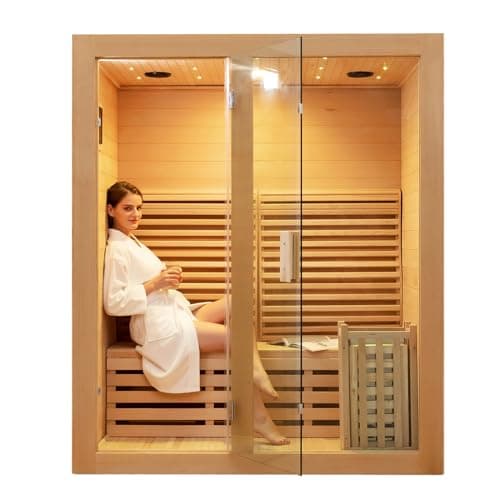
The honest summary: in large Finnish cohort studies, men who used a sauna more often had lower levels of inflammatory markers such as C-reactive protein than men who used one rarely — and because those are observational studies, none of them establishes that the sauna did the lowering. If you want to use heat anyway, the format that matches the research is a traditional rock-stove sauna at Finnish temperatures several times a week, which is why the ZONEMEL hemlock cabin leads the picks below rather than an infrared box.
What the studies actually found
Nearly all of the human sauna-and-inflammation evidence comes from one place: the Kuopio Ischaemic Heart Disease (KIHD) cohort in eastern Finland, a long-running population study of middle-aged men in a country where traditional sauna use is routine. That is both the strength and the limitation of this literature.
Cross-sectional association (2018). A paper in the European Journal of Epidemiology reported that more frequent sauna bathing was associated with lower systemic inflammation, with C-reactive protein as the headline marker. Men in the highest frequency category had lower CRP than those in the lowest.
The same question over time (2018). A companion analysis in Annals of Medicine looked longitudinally at sauna bathing against inflammation and oxidative stress markers in the same cohort. Following people forward is a stronger design than a single snapshot, and the direction of the association held.
Inflammation, sauna and mortality (2022). A later cohort study examined sauna frequency, inflammatory status and all-cause mortality together in middle-aged and older Finnish men. This is the paper most often summarized as "sauna reduces inflammation and death", and it is worth being precise: it describes how these variables travel together in a population, not what happens to an individual who starts using a sauna.
Why observational data cannot close the case
The problem is not the quality of the work; KIHD is a well-run cohort. The problem is structural. Men who use a sauna four times a week in Finland differ from men who use one once a month in ways that also affect inflammation: more leisure time, higher income, better cardiorespiratory fitness, fewer disabling illnesses. Some of that can be adjusted for statistically, and the authors do adjust for a lot. None of it can be adjusted away completely, and the direction of causation is genuinely ambiguous — being less inflamed and healthier makes it easier to sit in a hot room, not only the reverse.
What would settle it is a randomized trial of sauna frequency with inflammatory markers as the endpoint, run long enough to matter. That does not exist at the scale this question deserves. So the honest position is the one we take everywhere on this site: a consistent association in good cohort data, worth knowing about, not a demonstrated effect you can bank on. The same caution applies to the specific-condition pages — see sauna for arthritis and joint pain and sauna for fibromyalgia for how thin those literatures are.
What to look for in a sauna, if this is your reason
- Traditional heat, if you want to match the research. The Finnish sauna in these studies is a rock-stove room at 170-195F with steam from water thrown on stones. Infrared cabins at 120-150F are a different exposure. That does not make infrared useless, but no infrared study carries the weight of the KIHD data.
- Frequency over intensity. The cohort findings are about how often, not how hot. A cabin you will use four times a week beats a better one you use monthly, which in practice means siting and convenience matter more than peak temperature.
- A real temperature readout. If frequency and temperature are the variables you care about, know what yours actually are. A dual thermometer and hygrometer costs very little — see best sauna thermometers.
- Hydration, which is the one real risk you control. Heat means fluid loss. The CDC hydration guidance is the plain version, and sauna and dehydration is the sauna-specific one.
Which format, and why
Traditional rock stove is the exposure the evidence describes, and the ZONEMEL hemlock cabin is the cheapest honest way to get one — a real Harvia stove and stones you can ladle water onto. The costs are a 240V circuit, an electrician and ventilation. If you are shopping that lane, best 2-person indoor saunas is the ranking.
Infrared is the format most people actually end up using several times a week, because it plugs into a standard outlet and warms up fast. It is a lower-temperature, different exposure, and we are not going to pretend the Finnish data transfers to it unchanged. What it has going for it is adherence, which the cohort findings suggest is the variable that matters most. Infrared vs traditional lays out the trade.
A blanket is the option when there is no room for either. You lie inside it, your head stays out, and the heat is genuinely good for the money. It is the furthest from the research setting of the three, and the easiest to use daily in an apartment — see best sauna blankets and can you put a sauna in an apartment.
How to use it without overreaching
There is no inflammation protocol to give you, because nobody has established one. What the data describes is ordinary Finnish practice: sessions of roughly 15-20 minutes at traditional temperatures, several times a week, with cooling off in between. That is also what how long to stay in a sauna and how often should you use a sauna recommend, for the same reason — it is the exposure that has actually been observed in people, rather than a number we made up.
Two things to avoid. Do not combine heat with alcohol; the classic benefits-and-risks review is unambiguous about that combination, and so is our page on it. And do not use sauna heat to push through an acute injury or an active infection on the theory that it is "anti-inflammatory" — acute inflammation is a repair process, not a problem to cook away. Can you use a sauna with a cold covers that case specifically.
Finally, keep the size of the claim in view. Lower CRP in a cohort is a statistical signal measured across thousands of men. It is not a sensation you will feel after a session, and anyone selling you a cabin on the promise that you will is overselling it. For the broader picture of what sauna use is and is not associated with, read sauna benefits and sauna and blood pressure.