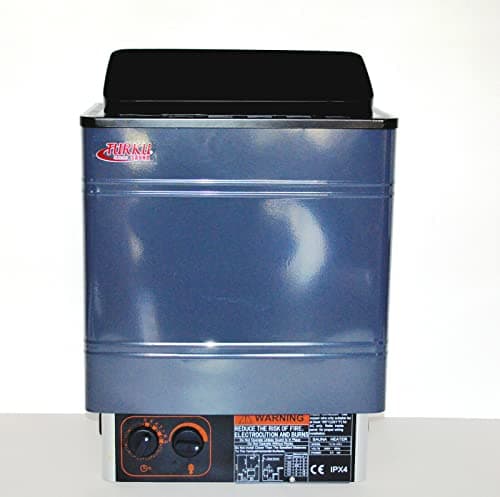
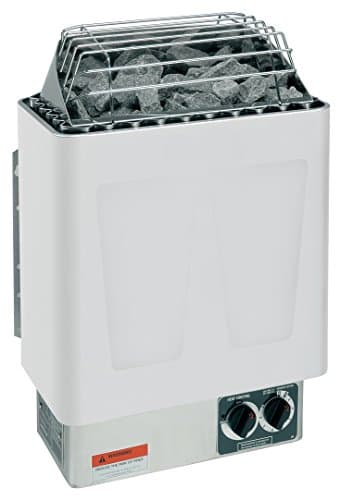
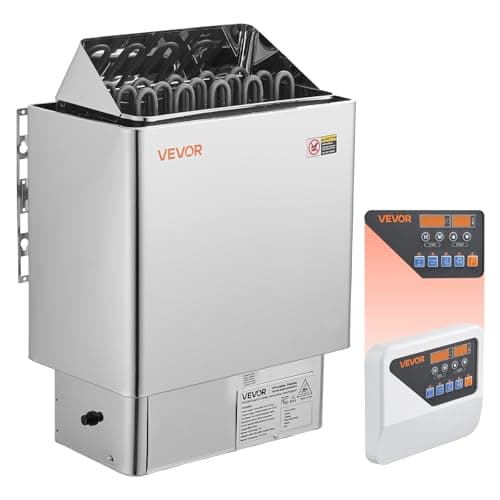
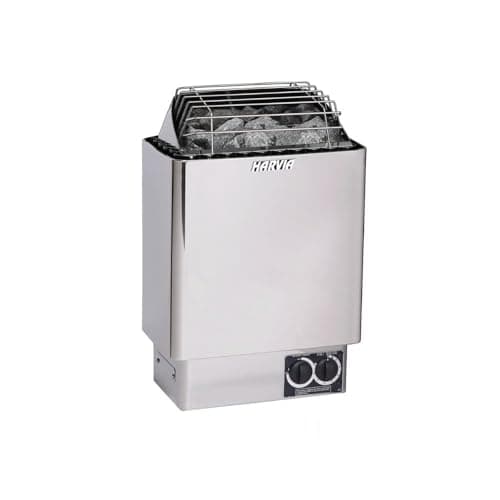
For a standard 6-foot-diameter barrel — the 4-to-6-person size almost everybody buys — the Harvia KIP 8kW is the right heater, and it is for the owner who wants to buy once. Go to 9kW only if your barrel is longer than about 7 feet or you want fast recovery in a cold climate; drop to 4.5kW if you own a genuine 2-person barrel. The mistake to avoid is sizing by the seat count on the listing, because a barrel encloses noticeably less air than a square room with the same benches, and an oversized stove in a barrel overshoots, cycles and scorches the wood above it.
Work out your barrel's cubic feet first
Heater makers rate their stoves against room volume, not people. A barrel is a cylinder, so the volume is the circle area times the length: multiply the radius in feet by itself, multiply by 3.14, then multiply by the barrel length.
- A 6ft diameter x 6ft long barrel: 3 x 3 x 3.14 x 6 = about 170 cubic feet.
- A 6ft diameter x 8ft long barrel: about 226 cubic feet.
- A 7ft diameter x 8ft long barrel: about 308 cubic feet.
Now compare those numbers against the picks below, and notice something: a 6 x 6 barrel at roughly 170 cubic feet is small-room territory by the published ratings, even though its listing says four to six people. That is the barrel paradox — the curve cuts out the dead corners a square room has, which is why barrels heat faster than cube saunas of the same seating. We cover the shape difference in barrel vs cube.
Two corrections to apply to that raw figure, both upward:
Glass. A barrel with a full glass end wall or a large window loses heat through it continuously. The convention heater makers publish is to treat glass and other uninsulated surface area as if it were extra volume. A big glazed end can add the equivalent of 30-50 cubic feet to what the stove has to carry.
Climate and insulation. An uninsulated barrel in Minnesota is a different job from an insulated one in Georgia. If you are routinely heating from below freezing, step up one size rather than running a correctly sized stove flat out — and read how to insulate a barrel sauna first, because insulation is cheaper than kilowatts.
The four, against published room-volume ratings
| Heater | Output | Published room volume | Barrel it suits | Who it is for |
|---|
| Harvia KIP 8kW | 8kW, 240V single-phase | ~350-450 cu ft | 6ft x 6-8ft, glass end included | The buy-once default for a standard barrel |
| Turku 9kW | 9kW, 240V, wet/dry | ~450-550 cu ft | 7ft diameter or 8ft+ long | Large or cold-climate barrels, at a mid price |
| Harvia KIP 4.5kW | 4.5kW, 240V single-phase | ~200-250 cu ft | True 2-person barrels (about 5ft x 5ft) | Small barrels and a lighter circuit |
| VEVOR 9kW | 9kW, 240V, external digital controller | ~450-550 cu ft | 7ft diameter or 8ft+ long | The lowest price at 9kW |
Those volume figures are the manufacturers' published ratings — the kind Harvia publishes across its own range — not numbers we measured. Our heater size guide explains the sizing rule in general, and our methodology explains what our scores are and are not.
Why the 8kW leads rather than a 9kW: a standard 6ft barrel with a glass end lands comfortably inside the 8kW's published band once you have added for the glass, and the 8kW is a lighter electrical load. Buying 9kW for a 6 x 6 barrel means a heavier circuit, a bigger breaker and a stove that reaches set point and then spends the session cycling.
Barrel-specific things that are not true of indoor rooms
The bench is curved, so clearance is tighter than you think. In a barrel the wall curves in above the heater, which means the published clearance to combustibles above the stove is the dimension to check, not the clearance to the side. Barrel kits include a heater guard or a shielded corner for exactly this reason, and skipping it scorches the staves. Our clearances guide and heater guard guide cover it.
The cable run is outdoors. A barrel is a detached structure, so the 240V supply is a buried or overhead run with outdoor-rated conduit, a disconnect and a GFCI consideration — all done to the NEC as adopted locally. That is a bigger electrical job than an indoor heater on the same kW, and the conduit run often costs more than the stove. Price it before you choose the heater, not after: see sauna electrical requirements and breaker size.
Controls want to be outside the barrel. On an outdoor sauna, an external digital controller lets you start the heater from the house and walk out to a hot barrel — which, in a climate where the walk is unpleasant, is the difference between using it and not. The VEVOR ships with one; the built-in-knob Harvia and Turku stoves do not. Our controls guide covers the options, and plug-in vs hardwired covers the wiring side.
Stones are not optional, and they are not always included. The stones are what store the heat and turn a ladle of water into loyly. Both Harvia picks include them; budget stoves frequently do not. Add the right rock to your basket if you buy the VEVOR, and plan to replace them periodically — they break down.
Check the certification mark. A sauna heater is a high-wattage appliance in a wet outdoor structure. Confirm a UL, ETL or CSA listing mark, and if a listing claims one you can check it in the UL Product iQ directory. An uncertified heater can fail inspection and complicate an insurance claim.
Electric or wood-fired for a barrel?
All four picks here are electric, and that is a deliberate limit rather than a verdict: wood-fired barrel stoves are a real and popular choice, but we only rank products we have verified as live listings, and our registry currently holds no standalone wood-burning barrel stove. What we do hold is a complete wood-fired barrel — covered in best barrel saunas — which is how most wood-fired buyers end up purchasing anyway, as a matched kit rather than a separate stove.
The trade is straightforward. Wood needs no electrician, no conduit trench and no panel capacity, which in a far corner of a yard can save thousands; it costs you a chimney, a fire to tend, 45-60 minutes of lead time and local rules about outdoor burning. Electric costs you the wiring and gives you a timer. Our electric vs wood-burning comparison works it through properly, and electric vs wood-burning sauna heater does it at the stove level.
Finally: if you are replacing a dead heater rather than specifying a new barrel, check whether the failure was the element, the contactor or the controller before you buy a whole stove — our troubleshooting guide walks the sequence, and heater lifespan sets expectations for what should have lasted how long.