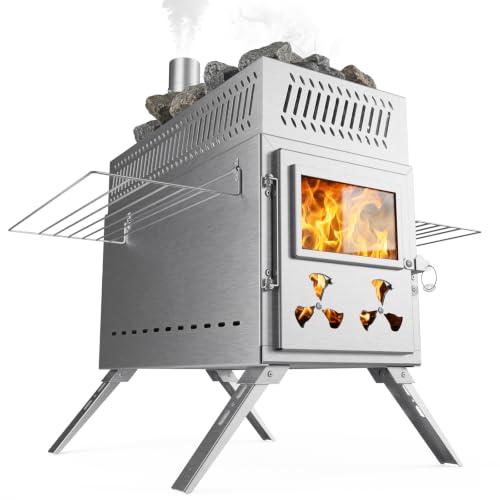
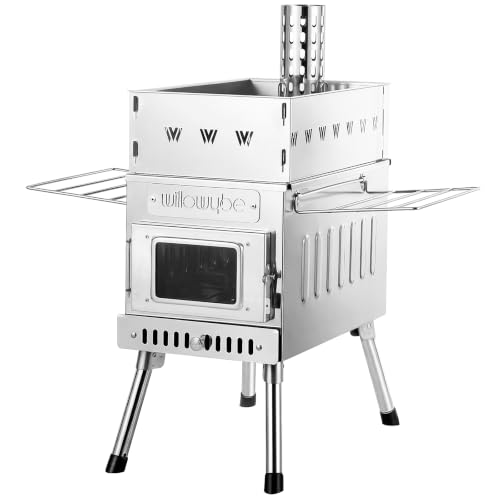
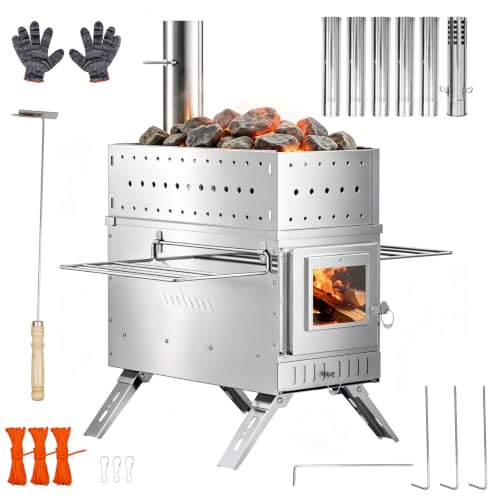
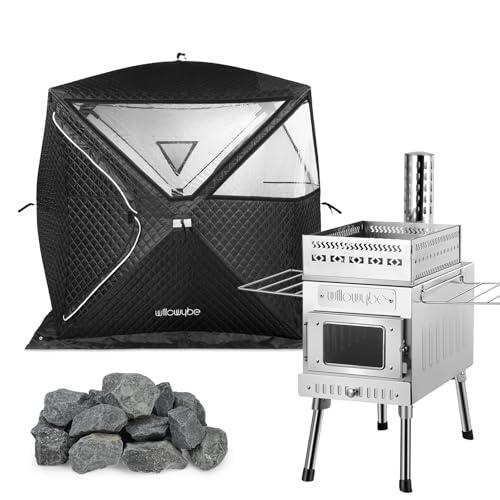
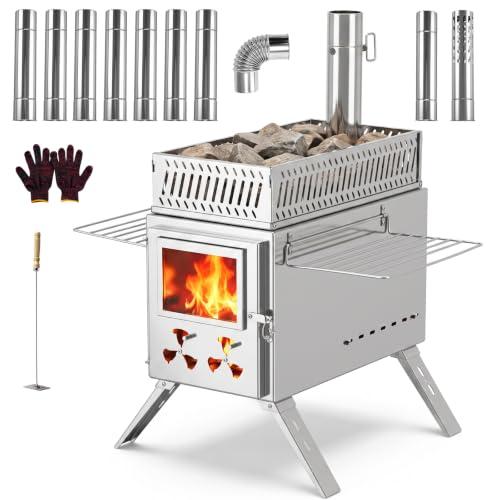
Buy the H&ZT. It is the only stove here that ships a removable sauna stone box AND a genuinely complete nine-section flue with a damper, an elbow and a spark arrestor — which is the combination that turns a camping stove into a sauna stove instead of a hot box. If you want published materials rather than adjectives, the Obqer states a 1.4mm stainless gauge and its exact firebox and chimney dimensions. If you want a steadier burn, the heavier WILLOWYBE holds heat between loads. The 19-pound unho is the budget and carry-it-anywhere pick, and the WILLOWYBE bundle exists for people who do not own a tent yet.
What makes a tent stove a SAUNA stove
Almost every stove in this category is sold twice: once as a hot-tent camping stove and once as a sauna stove. The hardware is frequently identical, and the listings reuse the same photographs. Three features decide whether a given stove will actually give you a sauna.
A stone basket or stone box. This is the one that matters most and the one the cheapest stoves leave out. Without stones over the firebox you have radiant heat and nothing to pour water onto, which means no loyly and no humidity control — and the Finnish Sauna Society treats that steam burst as the defining feature of a sauna, not an extra. A stove with no basket is a tent heater with a sauna keyword in its title.
A complete chimney, with a damper and a spark arrestor.Tent saunas are tall, so the flue needs height to draft properly, and a fabric roof needs a spark arrestor rather than an open pipe. A damper matters more here than on a room stove because these fireboxes are small and light: without one, a rocket-style stove runs away and burns through wood in half the time. Count the sections and look for the elbow — the H&ZT ships nine, the Obqer eight, the unho seven.
Enough mass to hold a temperature. A 19-pound stainless firebox lights in minutes and cools in minutes. A 35-pound one is slower both ways. Neither is wrong, but they suit different sessions: a quick solo round versus an hour with three people coming and going.
The honest limitation: nobody publishes an output
Not one stove on this page states a kW figure, a BTU figure or a tent-size range. That is the single biggest difference between this category and the room stoves we rank separately, where Harvia and HUUM both publish output and a cubic-foot band.
So we did not rank these on heat output as a number, because there is no number to rank. We ranked them on what the listings do publish — steel gauge, firebox dimensions, chimney length and section count, stove weight, and what is in the box — and we say plainly on each entry where a spec is missing. Anyone who tells you a specific tent stove delivers a specific kW is making it up.
In practice this matters less than it would for a built room, because a sauna tent is a small, well-insulated fabric shell and every stove here is oversized for it. The practical constraint is not whether the stove can get the tent hot; it is whether it can do so without scorching the wall it sits beside, which is a clearance and a heat-shield question rather than an output question.
How we ranked them
Criteria first. Everything below is a judgment from documented research — listing specifications, published dimensions and aggregated owner reports. We have not burned a fire in any of these stoves; our methodology says so in those words.
- Stone basket, and is it included? Included and removable beats included and fixed, which beats sold separately, which beats not offered. Stones themselves are almost never included — only the WILLOWYBE bundle ships rock.
- Chimney completeness. Section count, total height, and whether a damper, an elbow and a spark arrestor are in the box. A stove that needs a second order for pipe is more expensive than its price.
- Published materials and dimensions. A stated steel gauge is rare and valuable. Firebox length tells you how long your splits can be, which is a real daily annoyance if you get it wrong.
- Weight, both ways. Light means portable and fast; heavy means steady and durable. We say which each stove is instead of pretending one is better.
- Safety kit. Spark arrestor, gloves, ash tool, stakes and guy lines for a tall chimney. A 70-inch flue on a fabric tent in wind is a real hazard, and the stoves that ship stakes and rope have thought about it.
Which one is for you
- Most people with a sauna tent: the H&ZT. Stone box plus the most complete flue in the group, at a low price.
- You want the specs on paper: the Obqer. 1.4mm stainless, an 18 x 9.84 x 10.6 inch firebox and a stated 85.8 inch chimney. Cut your wood short.
- Long sessions with people in and out: the WILLOWYBE at a listed 35 pounds, with a real air-intake damper. Confirm whether the stone basket ships with it.
- Cheapest, lightest, and going in a car or a pack: the unho at 19 pounds, with the stone tray, spark arrestor, gloves, stakes and ropes included.
- You do not own a tent yet: the WILLOWYBE set — a 4-person insulated tent, a stove and about 35 pounds of volcanic stones in one box.
- You are heating a built, insulated room: none of these. Go to best wood-burning sauna stoves and buy a stove with a published cubic-foot range.
The ventilation rule, stated plainly
A wood stove in a fabric shelter is the one configuration in home sauna where getting it wrong can kill you, so this section comes before the shopping advice.
Wood combustion consumes oxygen and produces carbon monoxide. A sauna tent is designed to hold heat, which means it is also fairly good at holding exhaust. Every stove listing here says some version of the same thing, and the Obqer listing says it most directly: ensure proper tent ventilation, use a fireproof mat underneath, and never run the stove in a completely sealed tent. Fit a carbon monoxide alarm inside the tent, keep an intake vent open low down and the flue unobstructed, and do not sleep near a burning stove.
The flue is the other half of it. Assemble every section, use the spark arrestor, and guy the chimney out if the stove ships stakes and rope — a 70-inch pipe on a fabric roof is a lever in wind. Keep the stove the distance from the tent wall that the maker specifies, and use the heat shield or stove jack the tent provides rather than improvising one. Our heater clearances and safety page covers the general principle; the tent manufacturer's stove-jack instructions are the specific authority.
Finally, burn dry wood. Wet wood produces more smoke, more creosote and more carbon monoxide for less heat — the EPA's Burn Wise program exists mostly to make that point. Start with a small fire to establish a draft before loading full splits.
Stones: what to buy, because almost nobody includes them
Four of the five stoves here ship a basket or tray and no rock. That is not a flaw — stone is heavy and expensive to ship — but it means your order is not complete at checkout.
Buy olivine or peridotite, rounded rather than sharp, sized to fill the basket without packing it solid; water needs to drain through the bed rather than sit on top. A tent-stove basket is small, so you are buying tens of pounds, not hundreds — nothing like the 198 pounds a HUUM room stove carries. Expect a shorter, sharper steam burst as a result, and expect to replace crumbling stones more often because a small bed cycles harder. Our rock guide covers types and how often to replace sauna rocks covers the timing.
One honest note on temperature: a tent sauna heated by a small wood stove with a modest stone bed is typically a hot, dry room with intermittent steam. It is a different experience from a built room with a heavy stove, and it is much closer to a real sauna than any of the electric steam tents, which top out at 130-140F with your head in a zip collar. See sauna temperature for what the numbers mean.
Firebox size is a daily annoyance or a non-issue
The spec nobody thinks about until the first session: how long your firewood can be. The Obqer firebox is 18 inches long and 9.84 inches wide; the unho body is 15 by 7.6 inches. Standard cordwood is cut at 16 inches, which fits one of those and not the other.
If you are buying bagged or bundled wood, check the length on the bag against the firebox. If you split your own, this is a five-minute decision at the saw. And if you are going to be feeding the stove every ten minutes through a long session, the bigger firebox is worth more than any other difference on this page — which is the real argument for the heavier WILLOWYBE.
Where a tent stove beats everything else
A tent sauna with a wood stove occupies a genuinely useful position: it is the cheapest way to get real Finnish-style heat with stones and steam, it needs no electrical work at all, and it packs down. For a rental, a remote cabin, a lake, or a yard where running a 240V circuit is unreasonable, nothing else does that job. Our best portable saunas roundup covers the electric alternatives, and sauna tent vs sauna blanket covers the format question if you have not settled it.
What it is not is a replacement for a built room. There is no bench tier, no door seal worth the name, no permanence and considerably more work per session. If you own the property and intend to use a sauna twice a week for a decade, read outdoor vs indoor sauna and build something. A tent stove is the right answer to a different question.