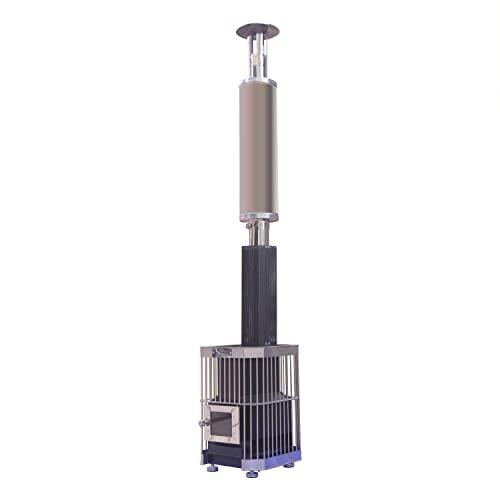
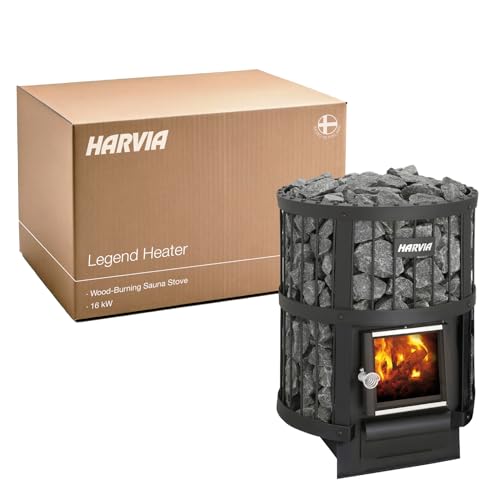
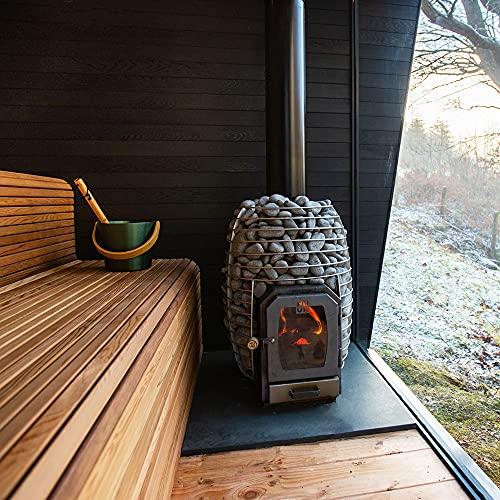
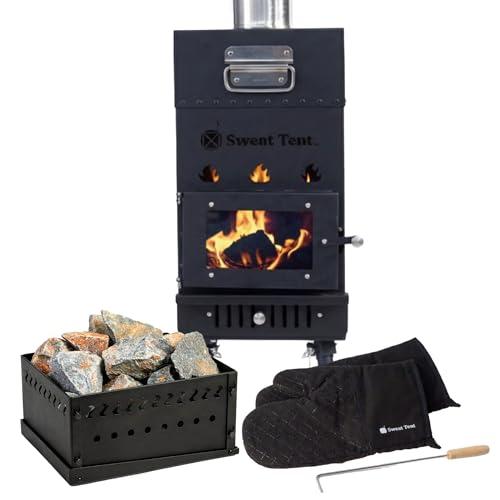
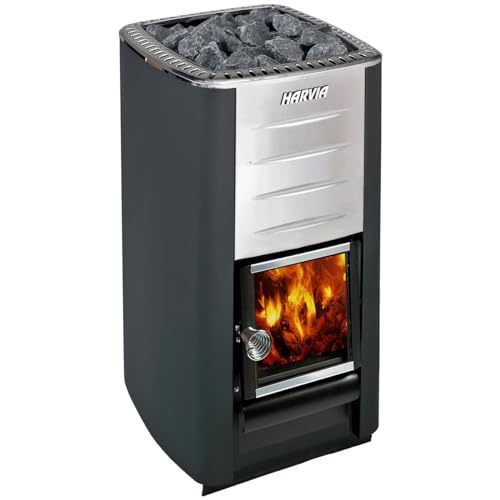
Buy the Harvia M3. It publishes the two numbers that matter — 16.5kW and a stated 212-459 cubic foot room range — it ships with its stones and ash box, and it comes from the largest sauna-heater manufacturer in the world, which is what you want behind a part you may need in ten years. If the chimney is the part that worries you, buy the ALEKO kit instead and get the flue in the same box. If you want the softest, longest-lasting steam, the cast-iron Harvia Legend carries a far bigger stone bed. And if the sauna is a tent or a barrel rather than a built room, skip all of those and buy the portable SweatTent kit.
Why a wood stove is a different purchase from an electric heater
Everywhere else on this site, choosing a heater is a sizing exercise: work out the room volume, pick the kW, check the circuit. A wood stove changes the shape of the decision, because the stove is only part of what you are buying.
You are also buying a chimney, and it is not optional. A solid-fuel appliance needs a flue, a roof or wall penetration, the right clearances to combustible material and in most jurisdictions an inspection. The national reference for that work is NFPA 211, and which edition applies to you depends on what your jurisdiction has adopted — the ICC code adoption maps will tell you where to look. Only one stove on this page includes a chimney. For the other four, add it to the price before you compare anything.
You are buying a hearth. These stoves weigh 100 pounds and up empty, and once they are loaded with 50 to 200 pounds of stone they are considerably more. They sit on a non-combustible floor with stated clearances on every side. Our sauna heater clearances and safety page covers what those distances mean in a small room, and sauna permit requirements covers the paperwork side.
And you are buying a chore. Wood heat means splitting, stacking, carrying, lighting, feeding and emptying an ash box. People who love it describe that as the point. People who want a sauna at 7pm on a Tuesday find out in February that they do not. If you have not settled that question yet, read electric vs wood-burning sauna heater before you spend anything.
What you get in exchange is real: no electrical service, no 240V circuit, no electrician, a much higher practical heat ceiling, and the fire itself. An off-grid cabin or a far corner of a yard is a place a wood stove can heat and an electric heater simply cannot.
How we ranked them
Criteria first, in the order we weighted them. Everything below is a judgment from documented research — published manufacturer specs, listing data and aggregated owner reports. We have not lit a fire in any of these stoves, and our methodology says so in exactly those words.
- Does it publish a kW output? This is the hard filter. Two of the five stoves here publish a real kW rating, one publishes an electric-heater equivalence, one publishes a rating in its title, and one publishes nothing at all. A stove with no stated output cannot be sized to a room on paper — you are trusting an adjective.
- Does it publish a room-volume range?kW alone is only half the answer. Harvia and HUUM both state a cubic-foot band (212-459 cu ft for the M3 and the HIVE 13), which is the single most useful number on a wood-stove listing, because it already accounts for the manufacturer's own assumptions about insulation and glass. Our heater size guide has the arithmetic if your stove does not give you one.
- How much stone does it carry, and are the stones included? Stone mass is what separates a hot box from a sauna. A big bed of olivine stores heat and keeps producing steam after the flames drop, which is the whole reason a wood sauna feels different at the end of a session. The HUUM ships 198 pounds of it; the ALEKO ships none. See our sauna heater rock guide.
- What else is in the box? Chimney, ash box, door, stones, installation materials. On a wood stove, the parts list moves the real price by hundreds of dollars, and the cheapest sticker is frequently not the cheapest install.
- Will parts still exist? A sauna stove is a 15-year purchase that lives in a hot, humid room. Published manuals, a named warranty term and a dealer network are worth real money, which is why the two Finnish-lineage brands rank where they do.
One thing we deliberately did not rank on: certification marks. Most wood sauna stoves sold in the US carry no UL or ETL listing, because solid-fuel appliances are generally handled through installation codes rather than appliance listings. Where a mark does exist you can confirm it in the UL Product iQ directory, and your inspector will tell you what they want to see.
Which one is for you
- You are heating a normal built sauna room, 210-460 cubic feet: the Harvia M3. Published output, published range, stones and ash box included. It is the default for a reason.
- The chimney is the part you want solved: the ALEKO kit. Stove and flue in one purchase, with an anti-scald cover on the pipe. Budget separately for stones, which it does not include.
- You want the softest heat and the best steam: the Harvia Legend. Cast iron, a glass door and four boxes of olivine diabase stones, built so a dying fire still gives you loyly.
- You want everything documented before you pay: the HUUM HIVE Wood 13. kW, cubic-foot range, 198 pounds of stones, stainless body and a 3-year residential warranty, all published. It is also the most expensive thing on this page.
- The sauna is a tent, a barrel or anything that moves: the SweatTent kit at roughly a third of the price. Just know you are giving up every published number in exchange. For more of that category, see best sauna tent stoves.
- You are not sure wood is right at all: read electric vs wood-burning and how to choose a sauna heater. Most people who think they want a fire actually want 180F on a timer.
What the chimney really costs
This is the line item that decides whether a wood stove is cheaper than electric, and it is the one nobody quotes you up front.
A sauna flue is a short run — usually straight up through a roof — but it is still a solid-fuel chimney, which means insulated class-A pipe where it passes through combustible structure, a support box or roof flashing, a storm collar, a cap and a spark arrestor. Single-wall stove pipe is only for the exposed run inside the room, and it needs far larger clearances than insulated pipe. The standard that describes all of this is NFPA 211, and what your jurisdiction enforces is a local question.
The practical consequence for this page: the ALEKO kit arrives with its chimney sections, and the Harvia and HUUM stoves do not. That changes the comparison materially, and it is why a stove that looks mid-priced can be the cheapest one installed. Get a flue quote before you decide, in the same way you would get an electrician's quote before buying a 240V heater.
Sizing a wood stove without guessing
Electric heaters are sized on a simple rule — roughly 1kW per 45 cubic feet of well-insulated sauna, adjusted up for glass and cold walls. Wood stoves follow the same logic but with a wrinkle: output is not thermostatically controlled, so manufacturers publish a RANGE rather than a single figure. The Harvia M3 at 16.5kW is rated for 212-459 cubic feet; the HUUM HIVE Wood 13 at 13kW is rated for the same band. Those are not contradictory — a bigger firebox throttled down and a smaller firebox run hard can heat the same room.
Measure your room in cubic feet (length x width x height) and look for a stove whose published range contains that number comfortably, not at either edge. A typical 2-person indoor cabin is 60-100 cubic feet and is too small for every stove on this page; a 4-person room is roughly 180-220 cubic feet and is at the bottom of the M3's band, which is where you want to be. Our home sauna size guide has the room measurements, and heater size guide has the calculation.
If a listing gives you no range at all — which is the case for the SweatTent and for most portable stoves — the honest position is that you cannot size it on paper. Buy it for a tent, where the shell is small and the stove is oversized for it anyway, and do not buy it for a framed room.
Stones are the spec people skip
A wood stove without much stone is a space heater that happens to be in a sauna. The stones are the thermal battery: they absorb heat while the fire burns and release it slowly afterwards, and they are the surface you throw water onto for loyly — the steam burst the Finnish Sauna Society treats as the defining feature of a sauna rather than an optional extra.
Three of the five stoves here include stones. Harvia ships them with the M3 and four boxes of olivine diabase with the Legend; HUUM ships 198 pounds with the HIVE. ALEKO does not, and a large stone bed takes a lot of rock — so a 40-plus pound box is a real line item you should add to its price. Whatever you buy, buy the right stone: olivine or peridotite, rounded rather than sharp, and replaced when they start to crumble. Our rock guide and how often to replace sauna rocks cover both.
Burning it well
A wood stove rewards technique in a way an electric heater does not. Seasoned wood at or under 20 percent moisture burns hotter and dirtier wood burns colder and sootier — the EPA's Burn Wise program exists largely to explain that one point. Start small to warm the firebox and the flue before adding full splits, open the damper fully when lighting, and let the stove establish a draft rather than fighting a cold chimney with more wood.
Expect 45 minutes to an hour to reach temperature in an insulated room, longer in cold weather or an uninsulated one — see how long a sauna heater takes to heat up. Every heat-up figure a manufacturer publishes is a best case; none of the numbers on this page were measured by us.
And the safety point that is not negotiable: a solid-fuel appliance consumes air and produces carbon monoxide. A sauna needs a dedicated combustion-air path and working ventilation, not just a sealed insulated box — sauna ventilation covers how that is normally arranged. A carbon monoxide alarm outside the room is cheap and appropriate.
Where wood stoves actually make sense
Three situations, in order of how often we see them.
An outdoor barrel or cabin away from the house. This is the strongest case. No trench, no sub-panel, no electrician — see electric vs wood-burning sauna and best barrel sauna heaters. A wood stove also shrugs off the cold start that makes winter sessions slow, which barrel sauna winter use goes into.
A cabin or property with no service to spare. If your panel has no capacity for a 6-9kW circuit, a wood stove sidesteps the entire problem for less than an upgrade costs.
Someone who wants the fire. Not a sizing argument, and a perfectly good one. Just buy it with your eyes open about the flue and the firewood.
Where wood stoves do not make sense: inside a finished house where a flue would be a major build, in a small 2-person room they would roast, or for anyone whose honest use pattern is 20 minutes after work with no preparation. In those cases read best sauna heaters and buy electric.