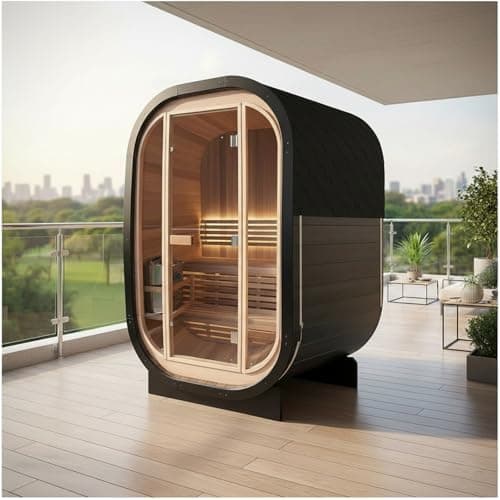
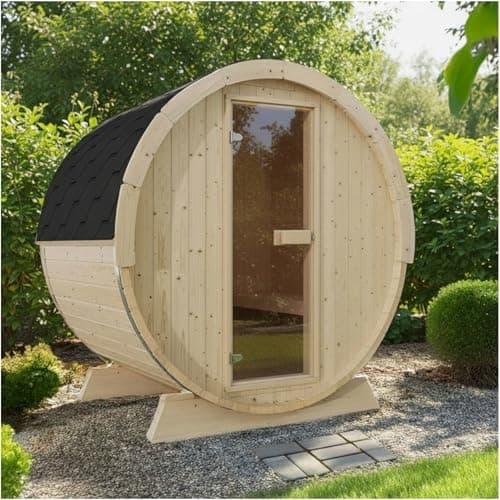
Buy the barrel if you want the most sauna per dollar and the fastest warm-up; buy the cube if you need the sauna to sit flat against a wall or fence, want full standing height at the sides, and care about the modern look. To keep it honest we've put the same manufacturer's two shapes side by side — ZONEMEL's 2-person barrel and 2-person cube, both running the identical ETL-listed 4.5kW TOULE rock heater — so the comparison is about geometry and timber, not about one brand being better than another.
What a "cube" sauna actually is
A cube sauna is a squared-off outdoor sauna: four flat walls, a flat or gently sloped roof, panelised construction rather than curved staves, and — almost always — a large tempered-glass front. It is the shape that has taken over the modern end of the outdoor market, and it is not the same thing as the traditional cabin sauna we compare in barrel sauna vs cabin sauna. A cabin reads like a tidy shed with a pitched roof; a cube reads like a piece of contemporary garden architecture, usually in dark-stained or black-clad timber. The ZONEMEL cube here is a black-finished Canadian red cedar box with an 8mm tempered-glass door.
The barrel, by contrast, is a cylinder lying on its side, drawn together with steel bands and resting on cradles. That single geometric difference — cylinder against box — is what drives every practical difference below.
The difference in one table
| Factor | Barrel sauna | Cube sauna |
|---|
| Air volume to heat | Less — the curve cuts the dead corners | More — a box holds air in every corner |
| Headroom at the walls | Curves away; you duck at the edges | Full height right up to the wall |
| Footprint efficiency | Needs clearance all round; can't tuck in | Sits flat against a fence, wall or corner |
| Roof and snow | Sheds off the curve by itself | Depends on the roof pitch and flashing |
| Glass | Usually a door-sized pane in the end wall | Often a large front glazed panel |
| Look | Rustic, unmistakably a sauna | Contemporary, blends with modern builds |
| Price for the same seats | Lower entry point | Typically a premium, often with better timber |
Heat-up: the barrel's built-in advantage
A cylinder encloses less air than a box of the same bench length, and it has no upper corners where warm air can stack away from the bench. That is a real, physical head start: with the same 4.5kW heater in both, the barrel simply has less air to bring to temperature, and the curved ceiling rolls the heat back down onto you rather than parking it overhead. In practice both shapes throw proper loyly, because both are rock stoves and both take water on the stones (Finnish Sauna Society) — but the barrel gets there with less to fight, which shows up in warm-up time on a cold evening. Our barrel heat-up guide puts numbers on the electric case.
The counter-argument for the cube is construction rather than shape. Cube saunas are usually panelised — a wall cavity that can carry insulation — where a barrel is solid timber staves with nothing behind them. A well-insulated cube can hold heat better once it is warm, which matters more than raw heat-up time if you sauna in a cold climate. Confirm what the specific listing actually claims before you assume it, though: plenty of budget cubes are solid timber too, and neither of the two here publishes an insulation R-value.
Headroom and how the bench feels
This is the thing people notice on the first session and never mention in reviews. In a barrel the walls curve away from you above shoulder height, so the space is generous at the middle and tight at the ends — you sit slightly hunched at the outer seats, and standing up fully is only possible along the centre line. A cube gives you full height right up to the wall, which means you can stand and stretch anywhere in the room, and a taller bather is comfortable on any seat rather than only the middle one. If anyone using it is over six feet, that difference is worth more than a hundred dollars of price gap.
The barrel gives some of it back in usable bench length for the money: a 2-person barrel puts two facing benches inside a tube that costs less to build than the equivalent box, which is a large part of why barrels have the lower entry price at every seat count.
Where each one fits in the yard
A barrel is round, so it never tucks. It needs clearance all the way round for airflow, for band checks and for you to walk past it, and it looks wrong jammed against a fence. A cube has flat walls and can sit close to a boundary, along a house wall or in the corner of a rectangular yard, which in a small garden can be the whole argument. If your usable space is a strip down one side of the house, the cube wins before any other factor is considered — and if you have an open lawn to be a centrepiece on, the barrel earns its keep as an object.
Both still need the same thing underneath: a firm, dead-level base, because a barrel that isn't level binds its door and stresses its staves, and a cube that isn't level racks its panels. That work is identical for both shapes and it is covered in barrel sauna foundation.
Roof, rain and snow
The barrel does its own weatherproofing. Rain runs off the curve, snow slides rather than sits, and there are very few seams for water to find — which is exactly why the barrel became the default outdoor shape in the first place (Almost Heaven builds both shapes). The ZONEMEL barrel here ships with asphalt shingles and a waterproof tarp on top of that.
A cube's roof is a design decision, and it is the thing to interrogate on any cube listing. A flat or very low-pitch roof holds snow load and can pond water unless it is properly pitched, membraned and flashed; a mono-pitch roof with a real overhang is fine. If you live somewhere with serious winters, ask the seller what the roof is made of and how it drains before you buy the cube — that single question separates the good ones from the ones that leak in year three. Either way, both shapes benefit from a cover in the off-season, which we cover in barrel sauna covers and weather protection.
What the price gap is actually buying
Read the two picks here carefully, because it is easy to attribute the whole difference to the shape and be wrong. The cube costs meaningfully more than the barrel — but the cube is Canadian red cedar, the aromatic, naturally rot-resistant sauna timber, and the barrel's listing never names its species at all. So part of that gap is cedar, not geometry. Cedar is a genuine upgrade for a structure that lives outdoors in rain and snow year round, and it is the same premium you pay across the catalog; the full argument is in cedar vs hemlock. Judge the two on wood and shape together rather than pretending you are buying identical saunas in different outlines.
The install is identical — plan for it either way
Both of these run the same 4.5kW electric rock heater, which means the same electrical job: a dedicated 240V circuit run out to the sauna by a licensed electrician, under the National Electrical Code and, in most places, with a permit and an inspection. That is real money on top of either sticker and it is the single most common surprise in this category. 4.5kW is at least the lightest version of that job — the 6kW and 9kW barrels ask for a bigger circuit. Shape changes nothing here; run the numbers in what a barrel sauna really costs and work through the barrel sauna buying checklist before you order either one.
How to choose between them
Choose the barrel if…
Your space is open rather than boxed in, you want the fastest warm-up and the lowest energy per session for the seats, you like the look, and you want the lowest entry price into a real rock-stove outdoor sauna. The barrel also wins on weather-by-default: the curve sheds rain and snow without you having to evaluate a roof spec. For most buyers with a lawn to put it on, the barrel is still the sensible default, and the wider field is ranked in best barrel saunas.
Choose the cube if…
Your yard is a rectangle or a narrow side return, you need the sauna to sit flat against a fence or wall, anyone using it is tall enough to resent a curved wall, or you want the contemporary look next to a modern house. The cube is also the shape to pick if you want a big glazed front — the view out is a genuinely different experience from a barrel's single end window, and it is the reason a lot of people choose one.
What to check on any cube listing
Cubes are newer to the mass market, so the listings are less standardised. Ask, in this order: what species is the timber and is it kiln-dried; what is the roof made of and what is its pitch; are the walls insulated or solid; what heater is fitted and at what kW; and what is actually in the box (stones, stove guard, benches, shingles). Anything a listing will not answer in writing, treat as absent. The same discipline applies to barrels, and it is the whole point of the buying checklist.
Don't decide on capacity claims alone
"2-person" means two adults sitting upright, shoulder to shoulder, in either shape. It does not mean two people stretching out, and it does not mean two people plus a guest. If there is any chance of a third regular bather, size up now — you cannot retrofit capacity into either a barrel or a cube. Our home sauna size guide works through the honest seat counts.
This choice is really only live at two seats, which is where both shapes exist at a sane price and on the same light 4.5kW circuit. Our best 2-person outdoor saunas page puts ZONEMEL's barrel and its cedar cube side by side with the two step-up options, so you can price the shape decision rather than only reason about it.