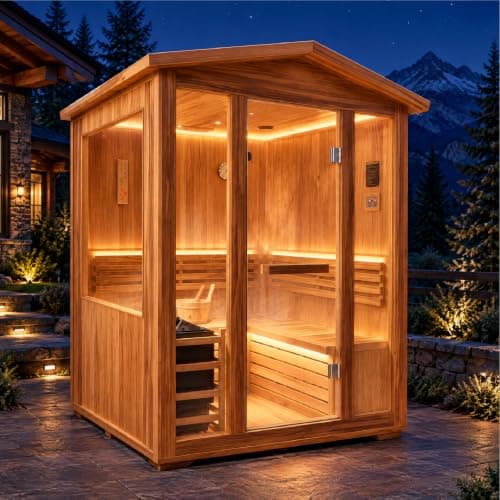
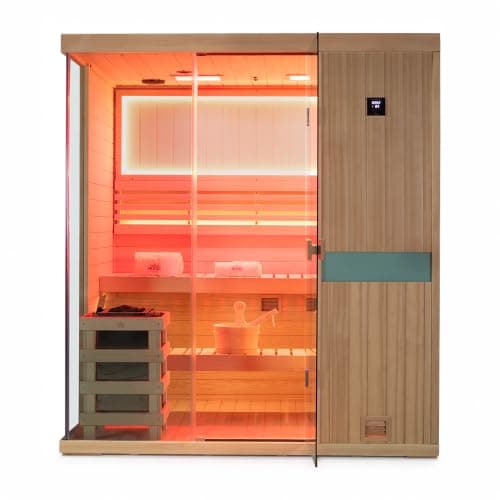
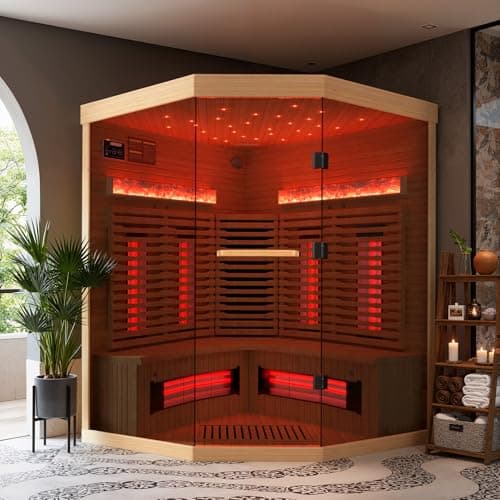
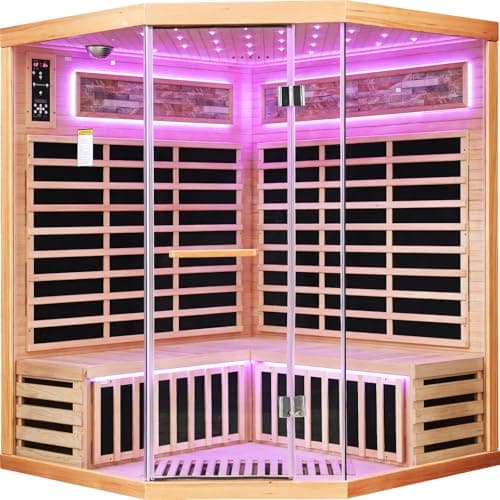
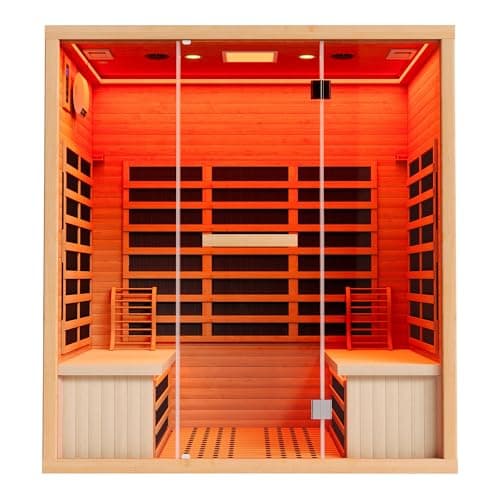
Buy the Albott 4-Person Infrared. It is the only cabin at this size that seats four on a 110V/20A household circuit, it publishes its wattage and its EMF class, and it does not start with a quote from an electrician. If you want a real Finnish sauna rather than an infrared cabin — stones, a bucket, water you can throw — buy the Trustmade 3-4 Person Japanese Cedar instead and accept the 220V circuit that comes with it. Those two picks cover almost everybody shopping this size. The other three are for specific rooms and specific priorities, and we say exactly which below.
Why four-person is the hardest size to shop
Two-person cabins are an appliance. You pick one, it arrives, it plugs in, and the worst thing that happens is you wish you had bought cedar. Four-person cabins are a different purchase, and three things change at once.
The room gets big enough that heater sizing starts to matter. A 2-person cabin is roughly 60-80 cubic feet and almost any stove will cope. A genuine 4-person room is closer to 180-220 cubic feet, and at that volume an undersized heater is not a minor annoyance — it is a sauna that never reaches temperature with four bodies and a glass door pulling heat out of it.
The electrical job gets real. Every traditional cabin at this size runs on 240V and needs a dedicated circuit, which means a licensed electrician working to the National Electrical Code as adopted in your jurisdiction, a breaker, and a cable run. Our sauna electrical requirements guide and breaker sizing guide tell you what to ask for. Budget for it before you compare prices, because it can move the ranking.
And the capacity claims get much less honest.This is the real reason this page exists. "4-person" in a listing title frequently means four people sitting upright, shoulder to shoulder, knees touching, for the length of a photograph. Three adults who want to stretch out is a far more realistic read of most of these cabins — which is why several of them are listed as "3-4 person" and why the honest ones say so.
How we ranked them
Criteria first, in the order we weighted them. Everything below is a judgment from documented research — published listing specs, manufacturer claims and aggregated owner reports. We did not put a thermometer in any of these cabins; our methodology says so in those words.
- Does it really seat four? We read the published footprint where there is one, and we discount a capacity claim that comes with no dimensions at all. A cabin that will not tell you its interior width is making a claim it does not want checked.
- Is the heater sized to the room? The working rule in this category is roughly 1kW per 45 cubic feet of well-insulated sauna, adjusted up for glass and cold walls — the same rule we use in the heater size guide. Where a listing publishes both a wattage and a footprint, we run that arithmetic and show it.
- What circuit does it need? 110V versus 240V is the biggest hidden cost difference on this page, and it is not reflected in the sticker price. A cabin that runs on a household circuit saves you an electrician; one that needs 240V adds a job, a permit question and a panel-capacity question.
- Infrared or a real stove? These are two different products that share a page. Only a rock stove gives you loyly — the steam burst the Finnish Sauna Society describes as the point of the whole exercise. No infrared cabin at any price can do it. If you are not sure which you want, read infrared vs traditional before you spend anything.
- Wood, and whether the species is named.Canadian hemlock is the budget-to-mid default; cedar costs more and gives you aroma and rot resistance. A listing that says only "cedar" with no species is a flag — see cedar vs hemlock.
- What the listing actually publishes. We score silence down. Not because a cabin with a thin listing is necessarily bad, but because a four-figure purchase you cannot verify carries real risk, and that risk belongs in the ranking.
The five, side by side
Every number here is as the listing publishes it, and a dash means the listing does not say. The dashes are the most useful column on this table.
| Cabin | Stated seats | Heat type | Rated power | Supply | Wood |
|---|
| Albott 4-Person Infrared | 4 | Far infrared, 10 carbon panels | 2,145W | 110V / 20A | Canadian hemlock |
| Trustmade 3-4 Person | 3-4 | Traditional stove + volcanic stones | 6kW | 220V | Japanese cedar |
| HKXSC 4-Person Traditional | 3-4 | Traditional stove | 4,500W | 240V | Canadian hemlock |
| SWHSE 3-4 Person Corner | 3-4 | Far infrared | — | 220V | Canadian hemlock |
| OUTEXER Corner | 4-5 | — | — | 240V | Canadian hemlock |
Read that table as a story about disclosure. The two picks at the top tell you their heat type, their power and their wood, and one of them tells you its footprint as well. The two at the bottom make the largest capacity claims and publish the least. That is not a coincidence, and it is exactly why they rank where they rank rather than where their size and price would put them.
The one piece of arithmetic worth doing before you buy
The HKXSC listing is the only one here that publishes an exterior footprint: 70.91 x 57.13 x 78.94 inches. Convert that to feet and you get roughly 5.91 x 4.76 x 6.58, which is about 185 cubic feet. Run it through the 1kW-per-45-cubic-feet rule and you need about 4.1kW. Its stove is rated 4,500W. So it clears the rule — but by less than ten percent, which is thin margin for a cabin with a full-view glass door, and it is why we are explicit that a cold basement will show up as slower heat-up rather than as a cabin that fails.
Now do the same for the Trustmade: 6kW against a comparable room volume gives you serious headroom, which is what you want if four people will actually use it and someone is ladling water on the stones. That difference — 4,500W clearing the bar versus 6kW clearing it comfortably — is the whole argument for why the cheaper cedar cabin outranks the more expensive hemlock one.
For the two cabins with no published wattage, you cannot do this arithmetic at all. That is the thing to weigh, not the price.
Which one, by what you are actually solving for
- You want four seats and no electrician: the Albott. It is the only pick on this page that answers that question, and it is the reason it wins.
- You want a real sauna with stones and steam: the Trustmade. Cedar, a 6kW stove, and the bucket and ladle in the box. Add 220V wiring to the budget.
- You want a traditional room and you want to check its sizing on paper first:the HKXSC. It is the priciest here and the stove is smaller than the Trustmade's, but it is the one listing that gives you a footprint to work with.
- Your room has an awkward corner and a tight budget: the SWHSE corner cabin. Just understand that its 220V supply means you are paying for an electrician anyway, which undercuts the usual reason to buy infrared.
- You need the biggest stated capacity in a corner shape: the OUTEXER. Get interior dimensions and a heater rating from the seller in writing before you pay.
- You are not sure four seats is right: stop and read 2-person vs 4-person sauna. Most people who think they need four seats are buying for two or three people and one hypothetical dinner party, and a 3-person cabin heats faster, costs less to run and fits rooms a four-seater does not.
What four seats costs you after the sticker price
Three line items decide whether a 4-person cabin is a good buy, and none of them appear in the listing price.
The circuit. Four of the five picks here need 240V. That is an electrician, a breaker, a cable run and — if your panel has no spare capacity — a much larger conversation. Get the quote before you buy the cabin, not after. Our electrician guide covers what that work involves, and plug-in vs hardwired explains where the boundary sits.
The floor. A four-person cabin is heavy, and once four people are inside it is considerably heavier. On a slab this is a non-issue. On a suspended wood floor upstairs it is worth a look — see can a sauna go upstairs. You also want a surface that tolerates water, which is what indoor sauna flooring is about.
The running cost. Bigger room, bigger stove, longer heat-up. A 6kW stove drawing full power for an hour is 6kWh, which at the U.S. average residential rate published by the EIA is about a dollar in electricity — and real sessions draw less than nameplate once the room is up to temperature, because the thermostat starts cycling the elements. The 2,145W infrared cabin is a fraction of that. Our running-cost guide works the arithmetic through properly with your own rate.
Will four people actually fit?
Here is the test. A comfortable adult seat on a sauna bench is about 24 inches of bench width, and you want roughly 36-40 inches of bench depth if anyone is going to lie down. Four seats therefore wants about 8 feet of total bench run — which almost no cabin on this page has on a single tier. Which is why four-person cabins are nearly always an L-shaped bench, a two-tier bench, or both.
So when you read "4 person", translate it: four people sitting upright on an L or on two tiers, no one lying flat. If your actual use case is two people who both want to stretch out, a 4-person cabin is the right buy for a different reason than the number suggests — you are buying bench length, not headcount. Our home sauna size guide and 3-person sauna dimensions page have the measurements to hold a listing against.
And measure the route in, not just the room. A four-person cabin arrives as large panels on a freight truck, and the doorway, stair turn and basement hatch it has to pass through are a real constraint. People discover this after the crates are on the driveway.
Infrared or traditional at this size
At 2-person size this is mostly a preference question. At four seats, the economics tilt.
An infrared cabin that seats four on a 110V circuit — which is what the Albott is — is a genuinely unusual thing, because it means you get the biggest size class in the category without the biggest cost item in the category. That is a strong, specific argument, and it is the one that wins this page.
But if you are going to pay for 240V anyway, the argument flips hard. Once the circuit is a sunk cost, a traditional stove gives you the higher temperatures, the humidity you control, and the loyly that infrared cannot produce at any price. That is why the SWHSE corner cabin — an infrared unit on a 220V supply — scores where it does: it takes on the cost of a traditional install without the benefit. If your plan already includes an electrician, shop the traditional cabins.
One more thing worth checking on either type: a certification mark. A sauna heater is a high-wattage appliance in a hot, humid room, and you want a UL, ETL or CSA listing you can look up in the UL Product iQ directory. An uncertified heater can also fail inspection and complicate a homeowner's policy.
Where to put it
Four-person cabins mostly end up in one of three places, and each has its own guide on this site. A basement is the most common and usually the best — it is cool, it is already a slab, and the panel is normally close by (basement saunas, basement sauna installation). A garage is the next most common and the one where insulation matters most (garage saunas). A spare room upstairs is the one to check the floor and the delivery route for first.
Whichever you choose, give the cabin the clearances the manufacturer asks for and plan the ventilation properly — sauna ventilation is the difference between a room that feels fresh at four bodies and one that feels like a sealed box. At this capacity, that is not a nicety.