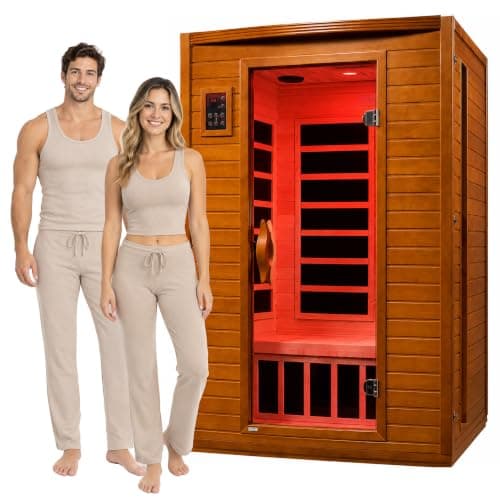
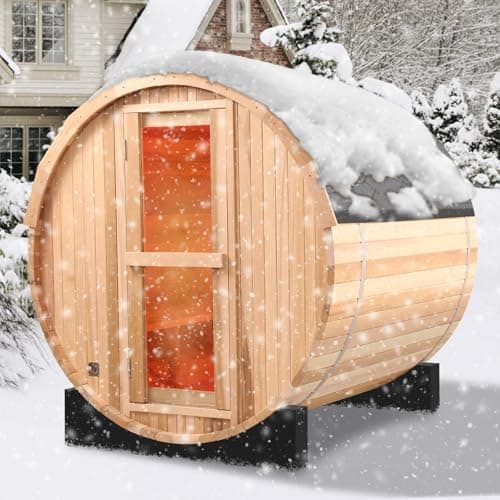
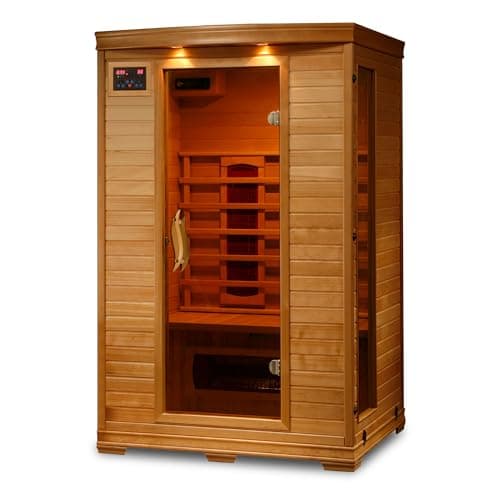
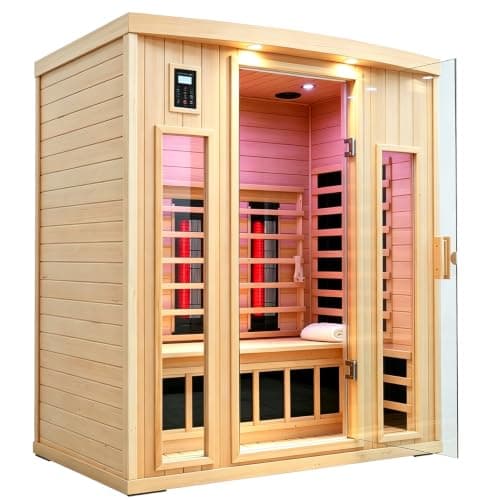
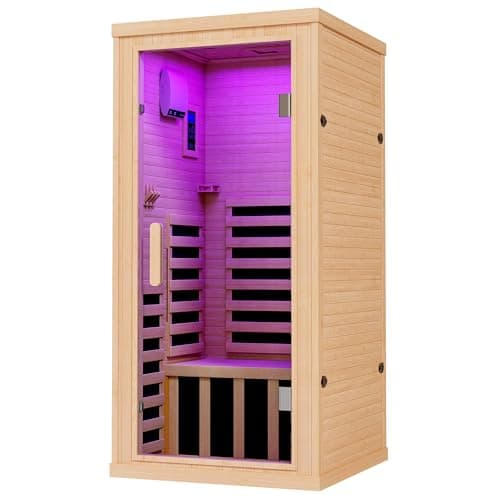
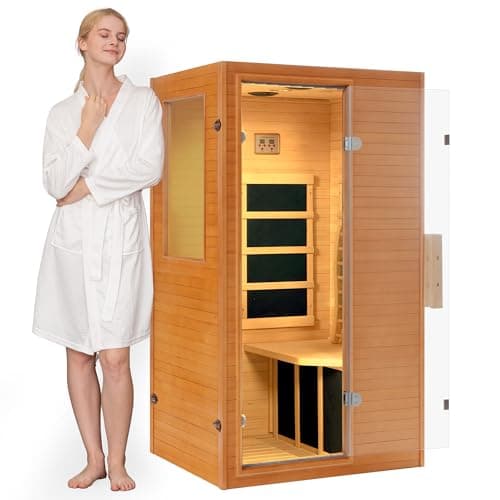
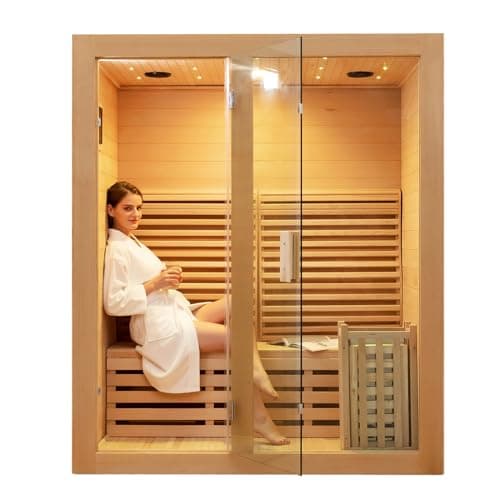
If you want the best hemlock sauna and you want a real one — stones, a ladle, steam you can throw — buy the ZONEMEL 2-person hemlock with the 3.5kW Harvia stove. It is the only hemlock cabin on this page with a genuine brand-name rock stove in it, and it publishes more of its own numbers than anything near it. If you are heating a room with electricity you already have and you want the widest support network in the category, the Dynamic Andora is the hemlock infrared cabin to buy instead. The budget pick is the Real Relax 1-person: the cheapest cabin on this site that is still a real Canadian hemlock box rather than a tent. Every price in the table below is live and carries its own as-of date.
Why a page about one wood
Because hemlock is what you are being sold, whether or not the listing makes a point of it. Walk the home-sauna market from roughly $700 to roughly $3,000 and the overwhelming majority of what you will find — infrared cabins, traditional kits, even outdoor barrels — is Canadian or Eastern hemlock. Cedar exists above it and marketing copy loves it, but hemlock is the material the category is actually built from.
That makes "is hemlock any good?" the wrong question. The right question is: what does hemlock do well, what does it not do, and which hemlock cabin is worth buying. We have a separate cedar vs hemlock comparison that argues the material question out in full, and a best red cedar saunas roundup for people who have already decided to pay the premium. This page is the other half: the ranked answer for everyone buying the wood the market actually runs on.
What hemlock is, in one paragraph
Hemlock is a pale, close-grained softwood with very little resin and almost no smell. Those three properties are exactly why it ends up in saunas. Low resin matters because a resinous wood weeps sticky pitch at 180F and can scald skin where it pools. Close, even grain matters because it splinters less on a bench you sit on naked. And the absence of smell matters more than people expect — a hemlock room smells of hot wood and nothing else, which is the right background for a scent you actually chose rather than one the cabin imposes on you. The USDA Wood Handbook is the standard reference for the underlying material properties; the sauna-specific conventions come from the Finnish Sauna Society.
How we ranked them
Everything below is a judgment from documented research — the listings' and manufacturers' own published figures plus aggregated owner reports. We have not measured a heater, a temperature or a moisture content, and our methodology says so in those words.
- Is the hemlock stated, and stated where?"Canadian hemlock" in the title and nothing in the specs is weaker than a species named in the specification table. A cabin that will not name its wood at all scores below every cabin here.
- What heats it? A hemlock room with a real rock stove and a hemlock box with carbon panels are different products that happen to share a material. We rank them as what they are, and we say which is which in the first line of every pick.
- Does it publish an interior dimension? Seat-count claims are marketing; inches are a fact. Roughly 24 inches of bench width per adult is the working number we hold capacity claims against.
- What circuit does it need? 110-120V means you plug it in. 240V means an electrician and a breaker, which is a real cost no listing includes. See sauna electrical requirements.
- Is the hemlock doing a job it is suited to? Indoors, hemlock gives up very little. Outdoors, in weather, it gives up something real — and exactly one pick here is an outdoor cabin, with that trade spelled out.
Hemlock against the alternatives, side by side
| Wood | Smell | Rot resistance | Typical use | Price position |
|---|
| Hemlock | Essentially none | Low — needs to stay dry | Indoor cabins, most of the market | The baseline |
| Western red cedar | Strong, aromatic | High — naturally durable | Outdoor kits, premium indoor | A clear premium |
| Nordic spruce | Faint, resinous | Moderate | Finnish-market rooms | Rare in US listings |
Read the rot-resistance row before you buy anything for a garden. Indoors, in a ventilated room that dries between sessions, hemlock's low natural durability is a non-issue — the wood never stays wet long enough for it to matter. Outdoors it matters a great deal, which is why the one outdoor pick here is the exception that needs justifying rather than the rule.
Which one is for you
- You want real loyly in a hemlock room — the overall pick: the ZONEMEL 2-person hemlock with the 3.5kW Harvia. A genuine Harvia rock stove, a compact indoor footprint and a 240V circuit. You can throw water; nothing else at this size and price can.
- You want the safest infrared buy: the Dynamic Andora. Canadian hemlock, low-EMF far-infrared panels, red-light LEDs and the largest parts-and-manuals network in the mid market, on a standard 120V outlet.
- You want hemlock outdoors anyway: the Smartmak hemlock barrel with the 6kW Harvia. The brand-name stove is the reason to buy it. Budget for a cover and read barrel sauna weather protection first — a hemlock barrel asks more of you than a cedar one.
- You want more heaters for the money: the HeatWave Coronado, a long-running Radiant Saunas 2-person hemlock with a denser emitter layout than the usual build, on a standard outlet.
- Three seats, no electrician: the KUNSANA 3-person in Eastern Canadian hemlock — eight far-infrared panels plus three ceramic tubes on 110-120V. Measure the room first; it is about six feet wide.
- One person, best-finished: the Albott 1-person, seven carbon panels plus a dedicated foot zone — the single-seat cabin that heats the part of you a single seat usually leaves cold.
- The lowest price that is still a real cabin — the budget pick: the Real Relax 1-person. A 950W Canadian hemlock box with a fitted backrest. It trades power and elbow room for the cheapest way into a wooden room rather than a portable tent.
What hemlock actually costs you versus cedar
Three things, and only one of them is a performance difference.
Aroma. This is the big one and it is entirely subjective. A cedar room smells like a cedar room from the moment it warms up, every session, for years. A hemlock room smells of warm wood. If the smell of cedar is a large part of why you want a sauna, no amount of reasoning about thermal conductivity will make you happy in a hemlock box, and you should raise the budget rather than talk yourself out of it.
Outdoor durability. Western red cedar contains natural extractives that resist decay; hemlock does not. Indoors that difference is academic. Outdoors it is the difference between a cabin that tolerates neglect and one that does not. A hemlock barrel in a wet climate needs a cover, needs its ends sealed and needs to dry properly between uses. Our cold-climate outdoor guide and the barrel maintenance page both treat that as mandatory rather than optional.
Resale and perceived quality. Cedar reads as premium. If you expect to sell the cabin on, that is worth something. If you expect to use it until it dies, it is worth nothing.
What hemlock does not cost you is heat. The wood in a sauna is a liner, not a heater. What gets the room to temperature is the stove or the panels, sized to the room volume — roughly 1kW per 45 cubic feet of well-insulated sauna, the same rule as our heater size guide. Harvia publishes a room-volume rating for every heater in its range, and not one of those ratings changes because the walls are hemlock.
The trap: "hemlock" that is not a specification
Two listings can both say hemlock and mean different things. The questions that separate them:
Is the species in the spec table or only in the title? Title copy is marketing and is routinely written by someone who never saw the cabin. A species that appears in the structured specification alongside wattage and dimensions is a claim the seller has committed to.
Is it the whole cabin or the visible faces? Some budget builds are hemlock-faced over a cheaper core. You usually cannot tell from the listing. What you can tell is whether the seller publishes a panel thickness — and the ones that do tend to be the ones with nothing to hide.
Canadian or Eastern? Both appear in these listings and both are legitimate. Canadian (western) hemlock tends to be the paler, more uniform of the two. It is not a quality grade and nobody should pay a premium for the word.
Living with a hemlock room
Do not oil, seal or varnish the interior. A finish traps moisture against the wood and can off-gas at temperature, and a sealed bench gets slippery and unpleasant. Bare wood, a towel under you, and ventilation afterwards is the whole maintenance regime — our maintenance guide covers the detail. Hemlock is pale enough that body oils will mark the benches over a year or two; a light sand returns them, which is a thing cedar owners do too.
If the room is traditional, give the stones the same respect as the wood. A rock stove is only as good as what is in the basket, and the stones themselves are the component most often left as the factory shipped it for far too long.