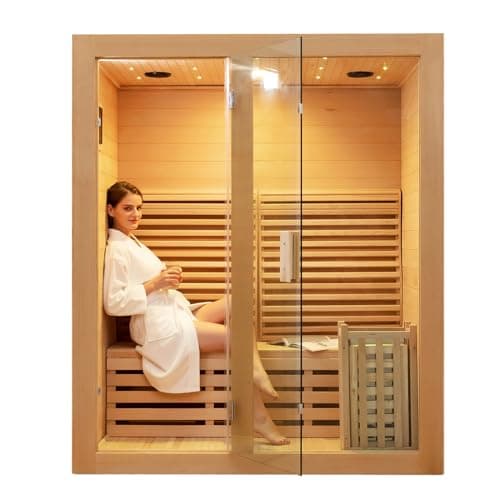
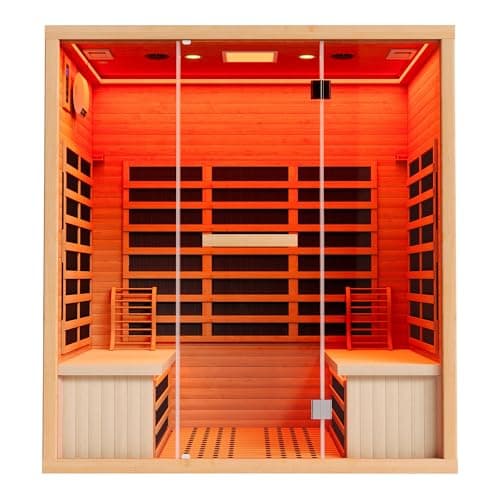
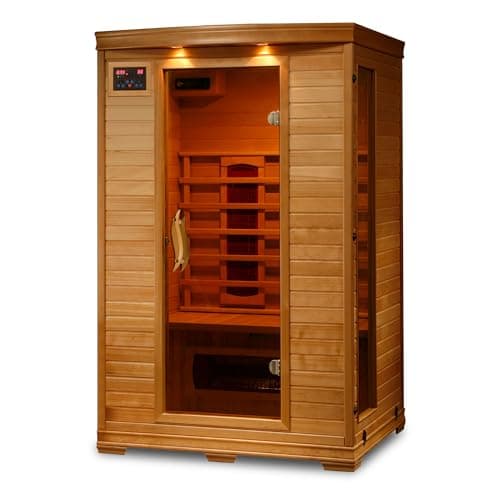
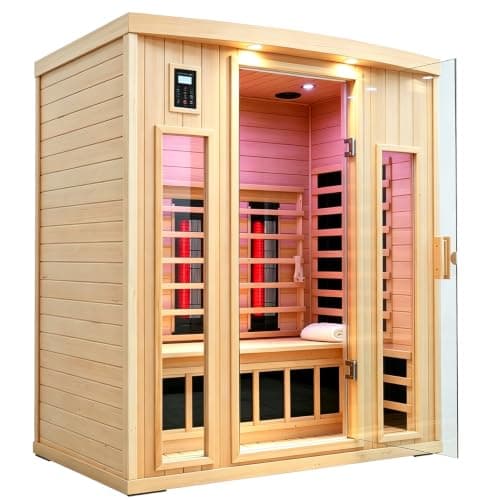
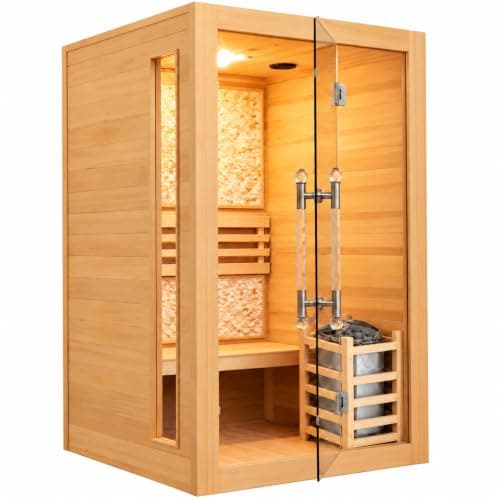
Under $3,000 you are choosing between two different things, not between seven similar ones. If you want a real sauna — stones, a ladle, steam you can throw — buy the AURGOD 2-person cabin with the 6kW Harvia stove and accept that it seats two and needs a 240V circuit. If you want four people in the room tonight with no electrician involved, buy the Albott 4-person infrared instead, and accept that you will never throw water in it. Everything else on this page is a variation on that trade. The one mistake to avoid is paying traditional money for a cabin that turns out to be infrared wearing the word "traditional" — a surprisingly common listing in this price band.
Why $3,000 is the interesting ceiling
It is the price at which the two halves of this category cross over, and that makes it the most decision-heavy budget in home saunas.
Below roughly $2,000, the choice makes itself: you are buying infrared, because a traditional rock-stove kit with a genuine Harvia in it does not exist down there. Above roughly $4,000, it also makes itself: a cedar traditional kit with a bigger stove is affordable and the infrared cabins stop improving much. At $3,000 both are genuinely on the table at the same time, and they are not the same product in two trims. One heats a room to a Finnish 170-190F and lets you pour water on hot stones; the other warms your body at 120-150F and cannot do that at any price.
The Finnish Sauna Society is unambiguous about which of the two is a sauna in the traditional sense, and we agree with them — but we are not going to pretend that settles a buying decision. An infrared cabin you use four times a week beats a traditional room you never wired up. Our infrared vs traditional guide lays the comparison out properly; this page is about what the $3,000 ceiling specifically does to it.
This is also a different question from the one our under-$4,000 page answers. At $4,000 all three picks are real cedar and hemlock rock-stove cabins, because that is what the extra thousand dollars buys. Drop the ceiling by a quarter and the field changes almost completely — which is exactly why both pages exist.
How we ranked them
Criteria first, and the ordering is deliberate: the ceiling makes electrical cost and heat type matter more than fit and finish. Everything below is a judgment from documented research — the listings' and manufacturers' own published figures plus aggregated owner reports. We have not measured a heater, a temperature or an EMF reading, and our methodology says so in those words.
- Real stove or infrared, stated honestly?A traditional sauna has a rock basket you can throw water into. If a listing says "steam" or "traditional" but describes carbon panels, it is an infrared cabin and we say so. This is the single most misrepresented thing in the price band.
- What circuit does it need, and is that in the price? 110V means you plug it in. 240V means an electrician, a breaker and a run of cable — a real cost that no listing includes. Under a fixed $3,000 ceiling, a cabin that needs $600 of electrical work is not competing at the same price as one that does not.
- Is the heater sized to the room? Roughly 1kW per 45 cubic feet of well-insulated sauna, the same rule as our heater size guide. Too little and it never gets there; too much and you have bought a heavier circuit than you needed.
- Does it really seat what it claims? We discount a capacity claim published with no interior dimensions. Roughly 24 inches of bench width per adult is the working number.
- What does the listing publish at all? Wattage, interior dimensions, temperature range, wood species, EMF class. Silence scores down — not because we found something bad, but because an unpublished number is one you cannot check before a freight delivery arrives.
Real stove or more seats — the two routes, side by side
| Route | What you get for $3,000 | Heat | Circuit | Can you throw water? |
|---|
| Traditional rock-stove kit | A 2-person hemlock room with a genuine Harvia stove | Roughly 170-195F, your choice of humidity | 240V, electrician | Yes — stones and a bucket |
| Infrared cabin | Three or four seats, often in hemlock | Roughly 120-150F radiant | 110V on some, 220-240V on others | No, at any price |
Read that table before the picks. If the bottom-right cell is what you came for, only two cabins on this page qualify and the decision is nearly made. If seats are what you came for, the traditional route is out — there is no four-seat rock-stove room under $3,000, and anything claiming to be one is worth reading twice.
Which one is for you
- You want a real sauna and two seats is enough — the overall pick: the AURGOD 2-person indoor traditional with the 6kW Harvia. The biggest stove on the page, with stones, bucket, scoop and an hourglass in the box, and it publishes its interior dimensions and temperature range.
- Same, but you would rather the lighter 240V circuit: the ZONEMEL 2-person hemlock with the 3.5kW Harvia. A real Harvia stove at nearly half the kilowatts, so a lighter electrical job — and the better-documented cabin of the two. It sits right at the ceiling.
- You want four seats and no electrician — the capacity pick: the Albott 4-person infrared, rated 2,145W on 110V/20A. The only four-seat cabin on this page that does not start with an electrical quote. Give it its own dedicated circuit.
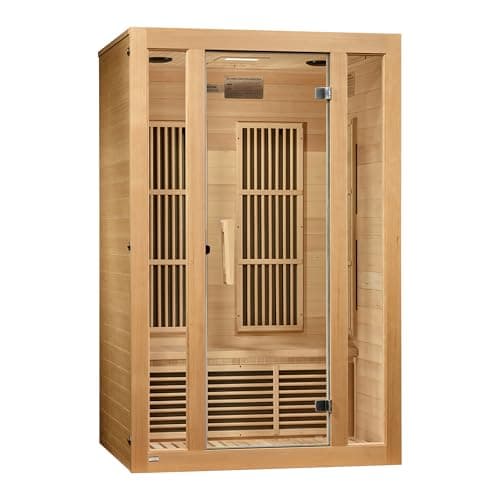
- You want the best-supported 2-person infrared: the Maxxus Seattle, on the Golden Designs platform, low-EMF rated and plug-in on 120V. Check it against the Dynamic Andora on the day and buy whichever is cheaper — they are near-identical.
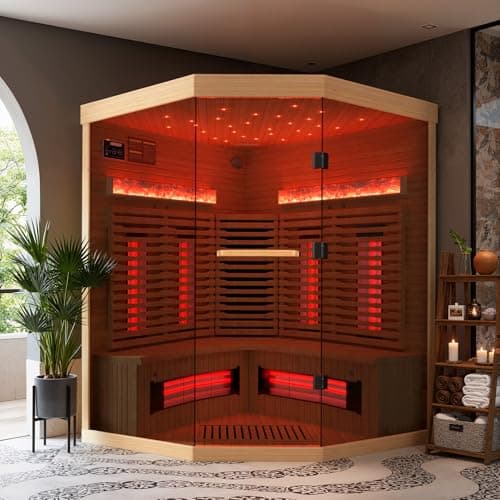
- Your room has an awkward corner: the SWHSE 3-4 person corner infrared, which tucks into the dead triangle a rectangular cabin wastes. Note the 220V quote, which spends the electrician you were trying to avoid.
- You want heat density over newness: the HeatWave Coronado, a long-running Radiant Saunas 2-person with more emitters than the usual layout, on a standard outlet.
- Three seats for the least money — the budget pick: the KUNSANA 3-person, eight far-infrared panels plus three ceramic tubes on a 110-120V circuit. Measure your room first: it is about six feet wide.
- Your budget is lower: best infrared saunas under $2,000 and under $1,000 carry the cheaper end. If it is higher, the under-$4,000 page is all real rock-stove cabins.
The cost that is not on the listing
A $2,800 cabin and a $2,800 cabin are not the same purchase if one of them needs a 240V circuit. This is the biggest hidden variable in the price band and the one most buyers discover last.
What 240V actually involves. A traditional sauna heater is hard-wired to a dedicated circuit with a breaker sized to the stove. In the US that work is governed by NFPA 70 as adopted by your jurisdiction, and in practice it means an electrician, a breaker, a cable run from the panel to the sauna, and possibly a permit. The cost depends entirely on how far the sauna is from your panel — a basement installation ten feet from the service panel is a different quote from a spare bedroom on the second floor. Get the quote before you buy the cabin, not after. Our sauna electrical requirements page covers the detail, and do you need an electrician answers the question directly.
Why 110V is worth real money here. Two of the cabins on this page run on a standard household circuit. That is not a minor convenience — it is the difference between a delivery and a project, and under a fixed ceiling it effectively adds several hundred dollars of headroom to the cabin price. It is also why the Albott, which seats four on 110V, is the pick we push hardest at anyone who cares about capacity rather than steam.
And the thing to watch for. An infrared cabin quoted at 220V throws away the main advantage of infrared. If you are hiring an electrician anyway, a traditional stove is back on the table and you should compare the two again rather than defaulting to the infrared you had already chosen.
Sizing the heater to the room, not to the seat count
Seat count sells cabins; room volume decides whether they work. The rule we use throughout the site is roughly 1kW per 45 cubic feet of well-insulated sauna, adjusted up for a lot of glass, a cold concrete wall or an uninsulated garage.
Run the AURGOD through it as a worked example. Its listing publishes a 51 x 41 x 75 inch interior, which is about 90 cubic feet, so the rule asks for roughly 2kW. It ships with a 6kW Harvia. That is a lot of stove for the room — which is a real advantage in use, because recovery between ladles of water is fast and the stones carry more stored heat, and a real cost at the panel, because 6kW is a heavier circuit than 2kW needs. The ZONEMEL's 3.5kW in a similar-sized cabin is the other side of that trade: lighter wiring, slower recovery.
Both are defensible. What is not defensible is a cabin that publishes a capacity claim and no interior dimensions, because then you cannot run the arithmetic at all. Harvia's own heater range publishes room-volume ratings for every model, which is the standard the rest of the category should be held to. More on this in the heater size guide and home sauna size guide.
What you are giving up at this ceiling
Four things, stated plainly, because a page that pretends a budget costs nothing is not useful.
Cedar. Every cabin on this page is Canadian or Eastern hemlock. Cedar — aromatic, naturally rot-resistant, the wood people picture — starts above this ceiling in traditional kits. Hemlock is perfectly serviceable indoors where there is no weather to resist; it just does not smell of anything. See cedar vs hemlock for whether that matters to you.
A four-seat traditional room. Not available under $3,000 from a listing we would stand behind. If four people and real loyly are both requirements, the honest answer is to save, or to look at 4-person indoor saunas and accept the higher number.
Full-spectrum infrared. The near- and mid-infrared cabins sit above this ceiling. Everything infrared here is far-infrared, usually with red-light or color LEDs alongside, which is not the same thing — full spectrum vs far infrared explains the difference.
A long review record on the traditional cabins.The two Harvia-stove kits here are recent listings with modest review counts, and both ship on a week-plus lead time rather than from a warehouse. That is normal for freight-delivered cabins in this band, but it means you are buying on the stove's reputation rather than the cabin maker's.
Running cost, and the surprise in it
The arithmetic is simple and the result is counterintuitive, so it is worth doing rather than assuming.
A traditional sauna draws more power — 3.5kW or 6kW — but a session is a heat-up plus a sit, and the stove cycles once it reaches temperature rather than running flat out. An infrared cabin draws far less, around 2kW, but takes a while to warm and runs continuously through the session because the panels are the heat. Multiply the draw by the hours and by your own electricity rate — the EIA publishes the US residential average, but your bill is the number that counts — and the two land closer together than the kilowatt figures suggest. Our home sauna running cost page does the full worked version, and infrared sauna electricity cost does the infrared half specifically.
What actually moves the number is insulation and habit, not heat type: a well-insulated room with the door shut and a sensible session length costs little either way, and a cabin in a cold garage with a lot of glass costs more either way. If you are siting this in a basement or garage, read basement sauna installation or garage sauna conversion before you choose the cabin — the room decides more than the brand does.
One last thing worth budgeting under the ceiling rather than after it. A traditional cabin wants accessories to be a sauna rather than a hot room: stones that are actually sauna rock, a bucket and ladle, and a thermometer that reads to 200F. None of it is expensive — best sauna stones and loyly accessories cover it — but leaving it off the budget is how a $2,800 cabin becomes a $3,100 purchase.