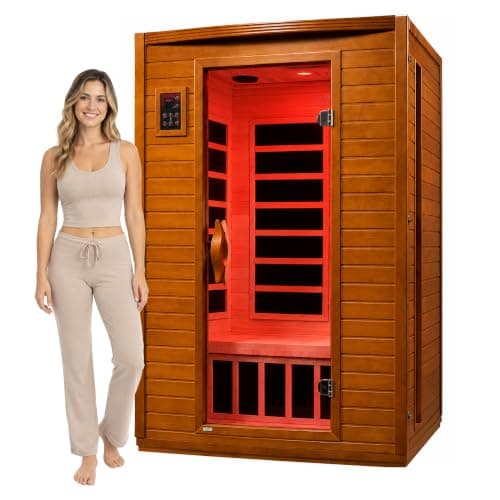
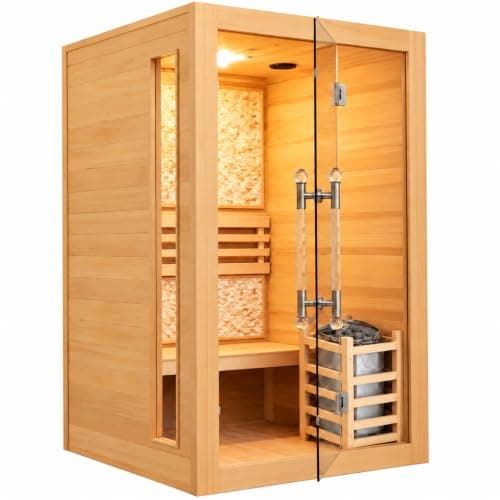
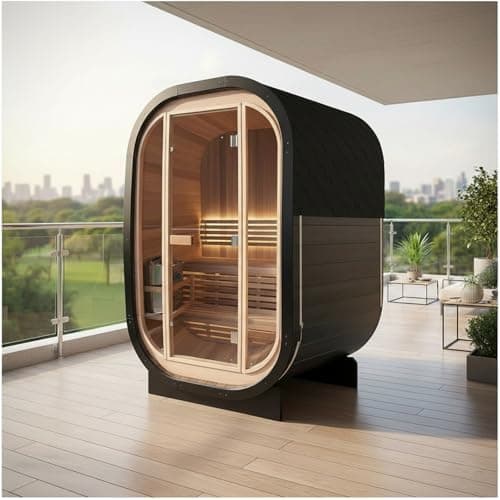
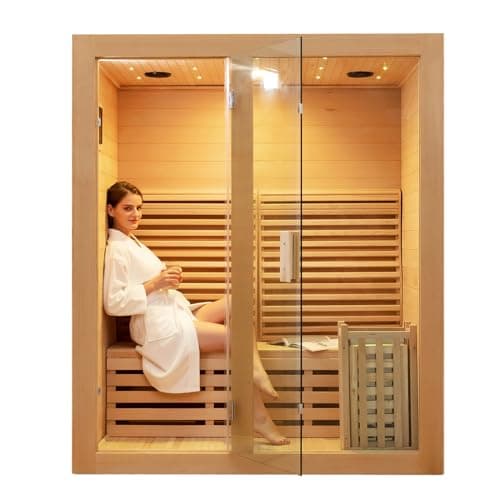
If your garage has a 240V circuit to spare, buy the ZONEMEL 2-Person Hemlock with the 3.5kW Harvia stove: it is the cheapest way to get a real rock-stove sauna into a garage, and a garage is the one room in a normal house where you can run a hot, wet room without worrying about the finishes. If the panel has nothing to spare, stop looking at traditional cabins entirely and buy the Dynamic Andora, which runs on a 120V outlet you almost certainly already have out there. That one question — spare 240V or not — decides this purchase more than wood, brand or price does, and it is the question nobody asks before the crates arrive.
Why a garage is the right room, and what it costs you
Garages win on the three things that normally kill an indoor sauna project. They have a concrete floor, so a few cups of spilled water are a non-event rather than a flooring claim. They have an exterior wall, usually more than one, so you can put a real air inlet low and an outlet high without boxing through a conditioned part of the house. And they are the only part of most houses where a 240V circuit is plausibly already in place — for a welder, a compressor or an EV charger — which is the most expensive line item in a traditional sauna install. Our garage sauna conversion guide walks the build itself; this page is about which sauna to put in there.
The cost is temperature. A garage is an unconditioned shell with a slab that sits near ground temperature all winter, and that slab is a heat sink your heater fights on every cold start. Nothing about that makes a sauna not work; it makes a small heater in a big, uninsulated garage slow. Which is exactly why the picks below are freestanding insulated cabins rather than a stud-framed room built against a cold exterior wall — a cabin heats its own small volume and ignores the 400 square feet of cold garage around it.
How we ranked them
- Electrical honesty. What the unit actually needs: a 120V household outlet, a light 240V circuit, or a heavy one. A 6kW stove is a different electrician visit than a 3.5kW stove, and a different conversation again from a plug-in cabin. Our sauna electrical requirements guide has the detail, and the work has to meet the NEC as adopted where you live.
- Heat-up from cold, not from warm. Every listed heat-up time assumes a room at room temperature. In an unheated garage in February the cabin, the benches and the stones all start far lower, so kW per cubic foot is worth more here than it is indoors.
- Whether it is a freestanding cabin. All four picks are self-contained rooms with their own insulated shell, floor and ceiling. That is deliberate — a cabin does not care that the garage is cold, and you can take it with you.
- Whether you can throw water. A garage can take the humidity, so a rock stove is genuinely on the table here in a way it is not in a carpeted spare bedroom. Three of our four picks are traditional stoves for that reason.
Scores come from our published rubric applied to manufacturer specifications and listing data, not from a lab.
The four, on the specs that matter in a garage
| Pick | Heat type | Power needed | Can you throw water? | Who it is for |
|---|
| ZONEMEL 2-Person Hemlock | 3.5kW Harvia rock stove | 240V, light circuit | Yes | A garage with a 240V circuit to spare |
| Dynamic Andora | Far infrared + red-light LEDs | 120V household outlet | No | A garage with no spare 240V |
| AURGOD 2-Person Indoor | 6kW Harvia rock stove | 220-240V, heavier circuit | Yes | Fast recovery in a cold garage, if the panel allows |
| ZONEMEL 2-Person Cube | 4.5kW ETL TOULE rock stove | 220V | Yes | A cedar build that could also live outside |
Every figure in that table is the manufacturer's published claim, not a measurement of ours. Heater sizing against room volume follows the published ratings makers like Harvia put on their own range — our heater size guide turns that into a rule of thumb.
Four things to do before the sauna arrives
1. Open the panel and count. Not the garage outlets — the panel. You are looking for two free adjacent breaker slots and enough headroom in the service for a 3.5kW to 6kW continuous load. If the house already runs an electric range, a dryer, air conditioning and an EV charger, the answer may be no, and that answer costs nothing to find out now and a great deal to find out later. Our breaker sizing guide tells you what to ask the electrician for; whether a permit is needed is a local question you can check against the adopted code and our permit guide.
2. Get the cabin off the slab. Concrete wicks cold and, in a garage, it is wet several months a year — snowmelt off a car, a hose, a humid night on a cold floor. Put the cabin on a level moisture barrier and treated sleepers or a composite pad so the underside of the floor is not sitting in it. This is the most common garage-sauna mistake we see and it is a twenty-dollar fix at install time. Our indoor sauna flooring guide covers it.
3. Plan the air, both directions. You want the garage itself ventilated, not just the cabin. The cabin needs its own low inlet and high outlet — see sauna ventilation — and the garage needs a path for the moisture that leaves it to go outside rather than condense on the back of the drywall. Cracking the overhead door a few inches during a session does more than any fan you can buy.
4. Measure the door swing and the route. Garage saunas are assembled in place, which is good, but the panels still have to get through the door, and the finished cabin still has to open its own door without hitting a car mirror. Measure the swept arc, not the footprint — our 2-person sauna dimensions page has the clearances.
Infrared or traditional, for a garage specifically
The usual answer to this question is about preference — dry radiant heat at 120-150F against hot air and steam at 170-190F. In a garage, two practical factors tilt it.
Traditional wins on the room. A garage can take the humidity, the spilled water and the heat, and a rock stove is the experience most people actually mean when they say sauna. You can throw water, you get loyly, and the cabin is doing what it was designed for.
Infrared wins on the install. A plug-in cabin is a weekend, a 120V outlet and no electrician. In a rented garage, a detached garage with a single 15A circuit, or a house whose panel is already full, that is not a compromise — it is the difference between having a sauna and having a quote. Read infrared vs traditional if you are genuinely undecided, and do infrared saunas need special wiring before you assume plug-in means no electrical work at all.
One thing that is not a factor: winter. Neither type minds a cold garage once it is insulated and running. Traditional stoves take longer from a cold start; infrared panels warm the body in front of them quickly but leave the cabin air cooler. Both work at 20F outside — see sauna use in winter for the detail.