For most basements the Dynamic Andora is the right buy: a 2-person far-infrared cabin on a 120V outlet, which means no dedicated circuit, no combustion and — the part that matters down there — far less moisture to get rid of than a rock stove produces. If your basement has a spare 240V circuit and a wall you can vent through to the outside, the ZONEMEL 2-Person Hemlock with the 3.5kW Harvia gives you a genuine steam sauna for comparable money, and it is the better sauna. The order of those two depends on your ventilation, not your budget.
What a basement actually imposes
A basement is attractive for obvious reasons: the space is already there, it is out of sight, and the floor is concrete. The constraints are less obvious, and they are why basement sauna projects go wrong.
Ceiling height. Sauna convention puts the ceiling around seven feet — low enough that the heat sits where you sit. That is a luxury in a basement with ductwork and joists eating into eight feet of headroom. Both traditional picks here are self-contained cabins rather than a framed room, so the cabin brings its own correct ceiling and you only need enough clear height to stand it up. See sauna ceiling height.
Nowhere for the moisture to go. This is the real one. A traditional sauna puts several quarts of water into the air per session. Upstairs, a bathroom fan handles it. In a basement with no exterior wall penetration it condenses on the coldest surface available — which is the foundation wall behind your finished stud bay. A traditional sauna in a basement needs a path to the outside: a rim-joist penetration, a window or a duct. If you cannot provide one, buy infrared, where the humidity is whatever your own sweat adds. Read do you need a vapor barrier in a sauna before you build anything.
Getting it down the stairs. All four picks ship as flat panels and assemble in place, which is the only sane way to put a sauna in a basement. Measure the stair width, the turn at the bottom and the door opening against the carton dimensions on the listing, not against the assembled footprint.
Electrical. Basements often have panel access — the panel is frequently down there — which makes a 240V circuit cheaper than it would be upstairs. That is the one way a basement is easier than the rest of the house. Our basement sauna installation guide covers the build sequence.
The four, on the specs that matter in a basement
| Pick | Heat type | Power | Moisture produced | Who it is for |
|---|
| Dynamic Andora | Far infrared + red light | 120V outlet | Sweat only | A finished basement with no vent to outside |
| ZONEMEL 2-Person Hemlock | 3.5kW Harvia rock stove | 240V circuit | High — needs a vent path | A basement you can vent, and a real steam sauna |
| EASYHAWK 2-Person | Far infrared, 6 panels | 1500W / 120V plug | Sweat only | The cheapest plug-in route |
| ZONEMEL 2-Person Red Cedar | 3.5kW Harvia rock stove | 240V circuit | High — needs a vent path | Cedar, where damp air is harder on wood |
Those are manufacturer-published claims, not our measurements, and the ranking is our rubric applied to listing data and aggregated owner reviews.
The short answer
Quick picks
#ad · Live prices from the Amazon Creators API, as of October 4, 2026. Where we have no verified live price, we show none — we would rather leave a gap than print a number that has rotted.
In detail
The picks, in full
Most people buying their first 2-person cabin
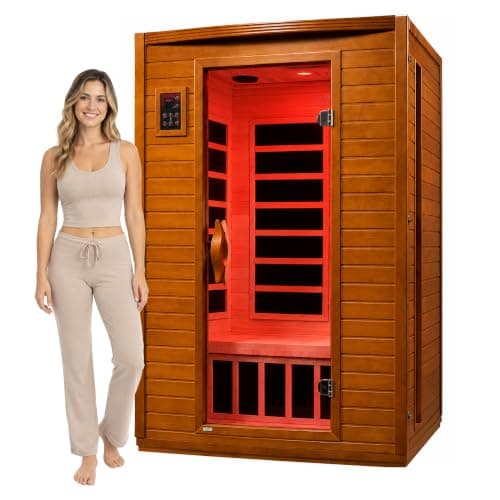
Dynamic Andora (2-Person Low EMF FAR)
2-personFar infraredRed-light therapyLow EMF (rated)120V outlet
The default 2-person infrared cabin. Low-EMF far-infrared heaters plus built-in red-light therapy, Canadian hemlock, and the widest support network in the category.
- Capacity
- 8
- Heat & comfort
- 8
- Low-EMF
- 8
- Build & wood
- 7
- Value
- 8
Pros
- +Runs on a standard 120V household outlet — no electrician, no dedicated circuit
- +Dynamic/Golden Designs is the largest mid-market brand, so parts, manuals and third-party reviews are everywhere
- +Carbon far-infrared panels rated low-EMF, plus red-light therapy LEDs built in
Cons
- −The heaters are far-infrared, not full-spectrum — no near- or mid-infrared HEAT like the pricier Maxxus models
- −Hemlock is the budget-to-mid wood; it lacks cedar's natural aroma and rot resistance
Don't buy this if…
…you want full-spectrum infrared HEAT (near, mid and far). The Andora's heating is far-infrared with red-light LEDs — step up to the full-spectrum Maxxus if near-infrared heat is the point.
The best value traditional indoor cabin
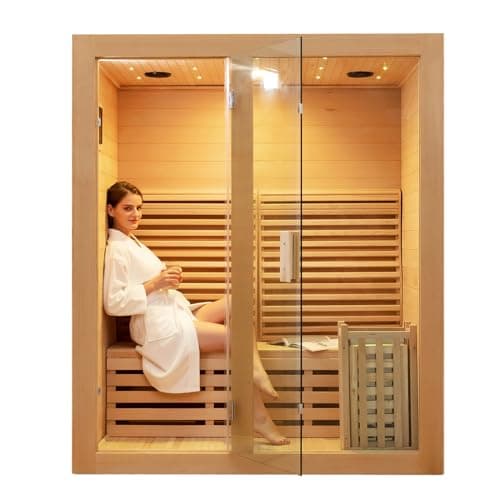
ZONEMEL 2-Person Hemlock (3.5kW Harvia Stove)
2-personTraditional (rock stove)3.5kW HarviaCanadian hemlock240V
The value real-loyly pick. A genuine Harvia rock stove in a compact indoor hemlock cabin — you can actually throw water and make steam.
- Capacity
- 7
- Heat & loyly
- 9
- Build & wood
- 7
- Wiring & install
- 6
- Value
- 9
Pros
- +A real Harvia stove and stones — throw water for loyly, which no infrared cabin can do
- +Compact enough to fit indoors in a basement or spare room
- +Far cheaper than a premium traditional kit for a genuine steam sauna
Cons
- −Needs a 240V circuit and, realistically, an electrician
- −Traditional saunas run hot (170-190F) and need proper ventilation indoors
Don't buy this if…
…you can't add a 240V circuit or ventilate a hot room. Traditional saunas are hotter and more demanding to install than plug-in infrared.
The best-value 2-person cabin
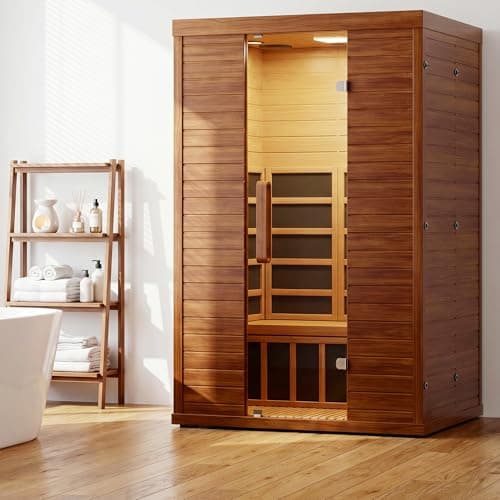
EASYHAWK 2-Person Infrared Sauna (Low EMF, 1500W)
2-personFar infrared6 low-EMF panels1500W / 120V5-year warranty
The value pick. Six low-EMF carbon far-infrared panels and 1,500W in a 47-inch wood cabin, on a standard household plug, for well under what the established brands charge.
- Capacity
- 8
- Heat & comfort
- 7
- Low-EMF
- 7
- Build & wood
- 6
- Value
- 9
Pros
- +Undercuts every other 2-person wood cabin here while still running six low-EMF carbon far-infrared panels
- +Standard 15A / 120V household plug — no electrician and no dedicated circuit, on any indoor surface including carpet
- +5-year limited warranty, which is long cover at this price
Cons
- −The listing never names a wood species, so you cannot compare the cabin against a stated hemlock or cedar build
- −Newer brand with nothing like the parts, manuals and third-party review depth behind Dynamic or Maxxus
Don't buy this if…
…you want a named wood and a long support track record. EASYHAWK is the price play here — Dynamic and Maxxus are what you buy for the network behind the cabin.
A cedar upgrade at 2-person size
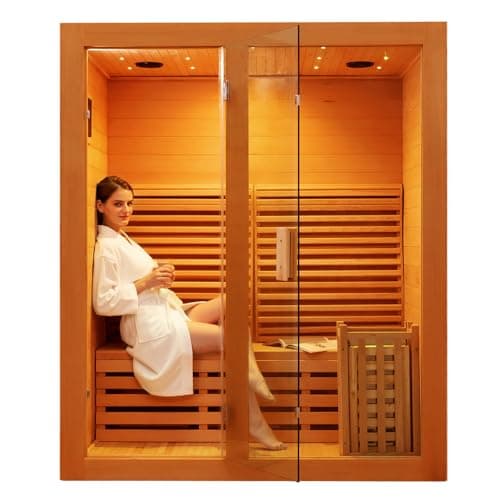
ZONEMEL 2-Person Red Cedar (3.5kW Harvia)
2-personTraditional (rock stove)3.5kW HarviaRed cedar240V
The cedar 2-person. Same real-Harvia formula as the hemlock model, in aromatic red cedar for a modest premium.
- Capacity
- 7
- Heat & loyly
- 9
- Build & wood
- 8
- Wiring & install
- 6
- Value
- 8
Pros
- +Red cedar's aroma and rot resistance over the hemlock version
- +Real Harvia loyly stove at a compact size
- +3.5kW can run on a lighter 240V circuit than the 6kW models
Cons
- −Still a 240V install
- −2-person size limits it to a couple at most
Don't buy this if…
…aroma isn't worth a premium to you. The hemlock version delivers the same heat for less — cedar is a comfort and longevity upgrade, not a performance one.
The decision tree, in order
Can you get a vent duct to the outside? If yes, a traditional cabin is on the table and you should take it — a rock stove is a better sauna than a panel. If no, buy infrared and do not negotiate with yourself about it. The failure mode of a traditional sauna in a sealed basement is not a bad session; it is mold behind finished walls, discovered a year later.
Does the panel have capacity? A 3.5kW stove is a light 240V circuit, and the panel is usually right there. If the service is maxed out, infrared on a 120V outlet is the answer again.
Is there a floor drain? Not required, but it changes how relaxed you can be. With a drain you can hose the cabin floor out. Without one you are mopping, and you should be stricter about drying the cabin after sessions — see sauna maintenance and cleaning.
How cold are the slab and the foundation wall? Cold surfaces are where water condenses. Keep the cabin off the concrete on a moisture barrier, leave an air gap behind it rather than pushing it tight to a foundation wall, and run a dehumidifier in the basement in the humid half of the year. That last item does more for a basement sauna's lifespan than any upgrade on the cabin itself.
Why infrared leads this list, when traditional is the better sauna
We are usually the first people to say that infrared and traditional are not the same product and that a rock stove is what most people actually want. In a basement the ranking inverts for one reason: consequences. An infrared cabin downstairs is an appliance you plug in. A traditional cabin downstairs is a wet-room installation with a ventilation requirement, and if you skip the ventilation to save a weekend, the cost lands on the building rather than on the sauna. The infrared vs traditional comparison is the honest version of the trade; what is basement-specific is that only one of the two can be got wrong expensively.
If you do go traditional down there, the 3.5kW picks are deliberate. A correctly sized stove for a 2-person cabin is a light electrical load and a modest amount of steam to vent. Putting a 6kW stove in a basement cabin because bigger sounds better doubles both problems; the published room-volume ratings from makers like Harvia exist precisely so you do not have to guess.
And if the basement turns out to be the wrong room — low headroom, no vent path, a finished floor you do not want to risk — the two alternatives worth pricing are a garage install, which is easier on almost every axis, and a barrel outdoors, where ventilation stops being your problem at all.
How we picked
We do not run a testing lab
We researched published manufacturer specifications, listing data and aggregated owner reviews, then scored each product against a published rubric. The scores are judgments from documented research — they are not measurements we took, because we don't have a lab and we're not going to pretend we do. Prices come live from the Amazon Creators API; where a spec came from a manufacturer we say so and link it in Sources.
Questions
Frequently asked
Can you put a sauna in a basement?+
Yes — it is the most common location for a home sauna. The three things to settle first are headroom (sauna ceilings sit around seven feet, and a self-contained cabin brings its own), moisture (a traditional sauna needs a vent path to the outside; an infrared cabin does not), and the route down the stairs for flat-packed panels. Panel access in a basement often makes the 240V circuit cheaper than it would be upstairs.
Does a basement sauna need ventilation?+
A traditional rock-stove sauna does, and it should vent to the outside — a rim-joist penetration, a window or a duct. Several quarts of water per session have to leave; if they cannot, they condense on the coldest surface available, which in a finished basement is the foundation wall behind the drywall. An infrared cabin produces only the humidity of your own sweat, which is why it is the default pick for a basement you cannot vent.
Will a basement sauna cause mold?+
Not by itself. Mold comes from humidity with nowhere to go plus a cold surface to condense on, which is a ventilation and detailing failure rather than a sauna problem. Vent a traditional sauna outside, keep the cabin off the concrete and slightly away from foundation walls, dry it after sessions, and run a dehumidifier in humid months. A plug-in infrared cabin sidesteps most of this.
What ceiling height do you need for a basement sauna?+
Sauna practice puts the ceiling near seven feet so the heat stays at bench level, and a freestanding cabin arrives built to roughly that. What you need is enough clear height to stand the cabin up and open its door under your joists and ductwork — measure the lowest obstruction in the footprint, not the average basement height.
Is infrared or traditional better for a basement?+
Traditional is the better sauna; infrared is the better basement appliance. If you can duct a traditional cabin to the outside and have a 240V circuit, take the rock stove — you can throw water and the heat is the real thing. If you cannot vent to the outside, buy infrared, because the consequences of unvented steam land on the building rather than on the sauna.
Can you get a sauna down a basement staircase?+
Yes, if you check the carton dimensions rather than the assembled size. All four picks here ship as flat panels and are assembled in place. Measure the narrowest point of the stair, the turn at the bottom and the door opening before you order, and plan for two people on the heavier panels.
Receipts
Sources
We do not run a testing lab, and we do not pretend to. Product specs are transcribed from the manufacturer's own listing and cited as claims; health figures come from peer-reviewed studies, named and linked. Where we could not verify something, we say so on the page rather than quietly leaving it out. Read our full method.