A 2-person sauna needs roughly a 4ft by 4ft interior footprint as a workable minimum, and about 5ft by 4ft before two adults stop negotiating knees — but the dimension that decides whether you like it is bench depth, not floor area. Two feet of bench depth lets you sit back properly; much less and you perch. If you want to lie down, the bench has to be longer than you are tall, which is why most "2-person" cabins seat two and recline none. Those three numbers — footprint, bench depth, bench length — are what to check before brand, wood or heater.
The numbers that matter, in order
Seated width per person. Shoulders are the constraint. Two adults side by side want something close to two feet each of bench width to not be touching, which puts a comfortable two-person bench around four feet long. A cabin advertising two people on a three-foot bench is advertising two people who know each other well.
Bench depth. Sauna practice lands on roughly two feet — about 24 inches — of depth for an upper bench, which is what lets you sit with your back against the wall and your feet up rather than dangling. Our sauna bench guide goes into tiers, fastenings and air gaps; for sizing, 24 inches is the number to hold onto.
Bench length, if you want to recline. Lying down needs a bench longer than your body, so six feet plus. Almost no cabin sold as a 2-person unit has a six-foot bench, and this is the most common surprise for people stepping up from a public sauna where they could lie down. If reclining matters, you are shopping for a larger cabin, not a 2-person one.
Ceiling height. Around seven feet is the convention, and it is a performance number rather than a comfort one: hot air layers at the top, so a ceiling far above bench level wastes heat while a very low ceiling makes the room feel like a box. Freestanding cabins arrive built to roughly this — see sauna ceiling height.
Door swing and clearance. Sauna doors open outward, always, for safety. So the space you need is the footprint plus the door's swept arc, plus whatever the heater's published clearance to combustibles is — the figure that catches people out in a tight indoor corner. Our heater clearances guide has the detail, and sauna doors explained covers the swing and the glass.
Volume, because it sizes the heater. Multiply interior length by width by height in feet and you have cubic feet, which is the number heater makers rate against. A 5ft by 4ft room at 7ft is 140 cubic feet — small-stove territory, a 3.5kW to 4.5kW heater rather than a 6kW one. Oversizing is a common mistake; our heater size guide turns volume into kW, following the published room-volume ratings makers like Harvia put on their own range.
A worked example
Say you have a 6ft wide alcove in a basement with 7ft 6in of clear height under the joists, and you want two people sitting comfortably.
- Bench: one tier, 4ft long by 24in deep, against the back wall. Two adults, no negotiation.
- Interior footprint: about 4ft by 4ft — the bench depth plus roughly two feet of standing and heater space in front of it.
- Exterior footprint: add the wall thickness, so call it 4ft 4in square for a panel cabin.
- Volume: 4 x 4 x 7 = 112 cubic feet. A 3.5kW stove is the right size; a 6kW would be fighting its own thermostat.
- Clear space needed: the 4ft 4in square plus about 2ft 6in in front for the outward-swinging door. In a 6ft alcove that works — just.
Run that arithmetic on your own space before you shop and the shortlist writes itself. Our home sauna size guide does the same exercise for larger rooms, and best saunas for a basement covers what else a below-grade room imposes.
What the listings actually publish — and what they do not
This is where 2-person sauna shopping gets frustrating, and it is worth being blunt: most listings in this category publish an exterior footprint and a person count, and nothing about the bench. Of the three cabins we have picked out below, one publishes a full interior dimension, one publishes a seat footprint, and one publishes neither.
| Cabin | What the listing publishes | What you still have to ask |
|---|
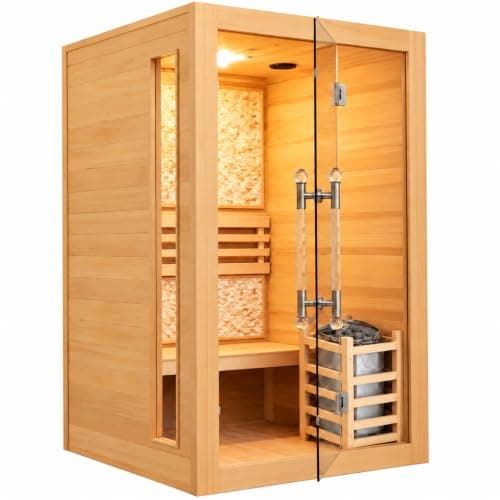
| AURGOD 2-Person Indoor (6kW Harvia) | A 51 x 41 x 75 in interior, plus a 120-195F range | Nothing on size — the most transparent listing of the three |
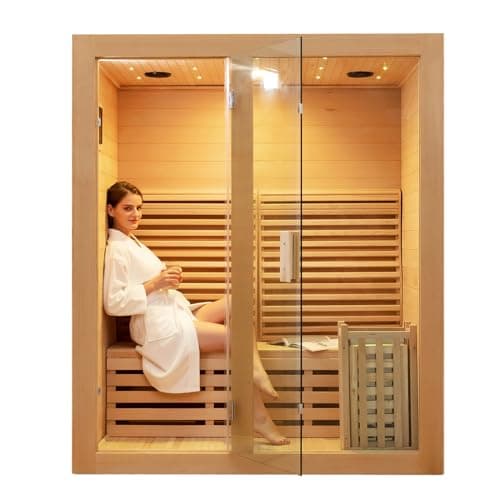
| ZONEMEL 2-Person Hemlock (3.5kW Harvia) | 2-person capacity, 3.5kW Harvia, hemlock, 240V | Bench depth and interior width — ask before you buy |
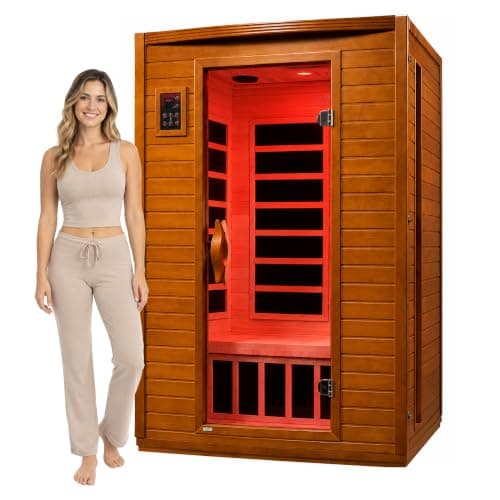
| Dynamic Andora (2-person infrared) | 2-person capacity, far infrared, 120V, red-light LEDs | Interior width and bench depth, and where the panels sit |
Two things follow. First, the AURGOD's published 51 x 41 in interior is a real 2-person room by the numbers above: 51 inches of bench wall is just over four feet, which is two adults side by side. Second, where a listing does not publish an interior figure, that is a question to ask the seller rather than an assumption to make — and a seller who will not answer it is telling you something. We treat published specs as claims throughout; see our methodology.
Three dimension mistakes worth avoiding
Buying by person count alone. "2-person" is a marketing figure, not a standard. It can mean a four-foot bench with 24 inches of depth, or two narrow perches facing each other. The person count tells you the price band; the inches tell you whether you will use it.
Forgetting the heater takes floor. A floor-standing rock stove occupies a corner of the room and needs published clearance around it, which comes out of the same footprint you were planning to sit in. Infrared cabins put the heat in the walls and give that space back, which is part of why they feel roomier at the same exterior size — see floor vs wall-mounted heaters.
Measuring the room and not the route. The cabin arrives as flat panels, and those panels have to get to the room. Stair width, the turn at the bottom, the door opening: measure all three against the carton dimensions on the listing. This is the one dimension error that cannot be fixed after delivery.
If the numbers say your space is really a one-person space, that is a perfectly good outcome — the 1-person cabins are cheaper, lighter and plug into a normal outlet. And if they say you have room for more than two, read 2-person vs 4-person before you spend the difference.