Skip to content
Sauna & Slate

HUB / INDOOR · Indoor Saunas

What a 2-Person Sauna Costs

The cabin is the part everyone compares and the smaller half of the decision. The circuit it needs is what actually separates a plug-in infrared cabin from a real rock-stove room.

By Stephen V.Reviewed How we research
#ad

We earn a commission when you buy through our Amazon links, at no extra cost to you. It never affects our rankings, and we say so when the cheaper product is the better buy. How this works.

A 2-person sauna has four costs, and they are not the four people expect: the cabin, the electrical work, the power it draws, and the accessories it needs to be usable. The cabin is the one everybody compares — and the electrical work is the one that decides your total. A plug-in infrared cabin adds nothing to the second line, because it runs on an outlet you already have. A traditional rock-stove cabin needs a 240V circuit installed, which is a contractor, a permit conversation and a number that depends entirely on your house. That single difference is why the same seating capacity can land at very different totals.

The four line items

1. The cabin or kit. This is the only line we can price for you, and we do it honestly: the live figure under each pick below comes from a daily price check with its own "as of" date, not from a number typed into this page. The band is wide — the cheapest 2-person wood cabins we track are plug-in infrared, the traditional Harvia-stove cabins cost several times as much, and cedar costs more than hemlock. What you should take from this page is the shape of the decision; take the actual dollars from the live prices.

2. The electrical work. Here is the fork in the road. An infrared cabin plugs into a standard 120V outlet, so this line is zero, which is most of the reason the category exists — see do infrared saunas need special wiring. A traditional 2-person cabin with a 3.5kW or 4.5kW stove needs a dedicated 240V circuit sized and installed to NFPA 70, which in practice means an electrician. We do not publish a dollar figure for that because it depends on your panel's spare capacity, the cable run and local permit rules, and any national average we quoted would be a guess dressed as data. Get two local quotes before you buy the cabin — our sauna electrical requirements and do you need an electrician guides tell you what to ask for.

3. The power it draws. Small and predictable, and much smaller than people fear. A 1,500W infrared cabin run for 45 minutes is a bit over a kilowatt-hour; a 3.5kW traditional stove cycling through a session is a few kilowatt-hours. At the residential rates the EIA publishes, that is cents to low dollars per session rather than anything that reshapes a power bill — the arithmetic is in home sauna running cost.

4. The accessories that make it usable. Modest but real, and routinely forgotten. A traditional sauna needs a bucket and ladle to be a sauna at all, plus a thermometer and hygrometer to know what the room is doing, and eventually replacement stones. An infrared cabin needs almost nothing. Our sauna accessories checklist is the complete list, and best sauna accessories under $50 covers most of it cheaply.

Infrared or traditional: where the money actually differs

Comparing a cabin to a cabin misses the point, so compare the whole installs.

Line itemPlug-in 2-person infrared2-person traditional (rock stove)
CabinThe cheapest 2-person wood cabins we trackSeveral times the infrared price, more again in cedar
ElectricalNone — a standard 120V outletDedicated 240V circuit, installed by an electrician
Per sessionAround a kilowatt-hourA few kilowatt-hours, stove cycling on thermostat
AccessoriesOptionalBucket, ladle, gauge, stones — not optional
What you get120-150F dry radiant heat, no steam170-190F with loyly on hot stones

That table is the whole decision. If the appeal is sweating in a warm wooden room at the lowest total cost, infrared wins on every line and it is not close. If the appeal is the Finnish thing — water on stones, a wall of steam, air hot enough to make your ears tingle — then no amount of money spent on infrared gets you there, and the honest comparison is between a traditional cabin and not having one. Our infrared vs traditional sauna page is where to settle that, and 2-person sauna dimensions is where to check the room will take either.

The short answer

Quick picks

#SaunaBest forScorePrice
01
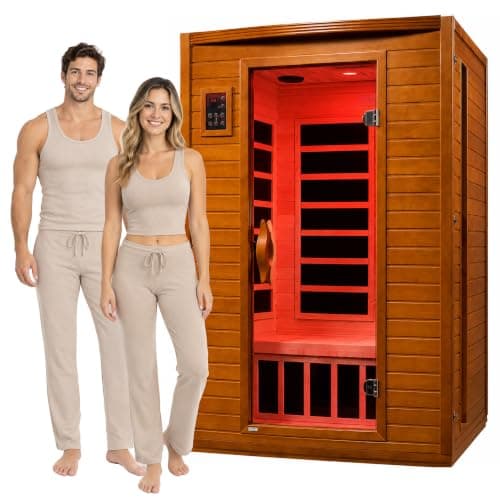
EASYHAWK EASYHAWK 2-Person Infrared Sauna (Low EMF, 1500W)
EASYHAWK 2-Person Infrared Sauna (Low EMF, 1500W)

The value pick. Six low-EMF carbon far-infrared panels and 1,500W in a 47-inch wood cabin, on a standard household plug, for well under what the established brands charge.

The best-value 2-person cabin
7.4
$1,249.99Amazon
02
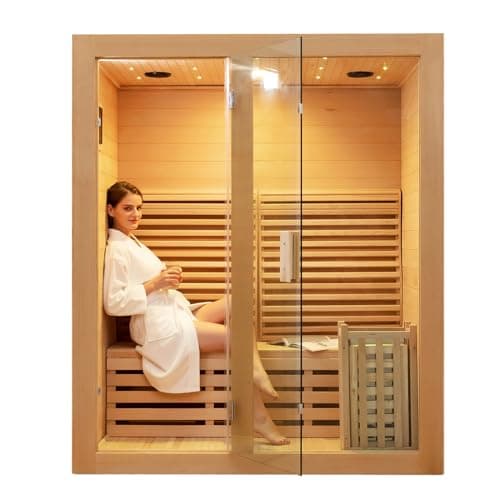
ZONEMEL ZONEMEL 2-Person Hemlock (3.5kW Harvia Stove)
ZONEMEL 2-Person Hemlock (3.5kW Harvia Stove)

The value real-loyly pick. A genuine Harvia rock stove in a compact indoor hemlock cabin — you can actually throw water and make steam.

The best value traditional indoor cabin
7.6
$3,099.99Amazon
03
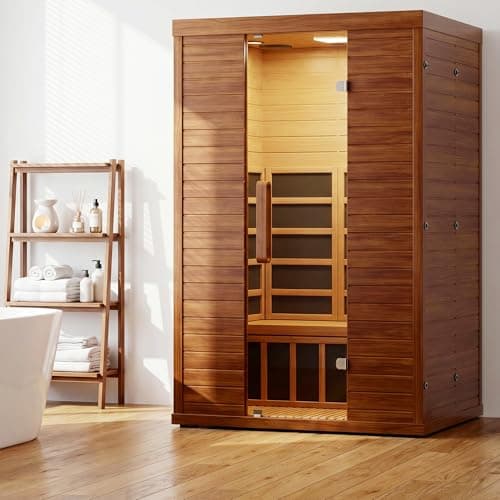
Dynamic Saunas Dynamic Andora (2-Person Low EMF FAR)
Dynamic Andora (2-Person Low EMF FAR)

The default 2-person infrared cabin. Low-EMF far-infrared heaters plus built-in red-light therapy, Canadian hemlock, and the widest support network in the category.

Most people buying their first 2-person cabin
7.8
$2,099.99Amazon
04
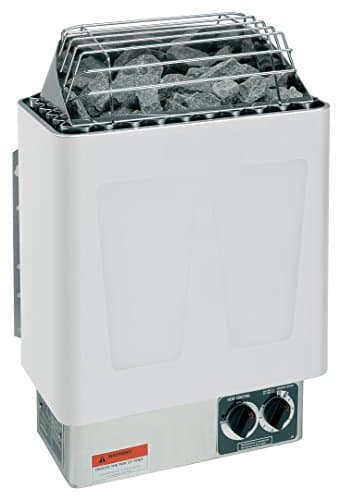
Harvia Harvia KIP 4.5kW (240V, incl. stones)
Harvia KIP 4.5kW (240V, incl. stones)

The small-room Harvia. Same benchmark stove at 4.5kW — the right size for a 2-person cabin and a lighter electrical load.

Small 2-person rooms
7.6
$1,121.00Amazon

#ad · Live prices from the Amazon Creators API, as of October 21, 2026. Where we have no verified live price, we show none — we would rather leave a gap than print a number that has rotted.

In detail

The picks, in full

01
EASYHAWK EASYHAWK 2-Person Infrared Sauna (Low EMF, 1500W)

The best-value 2-person cabin

EASYHAWK 2-Person Infrared Sauna (Low EMF, 1500W)

2-personFar infrared6 low-EMF panels1500W / 120V5-year warranty
7.4/10

The value pick. Six low-EMF carbon far-infrared panels and 1,500W in a 47-inch wood cabin, on a standard household plug, for well under what the established brands charge.

Capacity
8
Heat & comfort
7
Low-EMF
7
Build & wood
6
Value
9

Pros

  • Undercuts every other 2-person wood cabin here while still running six low-EMF carbon far-infrared panels
  • Standard 15A / 120V household plug — no electrician and no dedicated circuit, on any indoor surface including carpet
  • 5-year limited warranty, which is long cover at this price

Cons

  • The listing never names a wood species, so you cannot compare the cabin against a stated hemlock or cedar build
  • Newer brand with nothing like the parts, manuals and third-party review depth behind Dynamic or Maxxus

Don't buy this if…

…you want a named wood and a long support track record. EASYHAWK is the price play here — Dynamic and Maxxus are what you buy for the network behind the cabin.

$1,249.99View on Amazon

Price as of October 21, 2026. Prices change — Amazon's is the one that counts.

#ad · we may earn a commission from this link to EASYHAWK 2-Person Infrared Sauna (Low EMF, 1500W)

02
ZONEMEL ZONEMEL 2-Person Hemlock (3.5kW Harvia Stove)

The best value traditional indoor cabin

ZONEMEL 2-Person Hemlock (3.5kW Harvia Stove)

2-personTraditional (rock stove)3.5kW HarviaCanadian hemlock240V
7.6/10

The value real-loyly pick. A genuine Harvia rock stove in a compact indoor hemlock cabin — you can actually throw water and make steam.

Capacity
7
Heat & loyly
9
Build & wood
7
Wiring & install
6
Value
9

Pros

  • A real Harvia stove and stones — throw water for loyly, which no infrared cabin can do
  • Compact enough to fit indoors in a basement or spare room
  • Far cheaper than a premium traditional kit for a genuine steam sauna

Cons

  • Needs a 240V circuit and, realistically, an electrician
  • Traditional saunas run hot (170-190F) and need proper ventilation indoors

Don't buy this if…

…you can't add a 240V circuit or ventilate a hot room. Traditional saunas are hotter and more demanding to install than plug-in infrared.

$3,099.99View on Amazon

Price as of October 21, 2026. Prices change — Amazon's is the one that counts.

#ad · we may earn a commission from this link to ZONEMEL 2-Person Hemlock (3.5kW Harvia Stove)

03
Dynamic Saunas Dynamic Andora (2-Person Low EMF FAR)

Most people buying their first 2-person cabin

Dynamic Andora (2-Person Low EMF FAR)

2-personFar infraredRed-light therapyLow EMF (rated)120V outlet
7.8/10

The default 2-person infrared cabin. Low-EMF far-infrared heaters plus built-in red-light therapy, Canadian hemlock, and the widest support network in the category.

Capacity
8
Heat & comfort
8
Low-EMF
8
Build & wood
7
Value
8

Pros

  • Runs on a standard 120V household outlet — no electrician, no dedicated circuit
  • Dynamic/Golden Designs is the largest mid-market brand, so parts, manuals and third-party reviews are everywhere
  • Carbon far-infrared panels rated low-EMF, plus red-light therapy LEDs built in

Cons

  • The heaters are far-infrared, not full-spectrum — no near- or mid-infrared HEAT like the pricier Maxxus models
  • Hemlock is the budget-to-mid wood; it lacks cedar's natural aroma and rot resistance

Don't buy this if…

…you want full-spectrum infrared HEAT (near, mid and far). The Andora's heating is far-infrared with red-light LEDs — step up to the full-spectrum Maxxus if near-infrared heat is the point.

$2,099.99View on Amazon

$2,399.9913% off

Price as of October 21, 2026. Prices change — Amazon's is the one that counts.

#ad · we may earn a commission from this link to Dynamic Andora (2-Person Low EMF FAR)

04
Harvia Harvia KIP 4.5kW (240V, incl. stones)

Small 2-person rooms

Harvia KIP 4.5kW (240V, incl. stones)

4.5kW240V single-phaseBuilt-in controlsStones included~200-250 cu ft
7.6/10

The small-room Harvia. Same benchmark stove at 4.5kW — the right size for a 2-person cabin and a lighter electrical load.

Heat output
7
Build
9
Controls
7
Install
8
Value
7

Pros

  • Harvia quality sized correctly for a small sauna — no overkill
  • 4.5kW draws less than the 8kW, so a lighter 240V circuit works
  • Stones included

Cons

  • Too small for a large room — don't undersize your heater
  • Premium price for the kW versus budget brands

Don't buy this if…

…your sauna is larger than about 250 cubic feet. An undersized heater never reaches temperature — use the sizing guide first.

$1,121.00View on Amazon

Price as of October 21, 2026. Prices change — Amazon's is the one that counts.

#ad · we may earn a commission from this link to Harvia KIP 4.5kW (240V, incl. stones)

The costs people miss

  • Panel capacity, not just the circuit. If your service panel has no spare 240V-capable slots, the quote stops being about a circuit and starts being about a subpanel. This is the single biggest swing factor in a traditional install, and it is knowable in ten minutes — look at your panel before you shop.
  • The floor. A cabin needs a flat, dry, non-combustible-enough surface, and in a basement that can mean addressing moisture first. Our indoor sauna flooring guide covers what is actually required versus what gets oversold.
  • Ventilation. Usually cheap, occasionally not. A hot, humid box in an interior room with no airflow is the one configuration that creates problems later — sauna ventilation.
  • Delivery and getting it inside. Cabins arrive as heavy flat panels on a pallet, kerbside. Factor in two people and a measured route; this is free if you plan it and expensive if you do not.
  • Replacement parts over time. Stones need replacing periodically in a traditional sauna; controllers and panels are the failure points in an infrared one. Neither is large, but a cabin from a brand with no parts network can become unrepairable, which is the most expensive outcome of all. See how often to replace sauna rocks and sauna warranty guide.

Where to spend and where not to

Worth paying for: the right heater size for your room volume, because an undersized stove never settles at temperature and an oversized one fights its thermostat — the Harvia range publishes room-volume ratings and our heater size guide converts them. Also worth paying for: a real warranty, and cedar if the cabin lives somewhere humid.

Not worth paying for: full-spectrum infrared you will not use, chromotherapy lighting, and sound systems you would rather replace with your own speaker. On the traditional side, the premium kit brands sell a better-finished room than the Amazon factory cabins, but the stove inside is often the same Harvia — which is why a ZONEMEL cabin with a genuine 3.5kW Harvia is such good value, and why the Harvia KIP 4.5kW is on this page as a standalone: if you are building the room yourself, the stove is the part to buy properly.

The cheapest route to a real sauna is worth stating since this is a cost page: a plug-in 2-person infrared cabin, bought on a sale, with no accessories. The cheapest route to a real Finnish sauna is a hemlock cabin with a genuine 3.5kW Harvia and a single 240V circuit — the cedar, the WiFi controller and the 6kW stove are all upgrades you can decline. Our best indoor saunas under $4,000 page is the practical version of that, and how much does a home sauna cost widens the question to every size.

Is it worth it at two seats?

Two seats is the sweet spot of the whole category, and the cost structure is why. A two-person cabin fits rooms a three-person cabin does not, runs on a lighter circuit than a 6kW room, heats up faster, and still seats the number of people who use a home sauna on a typical evening. Stepping up a size costs more on every one of the four lines above, and stepping down to one seat saves surprisingly little — which is the same conclusion our 2-person vs 4-person sauna comparison reaches from the other direction.

If the total still looks high, the two honest alternatives are a portable tent or a sauna blanket, both of which cost a fraction of a cabin and will tell you within a month whether this is a habit worth building a room for. Spending a little to find out is a better plan than spending a lot to be sure — is a home sauna worth it takes that question seriously.
How we picked

We do not run a testing lab

We researched published manufacturer specifications, listing data and aggregated owner reviews, then scored each product against a published rubric. The scores are judgments from documented research — they are not measurements we took, because we don't have a lab and we're not going to pretend we do. Prices come live from the Amazon Creators API; where a spec came from a manufacturer we say so and link it in Sources.

Questions

Frequently asked

How much does a 2-person sauna cost?
It depends far more on the heat type than the brand. A plug-in 2-person infrared cabin is the cheapest route and adds nothing for wiring; a traditional 2-person cabin with a Harvia rock stove costs several times more and needs a dedicated 240V circuit installed on top. The live prices on this page are checked daily — use those rather than any figure written into the text.
Does a 2-person sauna need expensive wiring?
Infrared: no, it runs on a normal 120V outlet. Traditional: yes, a dedicated 240V circuit sized to the stove and installed to code. The cost of that work depends on your panel's spare capacity, the cable run and local permits, so get two local quotes before you buy the cabin — it can be the largest single line item.
How much does it cost to run a 2-person sauna?
Cents to low dollars per session. A 1,500W infrared cabin uses around a kilowatt-hour in 45 minutes; a 3.5kW traditional stove uses a few kilowatt-hours per session because it cycles on its thermostat rather than drawing full power throughout. Neither reshapes a household power bill.
What is the cheapest 2-person sauna?
A plug-in infrared wood cabin — that is the lowest total cost of ownership at two seats, because there is no electrical work in the price. The cheapest route to a traditional 2-person sauna is a hemlock cabin with a genuine 3.5kW Harvia stove on a single 240V circuit, declining the cedar and the WiFi upgrades.
What hidden costs come with a home sauna?
A subpanel if your service panel has no spare capacity, floor preparation in a damp basement, ventilation if the room has none, and the accessories a traditional sauna needs to function — a bucket, ladle and gauge. Replacement stones and, eventually, controllers or panels are the long-run items.
Is a 2-person sauna cheaper than a 3-person?
Yes, on every line. The cabin costs less, the room volume is about half so the stove drops from 6kW to 3.5-4.5kW and the circuit gets lighter, the heat-up is quicker and the per-session draw is lower. Two seats is the size most households should buy for that reason alone.

Keep reading

More in Indoor Saunas

All indoor saunas →

Receipts

Sources

We do not run a testing lab, and we do not pretend to. Product specs are transcribed from the manufacturer's own listing and cited as claims; health figures come from peer-reviewed studies, named and linked. Where we could not verify something, we say so on the page rather than quietly leaving it out. Read our full method.