Skip to content
Sauna & Slate

HUB / GUIDES · Sauna Guides

Sauna With Red Light Therapy

Three completely different things are sold as red light in a sauna, and two of them are not red light therapy. Here is how to tell which one a listing is offering before you pay for it.

By Stephen V.Reviewed How we research

If you want genuine red light therapy in a sauna, the spec to demand is a published wavelength pair and an irradiance figure — something like 660 nm red plus 850 nm near-infrared at a stated mW/cm2. Almost no sauna listing publishes both, which is the single most useful fact on this page. Most cabins advertising "red light" are offering chromotherapy: coloured LED mood lighting at an intensity nowhere near therapeutic. That is not a scandal — it is pleasant, and it is cheap — but it is not the thing the term describes, and you should not pay a therapy premium for it.

Informational only, not medical advice. Red and near-infrared light therapy is an active research area with genuinely mixed evidence, and nothing here is a treatment claim. We do not run a lab and we do not test irradiance. If you are considering light therapy for a medical condition, that is a conversation with a clinician. Our sauna safety guide covers who should be cautious about heat exposure generally.

The three things sold as "red light" in a sauna

1. Chromotherapy. A low-power RGB LED strip or spotlight that can be set to red, blue, green and so on. It is in a large share of infrared cabins, it is usually described as "chromotherapy" or "colour therapy" in the specifications and as "red light" in the marketing, and it produces a coloured glow rather than a therapeutic dose. No wavelength and no irradiance figure will be published, because there is nothing flattering to publish. Enjoy it as lighting — our sauna lighting guide covers that side — but do not count it as therapy.

2. A real red / near-infrared LED panel. Purpose-built photobiomodulation hardware: banks of LEDs at specific wavelengths, usually around 660 nm (visible deep red) and 850 nm (near-infrared, invisible), with a published irradiance at a stated distance. This is what the term means in the research literature. In the home-sauna market it appears either as a standalone panel you hang or stand in front of, or as an integrated option on a handful of units.

3. Near-infrared heat from a full-spectrum heater. Full-spectrum infrared cabins add near- and mid-infrared emitters to the far-infrared panels that do the heating. Near-infrared overlaps the wavelength region red-light devices use, which is why full-spectrum cabins get marketed with skin and recovery language. The distinction that matters: these emitters are built to deliver heat across a broad band, not to deliver a controlled dose at a specific wavelength. It is a real difference from far-infrared-only, and it is not the same thing as a 660/850 panel. Our full spectrum vs far infrared page is the detail, and infrared sauna vs red light therapy compares the two categories head on.

How to read a listing in ninety seconds

What the listing saysWhat it almost certainly isWhat to ask for
"Chromotherapy lighting" or "7 colour LED"Mood lightingNothing — price it as lighting
"Red light therapy" with no numbersUsually chromotherapy, occasionally a weak panelWavelength in nm and irradiance in mW/cm2
"660 nm + 850 nm" with an irradiance figureA real red/NIR panelDistance the irradiance is measured at, and coverage area
"Full spectrum" / "near infrared heaters"A broad-band heater, not a dosed panelWhich bands, and the electrical requirement

The three units below are the ones in our registry that sit in different boxes on that table, and we have placed them deliberately: one has built-in red-light LEDs alongside its far-infrared heating, one publishes an actual wavelength pair and irradiance figure, and one is a full-spectrum cabin whose near-infrared is heat rather than a dose. None of them is a medical device, and we make no treatment claim for any of them.

The short answer

Quick picks

#SaunaBest forScorePrice
01
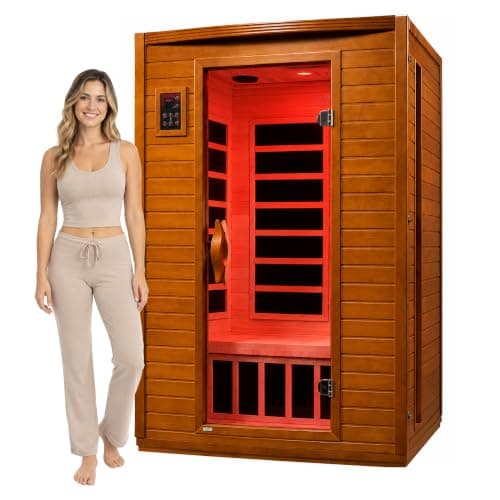
Dynamic Saunas Dynamic Andora (2-Person Low EMF FAR)
Dynamic Andora (2-Person Low EMF FAR)

The default 2-person infrared cabin. Low-EMF far-infrared heaters plus built-in red-light therapy, Canadian hemlock, and the widest support network in the category.

Most people buying their first 2-person cabin
7.8
$2,399.99Amazon
02
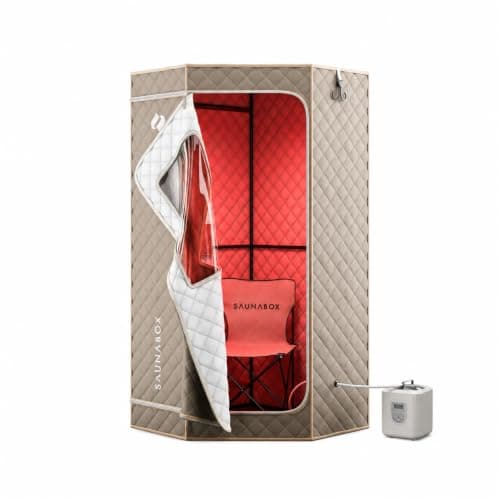
SAUNABOX SAUNABOX SmartSteam Pro with Red-Light Therapy
SAUNABOX SmartSteam Pro with Red-Light Therapy

The same 1,600 W steam tent with an IP65 red-light panel added — 660 nm red and 850 nm near-infrared, rated at 80.43 mW/cm2 at the surface.

Adding red light without a second device
8.2
$399.00Amazon
03
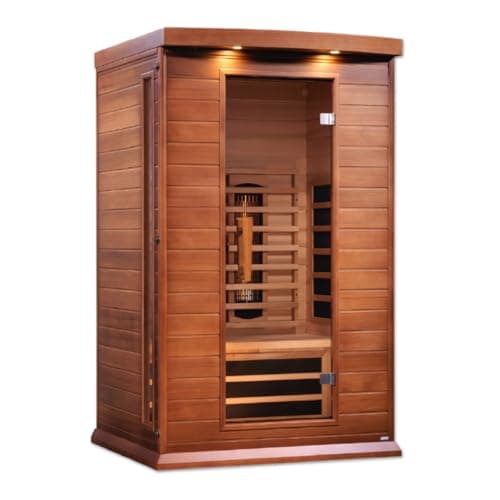
Maxxus Maxxus MX-M206-01 Full Spectrum (Red Cedar)
Maxxus MX-M206-01 Full Spectrum (Red Cedar)

The full-spectrum, red-cedar upgrade. Near-, mid- and far-infrared plus real cedar — the model to buy if far-infrared alone isn't the goal.

Buyers who want full-spectrum + cedar
8.2
$4,299.00Amazon

#ad · Live prices from the Amazon Creators API, as of October 4, 2026. Where we have no verified live price, we show none — we would rather leave a gap than print a number that has rotted.

In detail

The picks, in full

01
Dynamic Saunas Dynamic Andora (2-Person Low EMF FAR)

Most people buying their first 2-person cabin

Dynamic Andora (2-Person Low EMF FAR)

2-personFar infraredRed-light therapyLow EMF (rated)120V outlet
7.8/10

The default 2-person infrared cabin. Low-EMF far-infrared heaters plus built-in red-light therapy, Canadian hemlock, and the widest support network in the category.

Capacity
8
Heat & comfort
8
Low-EMF
8
Build & wood
7
Value
8

Pros

  • Runs on a standard 120V household outlet — no electrician, no dedicated circuit
  • Dynamic/Golden Designs is the largest mid-market brand, so parts, manuals and third-party reviews are everywhere
  • Carbon far-infrared panels rated low-EMF, plus red-light therapy LEDs built in

Cons

  • The heaters are far-infrared, not full-spectrum — no near- or mid-infrared HEAT like the pricier Maxxus models
  • Hemlock is the budget-to-mid wood; it lacks cedar's natural aroma and rot resistance

Don't buy this if…

…you want full-spectrum infrared HEAT (near, mid and far). The Andora's heating is far-infrared with red-light LEDs — step up to the full-spectrum Maxxus if near-infrared heat is the point.

$2,399.99View on Amazon

Price as of October 4, 2026. Prices change — Amazon's is the one that counts.

#ad · we may earn a commission from this link to Dynamic Andora (2-Person Low EMF FAR)

02
SAUNABOX SAUNABOX SmartSteam Pro with Red-Light Therapy

Adding red light without a second device

SAUNABOX SmartSteam Pro with Red-Light Therapy

1,600 W / 110V660 nm + 850 nm80.43 mW/cm2 at surfaceIP65 rated panel130-140F, 7 heat levels
8.2/10

The same 1,600 W steam tent with an IP65 red-light panel added — 660 nm red and 850 nm near-infrared, rated at 80.43 mW/cm2 at the surface.

Heat & humidity
8
Fit & comfort
9
Setup & storage
9
Build & materials
8
Value
7

Pros

  • The brand publishes an irradiance figure and a wavelength pair, which is more than most red-light add-ons disclose — you can at least compare it against a standalone panel
  • IP65 on the panel is the spec that matters in a tent running at high humidity; an unrated LED array in there is a warranty claim waiting to happen
  • Everything else is the Kit Pro — same stainless chamber, same 3.6 L reservoir, same fiberglass frame and insulated cover, so you are not trading away the steam to get the light

Cons

  • It costs meaningfully more than the plain Kit Pro and the steam performance is identical — you are paying purely for the light
  • A tent-mounted panel irradiates whatever it is pointed at, which in a seated 35in x 35in footprint is a partial-body dose, not the full-body coverage a large standalone panel gives

Don't buy this if…

…you already own a red-light panel, or red light is not something you would have bought on its own. The plain Kit Pro delivers the identical steam session for less.

$399.00View on Amazon

Price as of October 4, 2026. Prices change — Amazon's is the one that counts.

#ad · we may earn a commission from this link to SAUNABOX SmartSteam Pro with Red-Light Therapy

03
Maxxus Maxxus MX-M206-01 Full Spectrum (Red Cedar)

Buyers who want full-spectrum + cedar

Maxxus MX-M206-01 Full Spectrum (Red Cedar)

2-personFull spectrum (near/mid/far)Red cedarLow EMF (rated)240V
8.2/10

The full-spectrum, red-cedar upgrade. Near-, mid- and far-infrared plus real cedar — the model to buy if far-infrared alone isn't the goal.

Capacity
8
Heat & comfort
9
Low-EMF
8
Build & wood
9
Value
7

Pros

  • Full-spectrum heaters add near-infrared, the band associated with red-light/skin claims — the far-infrared-only cabins can't do this
  • Red cedar is the premium sauna wood: aromatic, naturally rot-resistant, and it looks the part
  • Same well-supported Golden Designs platform

Cons

  • Full-spectrum heaters typically need a 240V dedicated circuit — check before you buy, this can mean an electrician
  • Meaningfully more expensive than the far-infrared Andora/Seattle

Don't buy this if…

…you only have a standard outlet and don't want to add a 240V circuit. Full-spectrum cabins draw more — a far-infrared model plugs into the wall you already have.

$4,299.00View on Amazon

Price as of October 4, 2026. Prices change — Amazon's is the one that counts.

#ad · we may earn a commission from this link to Maxxus MX-M206-01 Full Spectrum (Red Cedar)

What a published figure actually tells you

The SAUNABOX red-light tent is worth a paragraph purely as an example of disclosure. The brand publishes 660 nm and 850 nm as its wavelengths and 80.43 mW/cm2 at the panel surface as its irradiance, and rates the panel IP65 for humidity. You can argue with any of those numbers, but you can argue with them — which is more than you can do with "red light therapy included".

Two caveats to read alongside any irradiance figure. First, "at the surface" is the most flattering place to measure; irradiance falls off with distance, so a number at the panel face tells you little about what reaches you sitting back from it. Ask at what distance. Second, coverage matters as much as intensity: a panel aimed at a seated torso in a 35-inch-square tent is a partial-body exposure, not a full-body one.

On the heat side, the IP65 rating is the genuinely important spec for a humid environment. An unrated LED array inside a steam tent or a sauna is a failure waiting to happen, and it is the reason most reputable sauna makers keep real light panels out of the hot, wet zone entirely.

The cheaper and usually better approach

If red light matters to you and the sauna matters to you, consider buying them separately. A standalone panel gives you a larger emitting area, a published irradiance, a usable distance, and the ability to use it on days you do not feel like a sauna — and the sauna you buy can then be chosen on heat, wood and electrics rather than on a lighting option. An integrated unit is tidier and costs less than two devices, but you are accepting whatever panel the sauna maker chose, permanently, inside a hot wet box.

That said, there is an honest case for integration: the habit. A panel in a cupboard gets used for three weeks. A panel in the sauna you already sit in four times a week gets used four times a week. If that is the difference for you, it is a legitimate reason to pay the premium — and the Dynamic Andora is the example of an infrared cabin that bundles red-light LEDs in at a mainstream price rather than as a luxury add-on.

What we would not do is pay a large premium for "full spectrum" purely to get near-infrared as a light therapy. Full-spectrum cabins are worth their money for the heat quality — and they typically need a 240V circuit for it, which is a real cost, so read do infrared saunas need special wiring before you commit. The light-therapy framing is marketing laid over a heater.

And a word on EMF, since it always comes up

Cabins that advertise light therapy tend to also advertise low EMF, and the two claims get tangled together. EMF in this category refers to the magnetic fields near heating elements, which is a separate question from light wavelengths entirely. The NIEHS summary of the research is the sober starting point, and our EMF explained page covers what the ratings on these listings do and do not mean. A cabin with a published low-EMF rating and chromotherapy lighting is still a cabin with chromotherapy lighting.

For the broader health evidence on heat exposure itself — which is far better established than the light claims — the Mayo Clinic Proceedings review and the Finnish cohort work are the two documents worth reading, and our sauna benefits page summarises them.
How we picked

We do not run a testing lab

We researched published manufacturer specifications, listing data and aggregated owner reviews, then scored each product against a published rubric. The scores are judgments from documented research — they are not measurements we took, because we don't have a lab and we're not going to pretend we do. Prices come live from the Amazon Creators API; where a spec came from a manufacturer we say so and link it in Sources.

Questions

Frequently asked

Is red light therapy in a sauna real?
It can be, but most of what is sold under that name is chromotherapy — low-power coloured mood lighting at an intensity nowhere near therapeutic. A real red-light setup publishes a wavelength pair (typically around 660 nm and 850 nm) and an irradiance figure in mW/cm2. If a listing publishes neither, assume it is lighting and price it accordingly.
What is the difference between chromotherapy and red light therapy?
Chromotherapy is coloured LED lighting intended to affect mood and ambience; it is typically an RGB strip or spotlight with no published wavelength or intensity. Red light therapy (photobiomodulation) uses specific wavelengths at a measured irradiance for a controlled dose. The hardware, the cost and the claims are different, and sauna marketing routinely blurs them.
Is near-infrared in a full-spectrum sauna the same as red light therapy?
No, although the wavelength regions overlap. A full-spectrum sauna uses near-, mid- and far-infrared emitters designed to deliver heat across a broad band; a red-light panel delivers a controlled dose at specific wavelengths. Full-spectrum cabins are worth buying for heat quality, not as a substitute for a dosed panel.
Should I buy a sauna with red light built in, or a separate panel?
Separately is usually the better hardware: a standalone panel gives you a larger emitting area, a published irradiance at a usable distance, and use on non-sauna days, while letting you choose the sauna on heat and electrics. Integration wins on one axis that matters more than it sounds — the habit. A panel inside a sauna you already use regularly gets used regularly.
What irradiance should a red light panel have?
There is no single agreed figure, and we will not invent one. What matters is that the maker publishes an irradiance in mW/cm2 and the distance it was measured at — surface readings are the most flattering — plus the coverage area. In a humid sauna or steam tent, also check for an ingress-protection rating such as IP65; an unrated LED array in high humidity will not last.
Is it safe to put a light panel inside a sauna?
Only if it is rated for it. Heat and near-total humidity are hostile to electronics, which is why reputable makers either keep panels out of the hot zone or publish an IP rating for them. Retrofit a consumer panel into a sauna and you are outside both products' design envelopes, and almost certainly outside their warranties.

Keep reading

More in Sauna Guides

All sauna guides →

Receipts

Sources

We do not run a testing lab, and we do not pretend to. Product specs are transcribed from the manufacturer's own listing and cited as claims; health figures come from peer-reviewed studies, named and linked. Where we could not verify something, we say so on the page rather than quietly leaving it out. Read our full method.