HUB / INDOOR · Indoor Saunas
Sauna Lighting Guide
Sauna lighting is a safety choice before it's an aesthetic one. Here's why ordinary household fixtures don't belong in a hot, wet room, what rated lighting looks like, and how a warm, indirect glow gets built in.
We earn a commission when you buy through our Amazon links, at no extra cost to you. It never affects our rankings, and we say so when the cheaper product is the better buy. How this works.
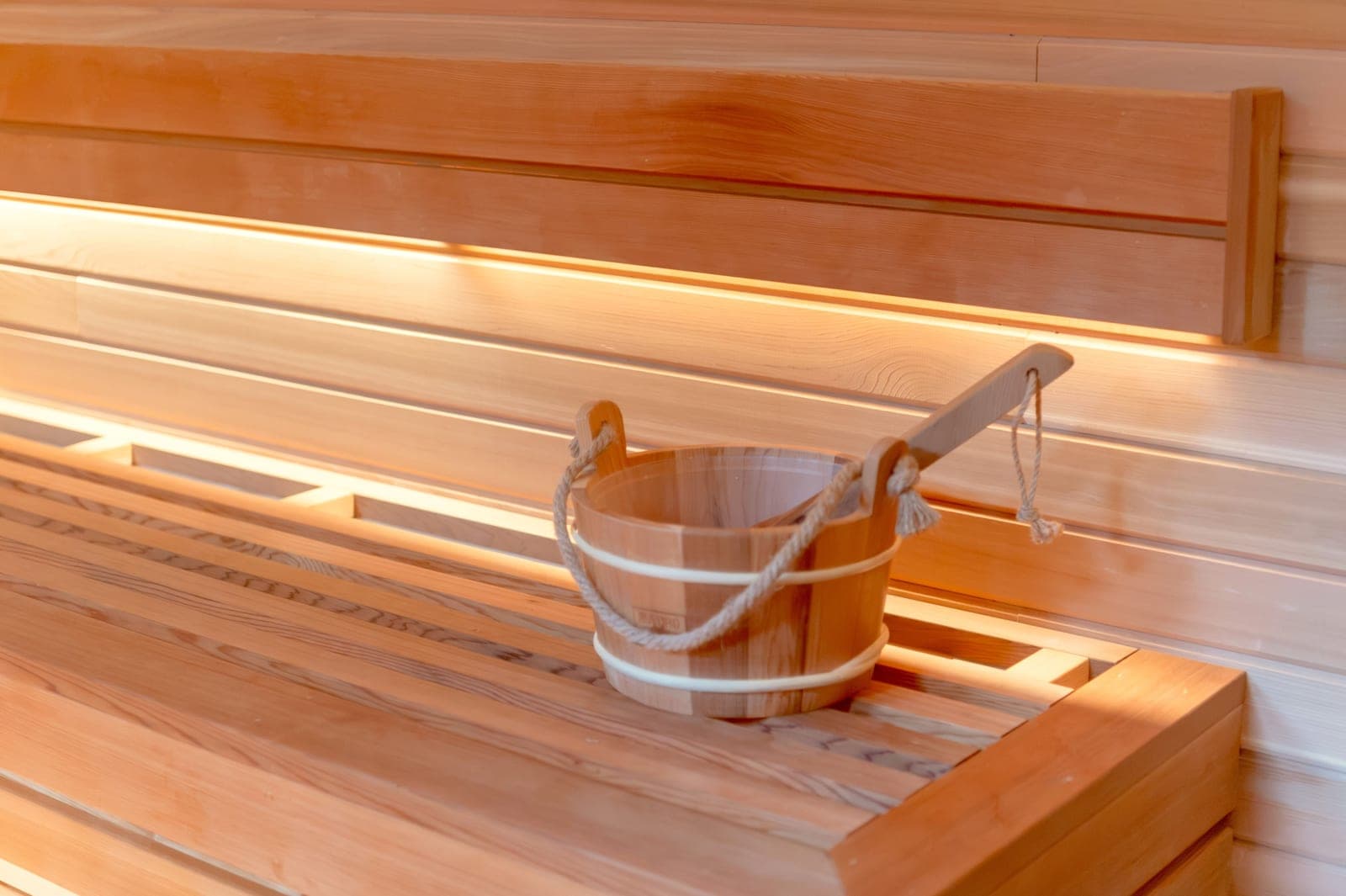
Sauna lighting has to clear a safety bar first and an atmosphere bar second. Any fixture in the hot zone must be specifically rated for high heat and humidity — a sauna-rated, sealed, IP-rated fitting — because standard household fixtures aren't built for it. The look you're after is warm, dim and indirect: light tucked behind a backrest or under a bench shield so you see a soft glow, not a bare bulb. And all of the wiring is work for a licensed electrician. It's tempting to treat sauna lighting as a finishing touch, but the fixture is sitting in an environment that would destroy an ordinary lamp — and it's wired into a wet, hot room, which is exactly where electrical shortcuts are most dangerous. Get the safety right and the mood follows naturally.
Rated for heat and humidity — always
The single most important rule: every fixture inside the hot room must be rated for the sauna environment. That means a fitting designed to take sustained high heat and high humidity — typically a sealed, heat-resistant, IP-rated sauna light with a proper gasket and a heat-tolerant lens. A normal household fixture is not built for this. Its plastic parts can soften or discolor, its seals aren't made for repeated humidity, and its wiring insulation isn't rated for the temperature — which in a wet room is a genuine hazard, not just a durability problem. Buy a fitting that explicitly says it's for saunas, and follow the manufacturer's maximum bulb wattage, because an over-wattage bulb defeats the rating.
Warm, dim and indirect
A sauna is a place to wind down, and harsh overhead light kills that instantly. The convention is a warm color temperature, kept dim, and aimed indirectly. The most effective trick is to hide the source: mount the fixture behind the upper backrest, under a bench, or behind a small wooden light shield, so what you see is a soft wash of light on the wood rather than the bulb itself. That does two things — it removes glare from the eyes of someone lying on the upper bench looking up, and it makes the timber grain glow, which is most of the atmosphere. A single well-placed indirect fitting usually beats several bright ones. Dimmable is a bonus if the rated fixture supports it. This quiet, low glow pairs with the other detail that sets a sauna's mood — the door — covered in sauna doors explained.
Low-voltage options
A common and sensible approach is low-voltage lighting — for example a low-voltage LED strip or fitting run from a transformer mounted outsidethe hot room. This keeps only a low-voltage circuit inside the sauna and puts the transformer and the mains side out in the cooler space, away from the heat. Low-voltage LED also runs cool and sips power, which suits a fixture that's on for a long, warm session. Whatever you choose, it still has to be a sauna-appropriate, heat-rated setup — low voltage doesn't exempt a fitting from needing to tolerate the environment — and it still needs installing correctly.
Keep the wiring out of the hot zone
Beyond the visible fixture, the wiring itself should be routed to stay out of the hottest part of the room wherever the design allows, and any transformer, driver or switch belongs outsidethe sauna, in the adjacent cooler space. Switches and controls are not mounted inside a hot, wet cabin. This is part of planning the room as a whole — where the barrier, the vent openings and the light penetrations all get sealed — which is why lighting is folded into the build sequence in how to install a home saunarather than bolted on at the end. Any hole for a light also has to be sealed back to the vapor barrier so it doesn't become a moisture path.
Leave the electrical work to a licensed electrician
This is the firm line. Combining electricity with a hot, wet room is exactly the situation electrical codes exist to govern, so the wiring — the circuit, the transformer, the connections — is work for a licensed electrician, done to the National Electrical Code and, in most places, permitted and inspected. Buying a rated fixture is the part you can do yourself; wiring it in is not. This matters even more when the heater is in the picture, since that's a 240V appliance on its own dedicated circuit. Choose the fixtures, plan where the light should fall, and let the pro make it live.
The short version
Use fixtures rated for sauna heat and humidity, keep the light warm, dim and indirect by hiding the source behind a backrest or bench, consider a low-voltage setup with the transformer outside the room, keep switches and drivers out of the hot zone, and have a licensed electrician do the wiring. That's a sauna that looks inviting and is safe to sit in — the basics of the room itself, like airflow, are covered in sauna ventilation.
Questions
Frequently asked
Can you use a normal light fixture in a sauna?
What kind of lighting is best in a sauna?
Is low-voltage lighting good for a sauna?
Do you need an electrician to wire sauna lighting?
Keep reading
Related
More in Indoor Saunas
Receipts
Sources
We do not run a testing lab, and we do not pretend to. Product specs are transcribed from the manufacturer's own listing and cited as claims; health figures come from peer-reviewed studies, named and linked. Where we could not verify something, we say so on the page rather than quietly leaving it out. Read our full method.