Buy the Dynamic Andora. It is the one two-person cabin here that ships red-light therapy LEDs as a named feature alongside its low-EMF far-infrared heaters, it runs on a standard 120V outlet, and it is for the person who wants the heat and the light in one appliance without adding a circuit. If what you actually want is near-infrared heat rather than a light panel, the full-spectrum Maxxus MX-M206-01 is the honest answer, and the reason is physics rather than marketing. And if you want a published wavelength and a published irradiance figure — the two numbers that make a red-light claim checkable — the only product on this page that gives you both is the SAUNABOX SmartSteam Pro, which is a steam tent rather than a cabin.
Three different things are being sold here
This is the corner of the category where listings are loosest, so sort the claim before you compare the prices. "Red light" in a sauna listing means one of three things, and they are not interchangeable.
- A red-light therapy LED array. Discrete diodes aimed at your body, intended to deliver light at a specific wavelength. This is what people mean by red light therapy. The specs that make it real are a published wavelength pair — typically a red band near 660 nm and a near-infrared band near 850 nm — and an irradiance figure in mW/cm2 at a stated distance.
- Chromotherapy, or "color light therapy". A multi-color LED that cycles through a palette, usually from the ceiling. It is mood lighting with a wellness name. There is no wavelength, no irradiance and no dose in any listing we have read, and a diode you cannot characterize cannot be compared against one you can.
- Full-spectrum infrared heating. Not a light panel at all: heaters that emit in the near-, mid- and far-infrared bands rather than far-infrared alone. The near band overlaps the wavelengths used in red-light work, which is why full-spectrum cabins get discussed in the same breath — but it arrives as heat from a heater, not as a dose from a panel.
Our sauna with red light therapy guide walks through what each of those is claimed to do and where the evidence stops; infrared sauna vs red light therapy is the version for someone deciding between a sauna and a standalone panel. This page is the shopping decision: which product to buy, and what each one really includes.
How the four compare
Every figure below is what the maker publishes. We did not measure a diode, an irradiance or a temperature — our methodology says so in those words — and the "not published" cells say that because the listing does not publish the number, which is itself the most useful thing on this table.
| Pick | Light type | Wavelengths published | Irradiance published | Who it is for |
|---|
| Dynamic Andora | Red-light therapy LEDs, built in | Not published | Not published | Two people who want heat and light in one plug-in cabin |
| Maxxus MX-M206-01 | Full-spectrum heaters (near/mid/far) | Band, not wavelength | Not published | Near-infrared as heat, in red cedar, if a 240V circuit is available |
| SAUNABOX SmartSteam Pro | IP65 red-light panel in a steam tent | 660 nm + 850 nm | 80.43 mW/cm2 at the surface | Anyone who wants a checkable red-light dose with their sweat |
| Albott 1-Person | Seven-color chromotherapy | Not published | Not published | One person buying the cabin, treating the color LEDs as mood lighting |
Read that irradiance column twice, because it is the whole argument of this page. The SAUNABOX is the only product here that tells you how much light lands on your skin, and the only one that tells you at what distance. Everything else asks you to take "red light therapy" on trust. That does not make the cabins bad — the Andora is still the default two-person infrared cabin on this site — it means you should buy them for the cabin and treat the light as a bonus you cannot audit.
The short answer
Quick picks
#ad · Live prices from the Amazon Creators API, as of October 21, 2026. Where we have no verified live price, we show none — we would rather leave a gap than print a number that has rotted.
In detail
The picks, in full
Most people buying their first 2-person cabin
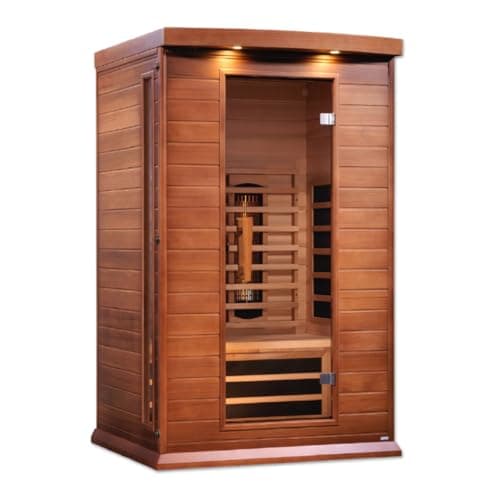
Dynamic Andora (2-Person Low EMF FAR)
2-personFar infraredRed-light therapyLow EMF (rated)120V outlet
The default 2-person infrared cabin. Low-EMF far-infrared heaters plus built-in red-light therapy, Canadian hemlock, and the widest support network in the category.
- Capacity
- 8
- Heat & comfort
- 8
- Low-EMF
- 8
- Build & wood
- 7
- Value
- 8
Pros
- +Runs on a standard 120V household outlet — no electrician, no dedicated circuit
- +Dynamic/Golden Designs is the largest mid-market brand, so parts, manuals and third-party reviews are everywhere
- +Carbon far-infrared panels rated low-EMF, plus red-light therapy LEDs built in
Cons
- −The heaters are far-infrared, not full-spectrum — no near- or mid-infrared HEAT like the pricier Maxxus models
- −Hemlock is the budget-to-mid wood; it lacks cedar's natural aroma and rot resistance
Don't buy this if…
…you want full-spectrum infrared HEAT (near, mid and far). The Andora's heating is far-infrared with red-light LEDs — step up to the full-spectrum Maxxus if near-infrared heat is the point.
Buyers who want full-spectrum + cedar
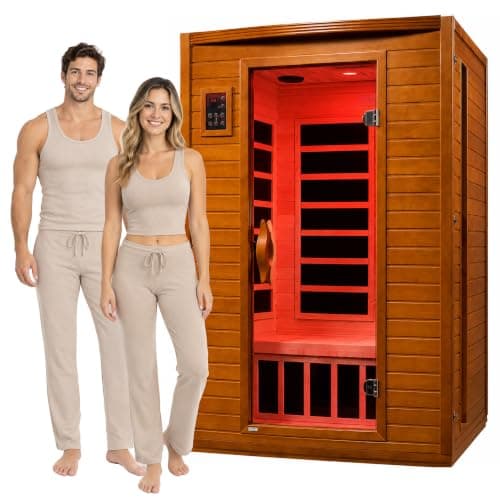
Maxxus MX-M206-01 Full Spectrum (Red Cedar)
2-personFull spectrum (near/mid/far)Red cedarLow EMF (rated)240V
The full-spectrum, red-cedar upgrade. Near-, mid- and far-infrared plus real cedar — the model to buy if far-infrared alone isn't the goal.
- Capacity
- 8
- Heat & comfort
- 9
- Low-EMF
- 8
- Build & wood
- 9
- Value
- 7
Pros
- +Full-spectrum heaters add near-infrared, the band associated with red-light/skin claims — the far-infrared-only cabins can't do this
- +Red cedar is the premium sauna wood: aromatic, naturally rot-resistant, and it looks the part
- +Same well-supported Golden Designs platform
Cons
- −Full-spectrum heaters typically need a 240V dedicated circuit — check before you buy, this can mean an electrician
- −Meaningfully more expensive than the far-infrared Andora/Seattle
Don't buy this if…
…you only have a standard outlet and don't want to add a 240V circuit. Full-spectrum cabins draw more — a far-infrared model plugs into the wall you already have.
Adding red light without a second device
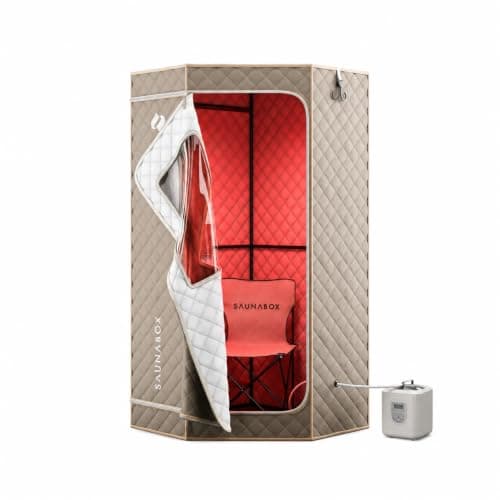
SAUNABOX SmartSteam Pro with Red-Light Therapy
1,600 W / 110V660 nm + 850 nm80.43 mW/cm2 at surfaceIP65 rated panel130-140F, 7 heat levels
The same 1,600 W steam tent with an IP65 red-light panel added — 660 nm red and 850 nm near-infrared, rated at 80.43 mW/cm2 at the surface.
- Heat & humidity
- 8
- Fit & comfort
- 9
- Setup & storage
- 9
- Build & materials
- 8
- Value
- 7
Pros
- +The brand publishes an irradiance figure and a wavelength pair, which is more than most red-light add-ons disclose — you can at least compare it against a standalone panel
- +IP65 on the panel is the spec that matters in a tent running at high humidity; an unrated LED array in there is a warranty claim waiting to happen
- +Everything else is the Kit Pro — same stainless chamber, same 3.6 L reservoir, same fiberglass frame and insulated cover, so you are not trading away the steam to get the light
Cons
- −It costs meaningfully more than the plain Kit Pro and the steam performance is identical — you are paying purely for the light
- −A tent-mounted panel irradiates whatever it is pointed at, which in a seated 35in x 35in footprint is a partial-body dose, not the full-body coverage a large standalone panel gives
Don't buy this if…
…you already own a red-light panel, or red light is not something you would have bought on its own. The plain Kit Pro delivers the identical steam session for less.
The best 1-person cabin
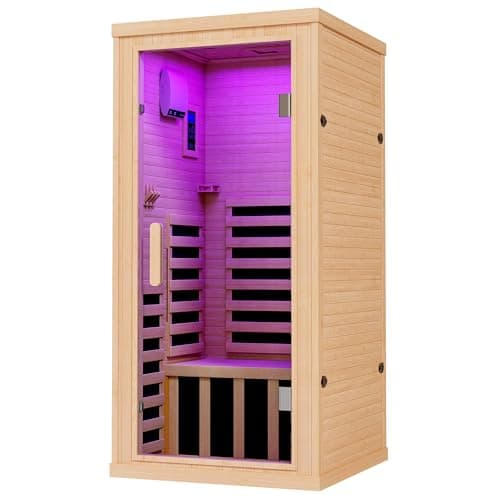
Albott 1-Person Infrared Sauna (7 Carbon Panels)
1-personFar infrared7 carbon panels + foot heaterCanadian hemlock1260W
The best single. Seven carbon panels plus a dedicated foot-heating zone in a Canadian hemlock box — the 1-person cabin that heats the part of you a single seat usually leaves cold.
- Capacity
- 6
- Heat & comfort
- 8
- Low-EMF
- 7
- Build & wood
- 7
- Value
- 8
Pros
- +Seven carbon far-infrared panels plus a separate foot-heating zone, which no other single here publishes
- +Canadian hemlock, safety-tempered glass and a door seal strip rather than a budget shell
- +Modular, no-tools assembly the listing rates at under an hour
Cons
- −One upright seat in a 32.3 x 32.3 in footprint
- −The listing calls the panels low-EMF in its own words, but publishes no measured figure or rating
Don't buy this if…
…you'll want to stretch out or share. This is a single upright seat — a 2-person cabin is the honest minimum for two.
What to check before you buy
- Wavelength and irradiance, or neither. A red-light claim without a wavelength is a color, and a wavelength without an irradiance is half a spec. The mechanistic literature on photobiomodulation — the proposed-mechanisms review is the standard summary — is explicitly dose-dependent, which is exactly why a product that publishes no dose cannot be compared against one that does.
- Panel area against body area. A ceiling LED strip and a 12-inch panel are not the same exposure even at the same irradiance. SAUNABOX itself is candid that a tent-mounted panel in a 35-inch footprint is a partial-body dose; a standalone panel you stand in front of covers more of you. If whole-body coverage is the goal, a sauna is the wrong chassis for it.
- The circuit. The Andora, the SAUNABOX and the Albott all run on an ordinary 120V household outlet. The full-spectrum Maxxus typically needs a dedicated 240V circuit, which means an electrician and a real line item — see do infrared saunas need special wiring.
- An ingress rating, if the light lives in steam. An LED array inside a 140F steam tent needs one. SAUNABOX publishes IP65 on its panel; an unrated array in that environment is a warranty claim in waiting. In a dry infrared cabin this matters much less.
- Whether you would buy the light on its own. This is the question that saves the most money. The red-light SAUNABOX costs meaningfully more than the identical plain Kit Pro and the steam performance is the same. If red light is not something you would have bought separately, buy the cheaper unit.
Cabin, tent or a separate panel
Buy the cabin if the sauna is the point. A two-person hemlock box on a household plug is a permanent, daily-use appliance, and the Andora is the best-supported one in the category — Golden Designs has the widest parts and manual network of any mid-market brand. The LEDs come along for the ride. If you want the cabin without the light question at all, 2-person infrared saunas is the ranking to read.
Buy the tent if the red light is the point and you want the dose documented. The published SAUNABOX specification gives you 660 nm, 850 nm, 80.43 mW/cm2 at the surface and an IP65 panel — more disclosure than any cabin on this site. You are trading a wooden room for a fold-away fabric one, and dry heat for steam. Our SAUNABOX SmartSteam review covers the tent itself in detail.
Buy a cabin plus a separate panel if you are serious about both. It is the only route that gets you a full-size sauna and a characterized, full-body light dose, and it is usually cheaper than the premium full-spectrum cabin. The catch is two appliances and two places to put them.
Near-infrared heat is not a light panel
The full-spectrum Maxxus deserves its own paragraph because it is the pick people most often misunderstand. Its near-infrared emission sits in the same part of the spectrum that red-light work uses, which is a real overlap — but it arrives as radiant heat from a heater designed to warm you, not as a measured dose from an array designed to irradiate you. Full-spectrum is worth paying for if you want hotter, more penetrating heat and red cedar; full spectrum vs far infrared is the detailed comparison. It is not worth paying for as a substitute for a panel.
One expectation to set while we are here: none of this is a Finnish sauna. The Finnish convention is dry air at 150-195F with steam thrown onto hot stones, and no infrared cabin at any price does that — infrared vs traditional sauna is the comparison to read before you spend, not after. Low-EMF claims deserve the same skepticism as red-light ones; the NIEHS EMF page is the sober background and infrared sauna EMF explained covers what a rating does and does not establish.
How we picked
We do not run a testing lab
We researched published manufacturer specifications, listing data and aggregated owner reviews, then scored each product against a published rubric. The scores are judgments from documented research — they are not measurements we took, because we don't have a lab and we're not going to pretend we do. Prices come live from the Amazon Creators API; where a spec came from a manufacturer we say so and link it in Sources.
Questions
Frequently asked
What is the best sauna with red light therapy?+
The Dynamic Andora, for most buyers: a two-person Canadian hemlock cabin with low-EMF far-infrared heaters and red-light therapy LEDs built in, running on a standard 120V outlet. If you want the light dose documented rather than claimed, the SAUNABOX SmartSteam Pro is the only product here that publishes both its wavelengths (660 nm and 850 nm) and its irradiance.
Is chromotherapy the same as red light therapy?+
No. Chromotherapy is a multi-color LED that cycles through a palette; no listing we have read publishes a wavelength, an irradiance or a distance for one. Red light therapy refers to light at specific wavelengths, usually a red band near 660 nm and a near-infrared band near 850 nm, at a stated dose. Treat color-cycling LEDs as cabin lighting.
Does a full-spectrum infrared sauna count as red light therapy?+
Not as the term is normally used. Full-spectrum heaters do emit in the near-infrared band that overlaps red-light wavelengths, but they are heaters: the output is radiant heat, not a measured dose from a panel aimed at you. Buy full spectrum for the heat and the cedar, and buy a panel if you want a dose.
Can you add a red light panel to a sauna you already own?+
Often yes, and it is usually the cheaper route to both. The constraint is the environment: a dry infrared cabin at 130-150F is far kinder to an LED array than a steam tent at high humidity, where you want a published ingress rating such as IP65. Check the panel maker's stated maximum operating temperature before mounting anything inside a traditional rock-stove room, which runs far hotter than either.
Does red light therapy in a sauna actually do anything?+
The mechanistic literature on photobiomodulation is real and dose-dependent, which is the honest summary: outcomes depend on wavelength, irradiance and exposure time. We have no lab and we make no outcome claims. What we can say as shoppers is narrower and more useful — a product that publishes no wavelength and no irradiance has not given you enough information to know what dose you are getting, whatever the listing calls it.
Do saunas with red light therapy need special wiring?+
Usually not. The Andora, the Albott and the SAUNABOX all run on a standard 120V household outlet, and LED arrays draw very little next to the heaters. The exception is the full-spectrum Maxxus, which typically needs a dedicated 240V circuit — and that is the heaters' doing, not the light's.
Receipts
Sources
We do not run a testing lab, and we do not pretend to. Product specs are transcribed from the manufacturer's own listing and cited as claims; health figures come from peer-reviewed studies, named and linked. Where we could not verify something, we say so on the page rather than quietly leaving it out. Read our full method.