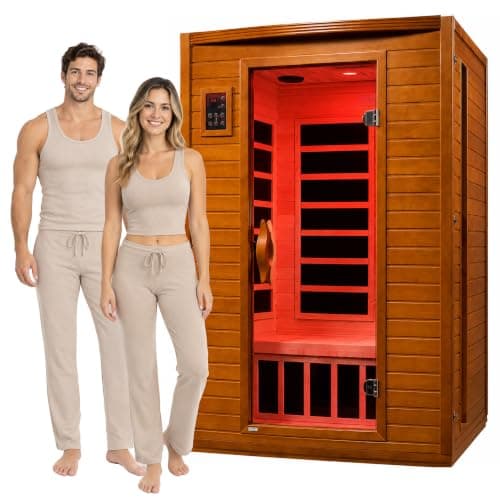
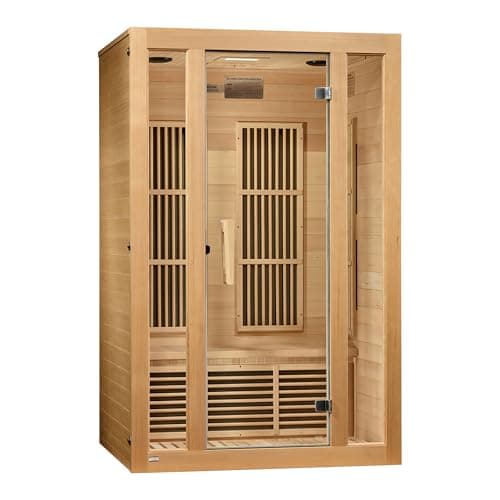
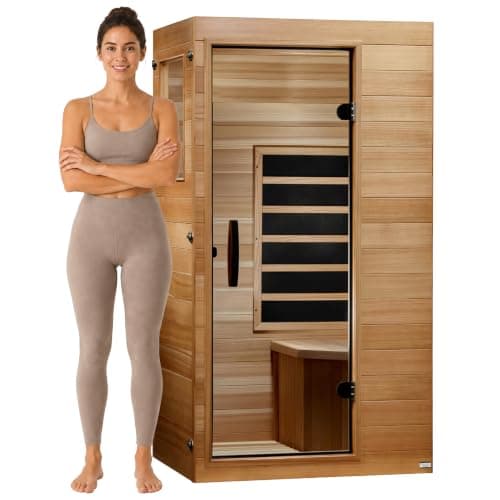
If EMF is what's making you hesitate, buy the Dynamic Saunas Elite: it is the only cabin here carrying an ultra-low-EMF rating rather than a plain low-EMF one — as long as a 1-person cabin suits you. It's the value winner for exactly the buyer this page is for — someone shopping their first infrared cabin who keeps landing on the word "EMF" and wants a straight, un-hyped answer. The short version: a low-EMF rating is a reasonable thing to prefer, the fields involved sit in the range of everyday household appliances, and none of the cabins here is a bad choice on that score. Below, what the ratings actually mean, then the five ranked.
What "low-EMF" and "ultra-low-EMF" actually mean
Every electric heater produces electric and magnetic fields — the same low-frequency EMF that surrounds any current-carrying wire, from your fridge to your hair dryer (NIEHS). Older ceramic-rod infrared heaters ran relatively high fields close to the body; the modern carbon and carbon-fiber panels every cabin here uses are designed to cancel much of that, which is what the "low-EMF" and "ultra-low-EMF" labels on the listings refer to. That's a real, meaningful improvement over the old designs — it is worth preferring.
Two honest caveats keep it in proportion. First, there is no single government standard that defines "low-EMF" for a sauna, so the phrase is a manufacturer-rated claim, not a measurement we took — we don't own a gaussmeter lab, and the scores here are judgments from documented specs and owner reviews, not lab readings. Second, the fields these panels emit sit in the same broad range as everyday appliances, and the science on low-frequency EMF at these levels is genuinely unsettled — not the certain danger the alarmist corners claim, nor nothing at all. The sensible move is to buy a cabin that publishes a low rating, sit back from the panels where you can, and not let EMF anxiety talk you out of the heat habit itself, which is the part with real evidence behind it (JAMA Internal Medicine) — general information, not medical advice. Our EMF explainer goes deeper on reading the numbers.
How we ranked these
The scores you see on each card are judgments from documented research — manufacturer specs, listing data and aggregated owner reviews — against a published rubric, not measurements from a lab we don't have. For a low-EMF roundup, we weighted three things:
- The published EMF rating.A cabin that carries an ultra-low-EMF rating ranks above one that carries a low-EMF rating, which in turn ranks above a carbon-heater cabin that doesn't headline EMF at all.
- Heater design. Carbon and carbon-fiber panels are the modern, low-emission layout; more heaters, better spread, warm you more evenly.
- Value at the live price.EMF anxiety shouldn't cost you a fortune — the cabin with the strongest published rating wins the top spot.
The picks, ranked
1. Dynamic Saunas Elite — the ultra-low-EMF pick. This is the cabin to buy if the published rating is what you are here for. Its PureTech far-infrared panels are rated ultra-low-EMF rather than plain low-EMF, it is Pacific cedar rather than hemlock, it plugs into a standard 120V outlet, and it comes with the largest support network in the category behind it. The honest con is the size: this is a genuine 1-person cabin, one upright seat with no room to share or lie down, so if you need space for two it is the wrong pick no matter how good the rating is. It is also far-infrared only, with no full-spectrum option.
2. Dynamic Andora — the mainstream low-EMF default.The Andora is the safe, boring, correct choice: carbon far-infrared panels rated low-EMF, built-in red-light therapy LEDs, a standard 120V plug, and the widest support network in the category because Dynamic/Golden Designs is the largest mid-market brand — parts, manuals and third-party reviews are everywhere. Its honest con is that the heaters are far-infrared only, and the hemlock cabin lacks cedar's aroma and natural rot resistance. It rates a notch below the Elite on EMF, but it seats two rather than one, so for most buyers it is the practical choice. We put it head-to-head with its Golden Designs sibling in Maxxus vs Dynamic.
3. Maxxus Seattle — the finish-focused low-EMF sibling.The Seattle is the same Golden Designs engineering and the same low-EMF rating as the Andora, in a slightly more finished cabin, with chromotherapy lighting and Bluetooth standard on most listings. That's also its honest con: it's genuinely hard to separate from the Andora on anything but price and trim, and it's far-infrared only. Because the two are rated identically on EMF, price should decide between them — don't pay a premium for the name difference.
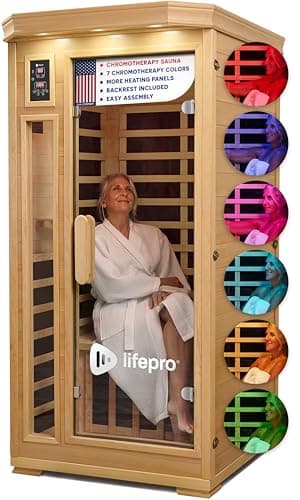
4. LifePro Rejuvacure — the modern-looking budget cabin.The Rejuvacure is the most contemporary-looking box here, from a fitness-recovery brand, with carbon-fiber heaters and a lower entry price. It's the outlier on this list, though, and honesty matters: it doesn't carry a published ultra-low-EMF rating like the Elite, so it earns its place on modern carbon-fiber heating and value rather than a headline EMF number. Its other honest cons are that "1-2 person" is generous — treat it as a roomy single, tight for two — and that it's a newer brand with a shorter track record in cabins specifically. Buy it for the styling and the price, not because it's the lowest-EMF option, because it isn't.
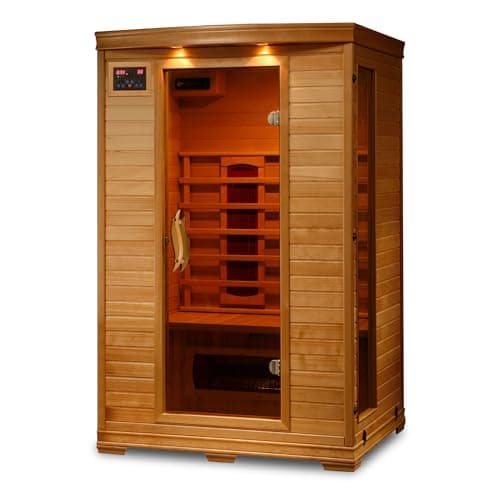
5. HeatWave Coronado — the heater-dense hemlock alternative.The Coronado packs five to six carbon emitters — more than the typical 2-person layout — so the heat wraps around you rather than radiating from behind, and it's a long-running Radiant Saunas line with wide retail availability. Its honest cons: it's a hemlock cabin with dated styling, far-infrared only, and it doesn't headline an ultra-low-EMF rating the way the Elite does, so it lands last on this specifically EMF-led list despite being a perfectly good cabin. We put it head to head with the value cabin most people cross-shop in HeatWave vs JNH.
Why every pick here is far-infrared
You'll notice all five are far-infrared cabins, not full-spectrum — and for an EMF-conscious first buy, that's a feature, not a gap. Far-infrared is the band that produces the deep, sweaty heat almost everyone buys a sauna for, and every cabin here runs it on a standard 120V outlet. Full-spectrum adds near- and mid-infrared, marketed for red-light-adjacent skin claims, but it usually means a 240V circuit and an electrician — more install, more power draw, and no lower EMF for it. If your priority is a low-emission cabin you can plug into the wall today, far-infrared is exactly the right lane. The wider roundup covers the full-spectrum options if you later decide near-infrared is the point.
How much the EMF gap between them actually matters
Be honest with yourself about the size of the difference you're ranking on. The step from the Elite's ultra-low-EMF rating to the low-EMF rating on the Andora and Maxxus, and then to the carbon-fiber heaters on the LifePro and HeatWave that don't headline a rating at all, is real on paper — it's why the list is ordered the way it is. But all five moved on from the old ceramic-rod designs that produced the higher fields in the first place, and the fields that remain sit in everyday-appliance territory (NIEHS). So use the rating to break ties and to buy with confidence — not as a reason to spend more, or to accept a worse fit than you otherwise would.
Living with one, honestly
Whichever you pick, set expectations for the ownership, not just the spec sheet. Assembly is a two-person job with heavy panels on every cabin in this class, so plan for a helper and an afternoon. You sweat directly onto the bench, so a towel and a wipe-down after each session keep it fresh. And these cabins run cooler than a traditional sauna — a comfortable, sustainable heat you can sit in regularly, which is the whole point: the health association is with the habit, not any single session (JAMA Internal Medicine) — general information, not medical advice.
The honest bottom line
Every cabin here uses modern carbon or carbon-fiber heaters, which is the design that made low-EMF possible in the first place. The ranking reflects who publishes the strongest EMF rating and at what price — but the practical gap between the top and bottom of this list is smaller than the marketing implies. If EMF is your headline concern and you want the best strongest documented rating and you sauna alone, the Dynamic Saunas Elite is the buy. If you need two seats and the biggest support network, the Dynamic Andora is the equally sane choice. Either way, don't over-index on EMF to the point of paralysis: buy the cabin, keep the sessions regular, and sit back from the panels. For the wider field beyond just the low-EMF angle, see our best infrared saunasroundup, and if it's specifically the couples size you're after, the 2-person cabins are ranked on their own.
How to buy a genuinely low-EMF cabin
Prefer a published rating over a bare "low EMF"
Because no standard defines the phrase, any brand can print "low EMF" on a listing. What separates the genuinely low-emission cabins is that they carry an actual rating — "ultra-low-EMF" on the Dynamic Elite, "low-EMF" on the Andora and Maxxus lines — that you can at least hold them to. When a listing just says "low EMF" with nothing behind it, treat it as marketing. Read every rating as a manufacturer claim, not a figure we measured.
Carbon and carbon-fiber panels are the modern design
The reason low-EMF cabins exist at all is the switch from old ceramic rods to carbon and carbon-fiber panels, which are engineered to cancel much of the field. Every pick here uses that modern design, so you're not choosing between a low-EMF and a high-EMF cabin — you're choosing between good and better on the same modern platform. That's worth remembering before you pay a premium chasing the last decimal point.
Keep EMF in proportion with the reason you're buying
The fields from these panels are in the range of everyday appliances, and the low-frequency EMF science at these levels is unsettled rather than settled either way (NIEHS). Meanwhile, the regular heat habit a sauna supports is the part with a real health association behind it (JAMA Internal Medicine) — general information, not medical advice. Buy down EMF where it's easy and cheap, but don't let it override the whole decision.
Stay on the outlet you already have
Every cabin on this list runs on a standard 120V household outlet — no electrician, no dedicated circuit. That keeps the install simple and the decision about EMF and value, not wiring. If you find yourself tempted by a bigger, full-spectrum cabin, note that those usually step up to a 240V circuit; for a low-EMF-focused first buy, a plug-in far-infrared 2-person cabin is the path of least resistance.
Don't let EMF anxiety pick a worse cabin
The trap on this page is spending more, or accepting a worse fit, for a marginally lower EMF claim you can't independently verify — for instance, taking a 1-person cabin when you need two seats, purely because it rates a notch better. Let the published rating narrow the field, then choose on size, price and fit like you would any cabin.
Size the cabin to the people, not the fear
A low-EMF rating is worthless if you buy a cabin that's the wrong size. A "2-person" cabin genuinely seats two; a "1-2 person" box like the LifePro is a roomy single, tight for two. Pick the capacity you'll actually use first, then let the EMF rating choose between the cabins that fit — that order keeps you from paying for an emissions number in a cabin that doesn't suit your household.