Skip to content
Sauna & Slate

HUB / GUIDES · Sauna Guides

Sauna vs Cardio

A hot room does raise your heart rate. It does not load your muscles, your bones or your lungs — which is most of what cardio is for.

By Stephen V.Reviewed How we research

A sauna is not a substitute for cardio, and the clearest evidence for that comes from the same Finnish research that made saunas famous: sauna use and cardiorespiratory fitness show their strongest associations when you have both, not when one stands in for the other. What a sauna does do is raise heart rate into a range that overlaps light-to-moderate activity, and drive some genuine heat adaptations. Read it as something to add to training, not something to trade it for. If you want heat in the week, the ZONEMEL hemlock cabin is the traditional format the research describes, and the plug-in infrared cabin or a blanket are the versions people actually use after a workout.

What a sauna does to your cardiovascular system

The physiology is not in dispute. Sitting in a hot room raises skin blood flow, dilates peripheral vessels, drops blood pressure and pushes heart rate up — in a traditional sauna at Finnish temperatures, into a range comparable with light-to-moderate exercise for the duration of the session. That is why the heart-rate-overlap argument gets made at all, and sauna and heart rate goes through it in detail.

The jump from there to "so it counts as cardio" is where it breaks. A raised heart rate is a marker of cardiovascular work, not the mechanism by which exercise improves you. Cardio raises heart rate because muscles are demanding oxygen and the whole system adapts to supply it: stroke volume, capillary density, mitochondrial content, bone loading, insulin sensitivity. In a sauna your heart rate rises because you are shedding heat. The destination is different even though the dashboard looks similar.

What the cohort data actually says

The famous JAMA Internal Medicine 2015 study found that more frequent sauna bathing was associated with lower fatal cardiovascular and all-cause mortality in middle-aged Finnish men. It is an observational finding, repeatedly misread as "sauna is cardio".

The study that speaks directly to this page is the one that put the two variables side by side: a 2018 analysis in Progress in Cardiovascular Diseases looking at the combined effect of sauna bathing and cardiorespiratory fitness on sudden cardiac death risk. Treating fitness as a separate, co-varying factor is itself the answer to the question: the data is about sauna and fitness, and the groups with both look best. A 2023 Mayo Clinic Proceedings review takes the same line across several lifestyle factors.

There is also real adaptation research on heat exposure. A crossover study of three heat-acclimation methods shows that repeated heat exposure produces measurable adaptations — plasma volume expansion, earlier sweating, better heat tolerance. Those are genuine and useful, particularly for anyone training or competing in heat. They are heat adaptations, not a training stimulus for your legs or your lungs.

What to look for if you want heat in your week

  • Traditional heat if you want the studied exposure. The Finnish sauna in this research is a rock-stove room at 170-195F. That is the thermal load the heart-rate figures come from, and an infrared cabin at 130F is a gentler one.
  • A format you will use after training, not instead of it. The practical question is where the sauna sits in your week. A plug-in cabin or a blanket you can run at 9pm wins over a better cabin that needs planning — sauna before or after a workout covers the sequencing.
  • Honest frequency. The associations in the cohort data sit with regular users. Buy for the habit you will keep: how often should you use a sauna.
  • Your own cardiovascular situation. Heat is a load. If you have a heart condition, uncontrolled blood pressure or take medication affecting blood pressure, this is a clinician conversation first — sauna and blood pressure and sauna safety.

The short answer

Quick picks

#SaunaBest forScorePrice
01
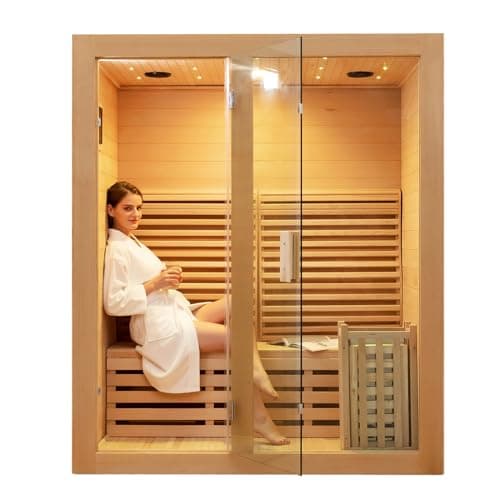
ZONEMEL ZONEMEL 2-Person Hemlock (3.5kW Harvia Stove)
ZONEMEL 2-Person Hemlock (3.5kW Harvia Stove)

The value real-loyly pick. A genuine Harvia rock stove in a compact indoor hemlock cabin — you can actually throw water and make steam.

The best value traditional indoor cabin
7.6
$3,099.99Amazon
02
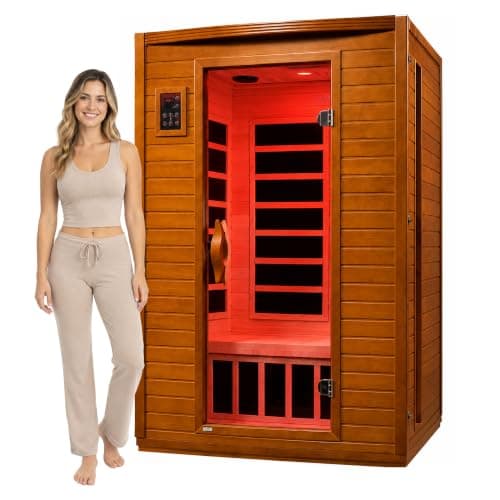
Dynamic Saunas Dynamic Andora (2-Person Low EMF FAR)
Dynamic Andora (2-Person Low EMF FAR)

The default 2-person infrared cabin. Low-EMF far-infrared heaters plus built-in red-light therapy, Canadian hemlock, and the widest support network in the category.

Most people buying their first 2-person cabin
7.8
$2,399.99Amazon
03
HigherDOSE HigherDOSE Infrared Sauna Blanket (Low EMF)
HigherDOSE Infrared Sauna Blanket (Low EMF)

The premium blanket, and the one you can actually buy on Amazon. Low-EMF far-infrared, well-made, and the anchor of the whole category.

The best sauna blanket
7.6
$699.00Amazon

#ad · Live prices from the Amazon Creators API, as of October 20, 2026. Where we have no verified live price, we show none — we would rather leave a gap than print a number that has rotted.

In detail

The picks, in full

01
ZONEMEL ZONEMEL 2-Person Hemlock (3.5kW Harvia Stove)

The best value traditional indoor cabin

ZONEMEL 2-Person Hemlock (3.5kW Harvia Stove)

2-personTraditional (rock stove)3.5kW HarviaCanadian hemlock240V
7.6/10

The value real-loyly pick. A genuine Harvia rock stove in a compact indoor hemlock cabin — you can actually throw water and make steam.

Capacity
7
Heat & loyly
9
Build & wood
7
Wiring & install
6
Value
9

Pros

  • A real Harvia stove and stones — throw water for loyly, which no infrared cabin can do
  • Compact enough to fit indoors in a basement or spare room
  • Far cheaper than a premium traditional kit for a genuine steam sauna

Cons

  • Needs a 240V circuit and, realistically, an electrician
  • Traditional saunas run hot (170-190F) and need proper ventilation indoors

Don't buy this if…

…you can't add a 240V circuit or ventilate a hot room. Traditional saunas are hotter and more demanding to install than plug-in infrared.

$3,099.99View on Amazon

Price as of October 20, 2026. Prices change — Amazon's is the one that counts.

#ad · we may earn a commission from this link to ZONEMEL 2-Person Hemlock (3.5kW Harvia Stove)

02
Dynamic Saunas Dynamic Andora (2-Person Low EMF FAR)

Most people buying their first 2-person cabin

Dynamic Andora (2-Person Low EMF FAR)

2-personFar infraredRed-light therapyLow EMF (rated)120V outlet
7.8/10

The default 2-person infrared cabin. Low-EMF far-infrared heaters plus built-in red-light therapy, Canadian hemlock, and the widest support network in the category.

Capacity
8
Heat & comfort
8
Low-EMF
8
Build & wood
7
Value
8

Pros

  • Runs on a standard 120V household outlet — no electrician, no dedicated circuit
  • Dynamic/Golden Designs is the largest mid-market brand, so parts, manuals and third-party reviews are everywhere
  • Carbon far-infrared panels rated low-EMF, plus red-light therapy LEDs built in

Cons

  • The heaters are far-infrared, not full-spectrum — no near- or mid-infrared HEAT like the pricier Maxxus models
  • Hemlock is the budget-to-mid wood; it lacks cedar's natural aroma and rot resistance

Don't buy this if…

…you want full-spectrum infrared HEAT (near, mid and far). The Andora's heating is far-infrared with red-light LEDs — step up to the full-spectrum Maxxus if near-infrared heat is the point.

$2,399.99View on Amazon

Price as of October 20, 2026. Prices change — Amazon's is the one that counts.

#ad · we may earn a commission from this link to Dynamic Andora (2-Person Low EMF FAR)

03
HigherDOSE HigherDOSE Infrared Sauna Blanket (Low EMF)

The best sauna blanket

HigherDOSE Infrared Sauna Blanket (Low EMF)

Full-body blanketFar infraredLow EMF (rated)Up to ~158F120V outlet
7.6/10

The premium blanket, and the one you can actually buy on Amazon. Low-EMF far-infrared, well-made, and the anchor of the whole category.

Heat
8
Low-EMF
8
Comfort
8
Ease of use
8
Value
6

Pros

  • HigherDOSE is the category benchmark and — unusually for the brand — the blanket is sold on Amazon even though its cabins are not
  • Low-EMF far-infrared with a clear temperature range and a proper controller
  • Lie-inside design heats the whole body, head excluded, in a compact rollout

Cons

  • The most expensive blanket by a distance
  • You lie still inside it — some people find that more confining than a tent

Don't buy this if…

…you're claustrophobic or want to move around. A blanket wraps you in place — a tent or cabin lets you sit up and shift.

$699.00View on Amazon

Price as of October 20, 2026. Prices change — Amazon's is the one that counts.

#ad · we may earn a commission from this link to HigherDOSE Infrared Sauna Blanket (Low EMF)

Where the two overlap, and where they do not

What you wantSaunaCardio
Elevated heart rate during the sessionYes, light-to-moderate rangeYes, across the full range you choose
Lower blood pressure acutelyYes, through vasodilationYes, after the session
Improved VO2 max and enduranceNo direct evidence of substitutionYes, this is the primary adaptation
Muscle, bone and joint loadingNoneYes, and nothing else provides it
Heat tolerance and plasma volumeYes, documented adaptationPartly, and more so when training in heat
Meaningful energy expenditureSmall — see our calories pageYes, scaled to intensity and duration

Read the fourth row twice. Loading is the one column where there is no substitute at all: no amount of heat exposure gives a bone, a tendon or a muscle a reason to get stronger. That is the structural reason a sauna cannot replace exercise even if every cardiovascular number happened to match.

Who might reasonably use heat as a stand-in

There is one honest exception, and it is about people who cannot exercise rather than people who would rather not. For someone whose mobility, injury or illness rules out meaningful cardio, passive heat is one of the few interventions that produces any cardiovascular response at all, and the research interest in heat therapy for exactly those populations is real. That is a clinical decision made with a clinician, not a shortcut for a healthy person with a gym membership they do not use.

For everyone else the sensible framing is additive: train, then use the heat for the reasons heat is actually good — the post-session wind-down, the sleep effect discussed in sauna for sleep, the muscle-recovery question in sauna for muscle recovery, and the ritual that makes you look forward to it.

Which format to buy

Traditional if you want the exposure the studies describe and can wire a 240V circuit. The ZONEMEL hemlock cabin is the cheapest route to a genuine Harvia rock stove, and our ZONEMEL ranking covers the range.

Infrared if what matters is using it four times a week on a standard outlet. It is a lower-temperature exposure and we say so; 2-person infrared saunas is the ranking.

A blanket if you train at home in a small space and want heat with no footprint. Best sauna blankets ranks them, and do sauna suits work explains why a blanket is a better buy than the suit people often consider first.

One last number to keep honest: the calorie question. A sauna session burns far less than people assume, and almost all of the weight change is water — how many calories does a sauna burn and sauna weight loss have the arithmetic.

How we picked

We do not run a testing lab

We researched published manufacturer specifications, listing data and aggregated owner reviews, then scored each product against a published rubric. The scores are judgments from documented research — they are not measurements we took, because we don't have a lab and we're not going to pretend we do. Prices come live from the Amazon Creators API; where a spec came from a manufacturer we say so and link it in Sources.

Questions

Frequently asked

Does a sauna count as cardio?
No. A sauna raises heart rate into a light-to-moderate range, but the reason is heat dissipation rather than muscular oxygen demand, so the adaptations are different. The Finnish cohort research treats sauna use and cardiorespiratory fitness as separate factors, and the best outcomes sit with people who have both.
Is 20 minutes in a sauna equivalent to a 20-minute run?
Only in the narrowest sense that heart rate is elevated in both. A run loads muscle, bone and the oxygen-delivery system and burns substantially more energy; a sauna session does none of the loading and burns little. They are not interchangeable.
Can a sauna improve cardiovascular fitness?
Repeated heat exposure produces genuine adaptations — plasma volume expansion, earlier sweating, better heat tolerance — and these can help someone training in hot conditions. That is heat acclimation rather than an improvement in VO2 max from heat alone.
Should you sauna before or after cardio?
After, for most people: heat before a hard session raises core temperature and perceived effort and can degrade the work. Our sauna-before-or-after-workout guide covers the exceptions, including deliberate heat acclimation.
Can a sauna replace exercise if you cannot exercise?
For people whose illness, injury or mobility rules out meaningful activity, passive heat is one of the few interventions that produces a cardiovascular response at all, and it is an active research area for exactly those groups. That is a decision to make with a clinician rather than a general substitution.

Keep reading

More in Sauna Guides

All sauna guides →

Receipts

Sources

We do not run a testing lab, and we do not pretend to. Product specs are transcribed from the manufacturer's own listing and cited as claims; health figures come from peer-reviewed studies, named and linked. Where we could not verify something, we say so on the page rather than quietly leaving it out. Read our full method.