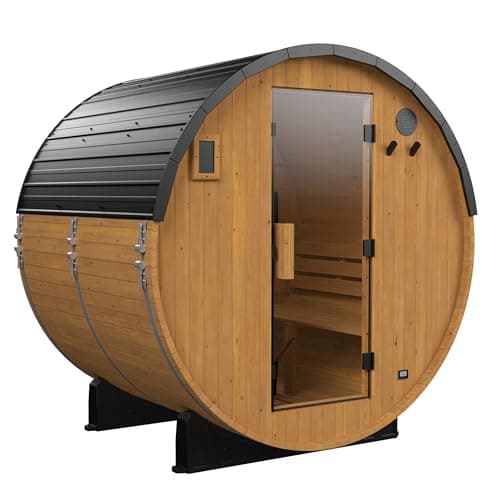
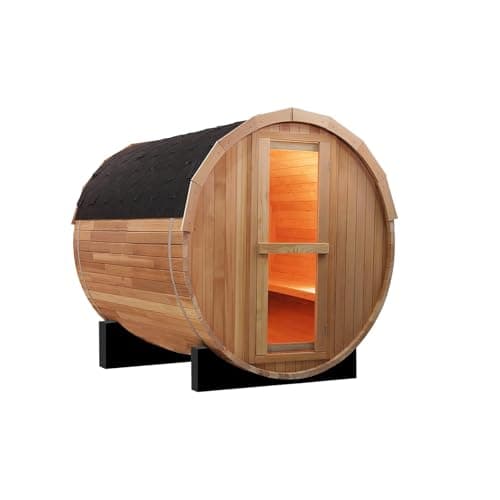
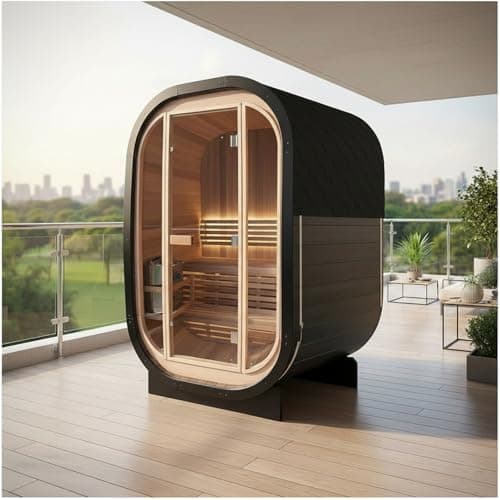
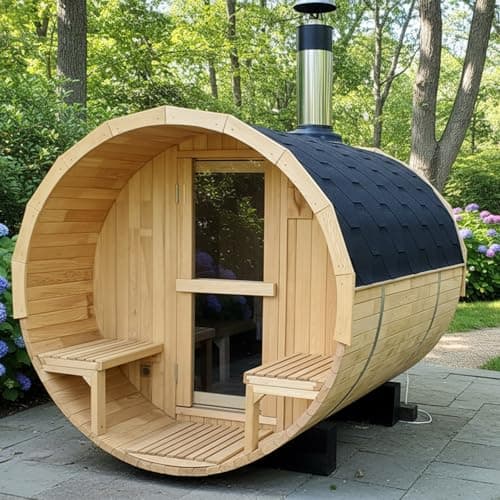
Buy the AURGOD Hemlock Barrel with the wood stove. In a genuinely cold climate a wood fire is the most reliable heat you can own — it does not care that it is -20F, it needs no 240V feed out to a frozen yard, and it is for the buyer who would rather tend a fire than trust a thermostat and a long cable run in winter. If you want push-button heat instead, the Backyard Discovery Paxton is the pick: tongue-and-groove cedar, a 9kW heater with real headroom and a galvanized steel roof on cradles that hold the barrel off frozen ground. For more seats in cedar, the TaTalife 4-6 is the one; for two people, ZONEMEL's cedar cube.
What a cold climate actually changes
Winter does not make an outdoor sauna harder to enjoy — it makes it better, and most owners in cold places use theirs more in January than in July. What winter changes is which specs matter. Four things move up the list.
Heater headroom. A stove sized exactly to the room volume on a mild day is undersized at -10F, because the shell is shedding heat to the air the whole session. The room-volume ratings heater makers publish assume an insulated indoor room, so outdoors in the cold you want to be at the upper end of the band rather than the lower — which is why the Paxton's 9kW in a 64-inch barrel is a cold-climate strength rather than overkill. Our heater size guide has the bands, and how long a barrel takes to heat up covers the cold-start penalty honestly.
The wood species. Freeze-thaw cycling is the hardest thing a sauna shell endures: water gets into the timber, freezes, expands, and does it again every night for months. Cedar's natural rot resistance and dimensional stability matter far more here than they do in a mild climate, and that is the single best reason to pay for it outdoors — cedar vs hemlock sets out the difference.
The roof and the base. Snow load sits on a barrel for weeks, and meltwater runs down the staves and pools where the barrel meets the ground. A real roof covering plus cradles or a base that keeps the timber out of standing water is what separates a barrel that lasts fifteen winters from one that rots at the bottom in three. The Paxton uses 29-gauge galvanized steel on HDPE cradles; the TaTalife ships asphalt shingles over a tarp lining with an EPDM rubber base.
What happens when the power is out. Cold-climate storms take the grid down, and a wood-burning sauna is the only one that still works. That is a comfort argument, not a spec, but it is a real one — and for an unwired yard it is also a large saving, since trenching a 240V feed through frozen ground is the most expensive thing on the whole project.
| Pick | Seats | Wood | Heat source | Cold-climate case |
|---|
| AURGOD Hemlock Barrel | 4 | Canadian hemlock | Wood stove + chimney | No electrical feed, works in any cold or outage |
| Backyard Discovery Paxton | 2-4 | Tongue-and-groove cedar | 9kW electric, Wi-Fi, 240V / 50A | Heater headroom, steel roof, HDPE cradles, 5-yr warranty |
| TaTalife Red Cedar 4-6 | 4-6 | Canadian red cedar | 6kW TOULE electric | Cedar at group size, shingles over tarp, rubber base |
| ZONEMEL 2-Person Cube | 2 | Canadian red cedar | 4.5kW ETL TOULE | Cedar and a small air volume that heats fast |
One honest caveat on the top pick: the AURGOD's body is hemlock, not cedar, so it wins on heat reliability rather than on shell longevity. If your winters are severe and you want cedar, the Paxton and the TaTalife are the two picks that give you both — and the ZONEMEL cube if two seats is enough. All figures here are manufacturer-published; see our methodology.
The winter checklist
- Size the heater up, not down. Take the top of the published room-volume band rather than the bottom. An undersized stove in a cold yard never reaches temperature, and there is no fixing it afterwards short of replacing the heater.
- Get the timber off the ground. Cradles, pavers, a gravel pad with drainage — anything that stops meltwater standing against the staves. Our barrel sauna foundation guide covers what works in a freeze-thaw climate.
- Plan for snow on the roof. Barrels shed snow from the curve, but the flat band at the top of a cube does not. Know what you will clear it with before February.
- Insulate if the winters are long. Insulating between the staves and the exterior cladding is the single highest-return winter modification, and it cuts the heat-up time as well as the bill — see how to insulate a barrel sauna.
- Drain and check the door seal before the first freeze. Standing water in a bucket or on a bench floor turns to ice, and a door that no longer seals bleeds the heat you are paying for. Our barrel sauna winter use guide is the seasonal routine, and barrel sauna maintenance is the year-round version.
- If wood-fired, respect the clearances. A solid-fuel stove and chimney carry clearance and installation requirements, and local rules vary — check them against the applicable NFPA codes and your jurisdiction before siting it, not after.
Wood-fired versus electric, when it is genuinely cold
This is the real decision on this page, so take it on its merits rather than on romance.
Wood wins on independence. No circuit, no cable trench, no outage risk, and a fire that reaches full heat regardless of the outside temperature. In an unwired yard it also removes the largest cost on the project. The Finnish tradition is wood-fired for a reason, and the heat quality — long, soft, with the stones holding temperature — is what purists prefer.
Electric wins on Tuesday evening. You set a timer or a phone app, walk out forty-five minutes later, and the room is at temperature with no fire to build in the dark at 10F. Over a winter of regular use that convenience is what determines whether you actually sauna or just own a sauna. The running cost at the rates the EIA publishes is a few kilowatt-hours a session — real, but rarely decisive; home sauna running cost has the arithmetic.
Our full comparison is at electric vs wood-burning sauna. If you land on electric, note that the cold-start penalty is real: budget longer than the listing claims in deep winter, and use whatever remote or timer control the heater offers.
Cold plunge, since you are already outside
One genuine advantage of a cold climate: the cold half of contrast therapy is free for several months of the year. A sauna in the yard next to a plunge tub that stays cold without a chiller is the cheapest version of the whole protocol, and our best cold plunge tubs and contrast therapy pages cover how to do it sensibly. In winter the thing to watch is the opposite problem — a tub freezing solid — and cold plunge temperature sets out the range you are actually aiming for.