HUB / INDOOR · Indoor Saunas
Sauna Bench Guide: Wood, Height and Layout
The benches decide how a sauna actually feels to sit in. Here's the wood that stays cool on bare skin, the tiered heights that put you in the heat, and the small details — hidden screws, air gaps — that separate a good bench from a painful one.
We earn a commission when you buy through our Amazon links, at no extra cost to you. It never affects our rankings, and we say so when the cheaper product is the better buy. How this works.
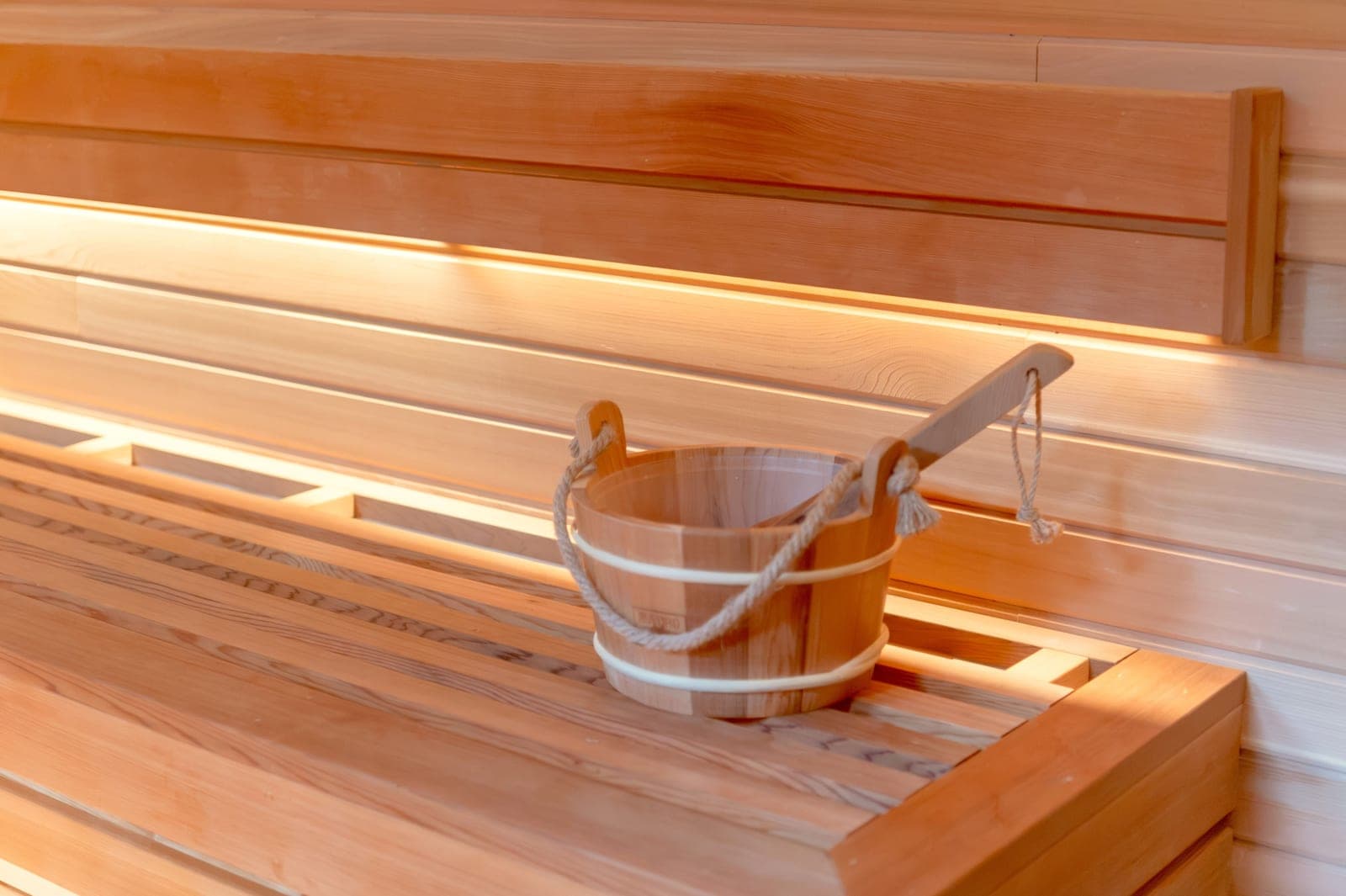
A good sauna bench comes down to three things: a clear, knot-free softwood that stays cool on bare skin (aspen, western red cedar, hemlock or alder), a tiered layout that lets you choose your heat by choosing your height, and hidden fasteners so no hot metal ever touches you. Get those right and leave air gaps between the boards, and the bench does its job for decades. The benches are the part of the sauna you're actually in contact with the whole time, so they matter more than almost any other detail. The wrong wood scorches you, a bench at the wrong height leaves you in the cool air near the floor, and an exposed screw head is a burn waiting to happen. This guide walks through the choices that make a bench comfortable and safe.
The wood: clear, cool, knot-free softwood
Bench wood has one non-negotiable requirement: it must stay comfortable to touch when the room is hot. That rules out dense hardwoods and anything metallic, because dense material stores and conducts heat and will burn you. It also rules out resinous or knotty timber — a knot or a bead of pitch gets far hotter than the surrounding wood and can scald skin. So bench timber is a clear (knot-free), low-density softwood: the usual choices are aspen, western red cedar, hemlock and alder. These stay relatively cool under the same air temperature, don't weep resin, and are gentle against bare skin. Aspen and alder are pale, neutral-smelling and very skin-friendly; cedar is aromatic and naturally rot-resistant. The wider comparison — including what goes on the walls versus what goes under you — is in the best wood for a sauna guide, but for the bench itself the rule is simple: clear softwood, no knots, no resin, nothing dense.
Heights and tiers: sit where it's hot
Heat rises, so a sauna is hottest near the ceiling and coolest near the floor — which is the whole logic behind tiered benches. A traditional layout has an upper bench set high, where the air is hottest and where you sit or lie to take the full heat; a lower bench a step down for a milder experience or for easing in; and a foot benchor step below that. The governing idea is that your body sits up in the heat while your feet rest on a lower tier — you want to be sitting in the hot band of air, not with your head in it and your feet in cold air near the floor. That's why the upper bench is set high enough that a seated bather's torso is up in the warmth, with the foot bench giving somewhere to rest feet at a comfortable, cooler level. This tiered geometry is old, well-documented practice; the Finnish Sauna Society describes the bathing tradition the layout serves. It also ties directly to ceiling height and overall room dimensions, which is why benches are best planned alongside the room in the home sauna size guide.
Depth: build the upper bench to lie down
One of the most common regrets is an upper bench too shallow to lie on. If you want to stretch out — and a lot of people do — the top bench needs to be deep enough to lie down comfortably, which in practice means roughly two feet (about 24 inches) of depth. A bench that's only deep enough to perch on forces everyone to sit upright the entire session. Even if you mostly sit, the extra depth makes the bench feel generous rather than cramped. Plan the deep upper bench first and let the lower tiers step out in front of it.
Hidden fasteners: no hot metal on skin
This is the detail that separates a proper bench from a dangerous one. Metal gets far hotter than wood in a sauna, so a screw head sitting proud of the bench surface is a small branding iron. Sauna benches are therefore built with hidden fasteners: screws driven from underneathup into the seat boards where possible, or countersunk from the top and then plugged with a wooden dowel sanded flush, so nothing metal is exposed where a body touches it. Never leave a bare screw or bracket on a seating or backrest surface. It's a little more work than surface-screwing the boards down, and it's the difference between a bench you can lean on anywhere and one with hot spots you learn to avoid.
Spacing: leave gaps for air and drainage
Bench boards are spaced with a small gap between them — usually around a finger's width — rather than butted tight. Those gaps let air circulate around the wood so it dries between sessions, and they let sweat and any splashed water drain through instead of pooling on the seat. A bench that drains and breathes stays hygienic and lasts; a solid, tightly-jointed slab traps moisture on top and underneath and degrades faster. The same logic applies to leaving the bench frame slightly off the wall and floor so air moves all around it. Build the benches as a removable module if you can — it makes cleaning underneath and the occasional refinish far easier.
Putting it together
A well-built bench is clear knot-free softwood, tiered so you sit up in the heat with your feet on a lower step, deep enough on top to lie down, fastened with nothing metal exposed, and spaced to drain and breathe. None of it is expensive; all of it is about comfort and safety in a hot, wet room. When you're ready to see how the benches slot into framing, barrier and cladding, the full sequence is in how to install a home sauna.
Questions
Frequently asked
What wood should sauna benches be made of?
How high should a sauna bench be?
How deep should a sauna bench be?
How are sauna benches fastened without burning you?
Keep reading
Related
More in Indoor Saunas
Receipts
Sources
We do not run a testing lab, and we do not pretend to. Product specs are transcribed from the manufacturer's own listing and cited as claims; health figures come from peer-reviewed studies, named and linked. Where we could not verify something, we say so on the page rather than quietly leaving it out. Read our full method.