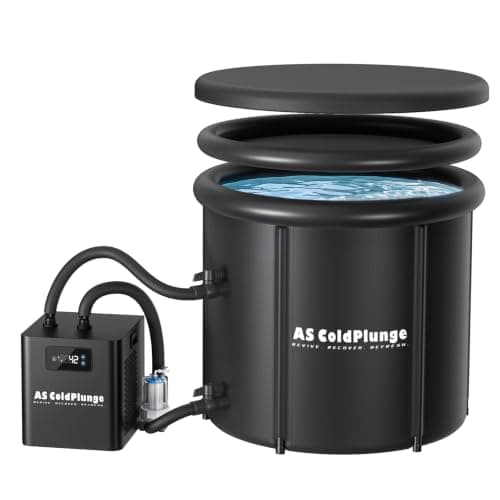
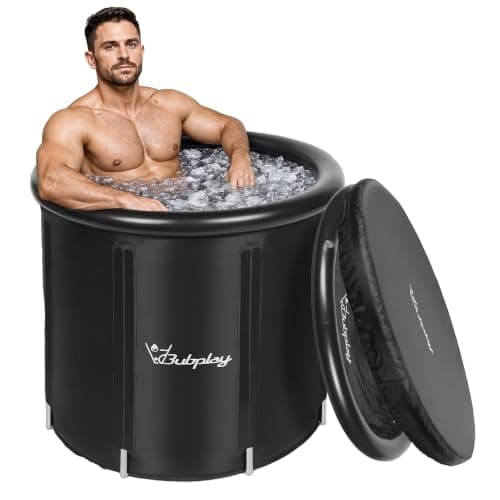
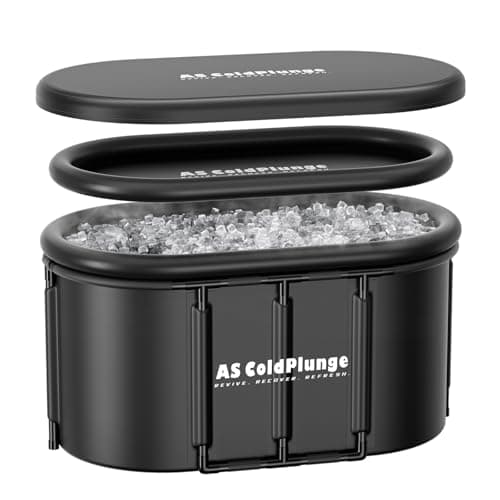
For almost everyone, a cold plunge at home. Water conducts heat away from you something like twenty-five times faster than air, so three minutes in 50F water is a bigger thermal dose than three minutes in a -220F cryotherapy chamber — and the plunge is a one-time purchase instead of a per-session fee forever. Cryotherapy earns its keep in exactly two situations: you want the exposure without getting wet or committing to a tub, or you have a clinic nearby and the walk-in convenience is worth more to you than the cost. Neither has evidence strong enough to justify treating it as medicine.
They are not the same stimulus
A cold plunge is water immersion: you sit in a tub of water somewhere between the high 30s and the low 50s Fahrenheit for a few minutes, usually to your shoulders. Whole-body cryotherapy is air or nitrogen vapor: you stand in a chamber at somewhere between -150F and -240F, usually for two to four minutes, with your head out and your extremities covered.
The number on the chamber is the most misleading figure in recovery. Air is a poor conductor; water is a good one. That is why 50F water is unpleasant within seconds while 50F air is a mild spring morning. A cryo chamber holds a far lower temperature for a far shorter time in a far worse conductor, and the practical consequence is that cryotherapy delivers a strong skin cooling with much less cooling of the tissue underneath. Immersion drops deeper tissue temperature; a chamber mostly does not. The classic work on immersion into water of different temperatures is the reason we treat water in the high 30s and water in the low 50s as different activities, let alone water against vapor.
That difference is also why the comfort comparison surprises people. Most first-timers find three minutes of cryotherapy easier than ninety seconds of a 45F plunge. If you have read that cryotherapy is the more extreme option, the thermometer said so and your nervous system disagrees.
What the research compares
There is now a review that puts both in the same analysis. A 2024 systematic review and meta-analysis in the Journal of Thermal Biology looked at cold water immersion alongside whole- and partial-body cryostimulation and their effects on cardiovascular and cardiac autonomic responses in healthy people. That is the right paper to read if you want the two modalities compared on something measurable rather than on marketing.
On the immersion side, the 2025 systematic review and meta-analysis of cold water immersion found effects on some health and wellbeing outcomes, with small trials and substantial variation between them — a real literature with real limits, which is how we describe it in cold plunge benefits too. On the recovery question specifically, the honest summary is the title of a 2017 Journal of Physiology paper: cold water immersion was no better than active recovery for the inflammatory markers it measured.
On the cryotherapy side, the 2021 review of cryotherapy in injury and exercise recovery is the readable overview, and a systematic review of pre-exercise whole- and partial-body cryotherapy covers the performance angle. The pattern across both literatures is the same: short-term effects on soreness and perception that are reasonably consistent, and much weaker support for the bigger claims about inflammation, injury healing or metabolic change.
So the research does not pick a winner. It tells you that both are mild interventions with modest, mostly subjective effects, which moves the decision onto the ground where it actually belongs: money, access and whether you will keep doing it.
The cost comparison, which is not close
Cryotherapy is a per-session business. A single visit is typically priced like a massage, and most clinics push you toward a monthly package — so using it twice a week is an ongoing subscription with no end date and nothing to show for it when you stop. A cold plunge is a capital purchase: an insulated tub is a mid-double-digit to low-triple-digit buy in the beginner tub bracket, after which your only recurring cost is bagged ice, or electricity if you add a chiller.
Run that over a year of twice-weekly use and the tub is cheaper by a wide margin, usually inside the first two months. It is also available at 6am on a Sunday, which is the real argument: adherence beats intensity in every habit of this kind, and the thing in your own yard gets used. We go through the equipment side in best cold plunge tubs and the full home-setup question in sauna and cold plunge combo for home.
The honest case for cryotherapy is narrower but real. You stay dry, which matters if you are going straight back to work. There is nothing to maintain, no water chemistry, no space given up in your yard, and no 400 pounds of water sitting on a deck. If you are renting, travel constantly, or simply do not want an appliance, paying someone else to own the hardware is a reasonable trade.
Which to choose
| If this is you | Choose | Why |
|---|
| You want to do this several times a week, long term | Cold plunge | The hardware pays for itself in weeks and then costs almost nothing |
| You want the deepest cooling of the tissue, not just the skin | Cold plunge | Water conducts; air does not. Immersion is the bigger thermal dose |
| You pair cold with a sauna | Cold plunge | Contrast cycles need the cold next to the hot, not across town |
| You cannot give up the space, or you rent | Cryotherapy | Someone else owns and maintains the equipment |
| You want to try cold exposure before committing | Either, cheaply | A few clinic sessions, or a cold shower, before you buy anything |
| You have a cardiovascular condition or are pregnant | Neither, until you have asked | Both produce a sharp cardiovascular response — this is a medical question |
If you choose the plunge, what to buy
The purchase splits into the vessel and the cold. Get the vessel right first, because the cold can be upgraded later and the shell cannot.
- Length over volume. What makes a plunge tolerable is being able to lie back with your shoulders under and your neck supported. A tub that forces you to fold up is one you will stop using in week three. Check the internal length against your own height before you look at anything else.
- An insulated lid is not an accessory. It is the difference between ice lasting a day and ice lasting an afternoon, and later it is the difference between a chiller cycling occasionally and running constantly.
- Published chiller ports, even if you plan to use ice. Most people start with bagged ice and get tired of the errand by the second month. A tub that publishes chiller compatibility means that upgrade does not involve rebuying the shell — the tubs that come with chillers are the shortcut if you already know.
- Site it before you order it. Level ground, a drain plan, and a bit of arithmetic: water weighs about 8.3 pounds a gallon, so a 150-gallon tub is well over half a ton once filled. On a deck or an upper floor that is a structural question.
If you choose cryotherapy, what to ask
- Nitrogen vapor or refrigerated air? Nitrogen-based open chambers displace oxygen as the vapor settles, which is why your head stays above the rim and why the room needs ventilation and monitoring. Refrigerated electric chambers avoid that mechanism entirely. Either way, you want a staffed session, not an unattended one.
- What covers your extremities? Frostbite in a cryo chamber happens at fingertips, toes, ears and anywhere damp. Dry skin, dry socks, gloves and no jewelry are standard for a reason.
- Is anyone screening you? A session that starts without a single question about blood pressure, pregnancy, Raynaud's or cardiac history is a clinic treating a strong physiological stimulus as a spa treatment.
- What is the per-session price without a package? Work out the annual number before you sign anything, then compare it against owning a tub. That arithmetic is why this page recommends the plunge for regular users.
Timing, if you lift or train
One genuine caution applies to both, and it is about when rather than which. Cooling straight after resistance training appears to interfere with the adaptation you trained for: a 2015 Journal of Physiology study found post-exercise immersion attenuated anabolic signaling and long-term strength adaptation, and a 2019 study found attenuated fiber hypertrophy after whole-body resistance training. If you are training to get bigger or stronger, put the cold somewhere other than the hour after your session. We lay out the scheduling in when to cold plunge.
And if you are weighing cold against heat rather than cold against cold, sauna vs cold plunge is the page for that decision — contrast therapy is what you get when you stop choosing.