HUB / GUIDES · Sauna Guides
Infrared vs Barrel Sauna
An indoor infrared cabin and an outdoor cedar barrel are the two most popular ways into a home sauna — and they could hardly be more different. Here's the honest split, so you buy the right one.
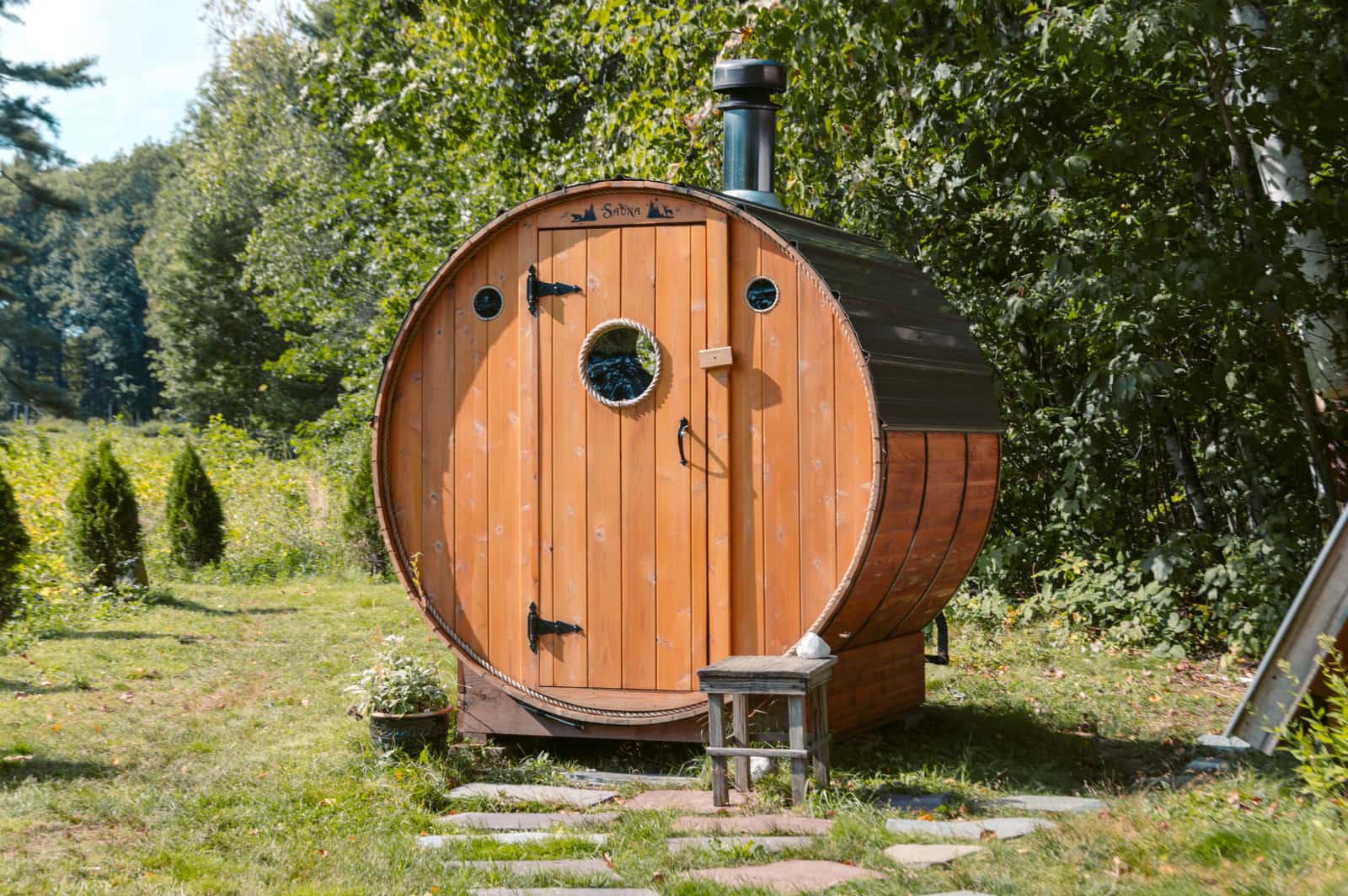
These aren't two versions of the same thing — they're two different experiences with two different install stories. An infrared cabin is a gentle, dry, plug-in indoor box. A barrel is a hot, steamy, wood-or- electric outdoor ritual. Neither is better; they answer different questions. If you want the easiest possible install and a low barrier to daily use, infrared. If you want real loyly, a backyard centerpiece and the traditional hot-sauna experience, a barrel. Here is how every axis that matters compares.
Heat: gentle and dry vs hot and steamy
This is the core difference. An infrared cabin warms your body directly with panels at a gentle 120-140F — dry heat, no steam, comfortable for long sessions and for people who find traditional saunas punishing. A barrel is a traditional sauna: an electric or wood stove heats the whole room to a proper 160-190F, and if it is a rock stove you can throw water for loyly, the burst of steam that defines the Finnish tradition (Finnish Sauna Society). If loyly is the experience you are picturing, an infrared cabin cannot give it to you — there are no stones. If gentle, sweat-in-comfort heat is what you want, the barrel's intensity may be more than you are after.
Install: plug-in vs a backyard project
The gap here is enormous, and for many buyers it decides everything. A 2-person infrared cabin plugs into a standard 120V household outlet — no electrician, no dedicated circuit, no foundation. You assemble it indoors and use it that evening. A barrel is a genuine outdoor project: a level, load-bearing foundation, clearances, and — for an electric barrel — a dedicated 240V circuit run by an electrician, plus possibly a permit. Our barrel sauna installation guide lays out the work; the infrared equivalent is essentially "find an outlet." If you rent, lack outdoor space, or want zero fuss, that alone points you at infrared.
Space and placement
Infrared lives indoors — a spare room, basement, garage corner — in the footprint of a large wardrobe. A barrel lives outdoors and becomes a feature of the yard, needing room around it and a sensible walk from the house. If you do not have outdoor space, the barrel is simply off the table; if you do not have indoor space to spare, or do not want a sauna in your living area, the barrel's outdoor home is an advantage. It is as much a question of where you have room as which experience you prefer.
Cost, upfront and ongoing
Upfront, a value 2-person infrared cabin often undercuts a barrel, and the barrel's all-in cost includes the foundation and possibly an electrician on top of the sticker — see the barrel sauna cost breakdown. Ongoing, infrared is cheap to run (a 2-person cabin draws ~1.6-1.8kW, cents per session at average EIA rates), while a barrel's bigger heater draws more — and a wood-burning barrel trades electricity cost for the price and effort of firewood. We do the full arithmetic on the running-cost page. Neither is expensive to run relative to the purchase; the upfront and install costs are where the real money is.
Running cost, with the arithmetic shown
Everyone quotes "pennies a session" and nobody shows the working, so here it is. Cost = power (kW) x time (hours) x your rate ($/kWh), at the U.S. residential average of about $0.18 per kWh (EIA):
- 2-person infrared cabin, 1.7kW, 45 minutes. 1.7 x 0.75 = 1.28 kWh, which is about $0.23 a session. Four sessions a week is roughly $3.90 a month.
- Electric barrel, 6kW, 30-minute warm-up plus a 30-minute sit. The heater runs flat out to get there (6 x 0.5 = 3.0 kWh) then cycles on the thermostat at roughly half duty while you're in it (6 x 0.5 x 0.5 = 1.5 kWh). That's 4.5 kWh, or about $0.81 a session — near $14 a month at the same cadence.
So the barrel costs roughly three to four times as much per session to run, and both numbers are still small — this is a rounding error next to the purchase price, and it should not decide your buy. Two caveats keep it honest: a barrel sits outdoors and uninsulated, so cold weather pushes the warm-up portion up, and a wood-fired barrel has no electricity cost at all, just firewood and your time. The full month-by-month breakdown for every sauna type is on the running-cost page.
Temperature, session length and how each one feels
The temperature gap changes what a session is. An infrared cabin sits around 120-140F, which is warm rather than punishing, so people commonly stay in for 30 to 45 minutes and read or listen to something. A barrel runs at a traditional 160-190F, where sessions are shorter and more intense — typically 10 to 20 minutes a round, then out to cool, then back in. Neither pattern is better, but they suit different temperaments: if the idea of a long, mild sweat appeals more than a short, fierce one, that is a real signal about which to buy. Our sauna temperature guide and how long to stay in a sauna cover both patterns.
The rounds-and-cooling rhythm of a hot barrel is also what makes it the natural partner for a cold plunge — the traditional hot-cold cycle assumes a sauna you cannot sit in indefinitely. If that is the setup you are picturing, the barrel is the half of this comparison that supports it; see sauna and cold plunge contrast therapy.
Year-round use and the weather
An indoor infrared cabin does not know what month it is. It heats the same in February as in July, and using it never involves going outside. A barrel does know: it is outdoors, usually uninsulated solid timber, and cold air and wind pull heat off the staves the whole time the heater is working. In deep winter that means a longer warm-up and a walk through the cold in a robe at both ends. Plenty of owners consider that walk part of the appeal — it is the traditional experience — but it is the honest reason some barrels get used far less between November and March. Siting it out of the wind and insulating it both help, as covered in barrel sauna winter use.
What each one simply cannot do
Short list, because these are the deal-breakers rather than the preferences:
- An infrared cabin cannot make loyly. No stones, no steam, no water on the rocks. If that is the ritual you want, no infrared cabin at any price delivers it.
- An infrared cabin cannot hit traditional temperatures. If you want a 180F room, this is not the product.
- A barrel cannot go indoors. It is round, it needs clearance all round, and it is built for the yard. No outdoor space means no barrel.
- An electric barrel cannot skip the electrician. The 240V circuit is not optional, and it is the biggest hidden cost in the comparison. Work through the barrel sauna buying checklist before you commit.
The honest recommendation
Choose infrared if you want the easiest install, gentle dry heat, indoor placement, low running cost and the lowest barrier to using it daily — it is the sensible default for most first-time buyers, and our best infrared saunas is where to start. Choose a barrel if you want real loyly, the hot traditional experience, a backyard centerpiece, and you have the outdoor space and appetite for an install — the best barrel saunas roundup is your list. The health case for regular heat bathing (JAMA) does not favor one type — it favors the one you will actually use, so buy for your space and your ritual, not for the spec sheet.
Questions
Frequently asked
Is an infrared or barrel sauna better?
Can you get loyly (steam) from an infrared sauna?
Which is cheaper, an infrared or a barrel sauna?
Do you need outdoor space for a barrel sauna?
How much more does a barrel sauna cost to run than an infrared one?
How hot does a barrel sauna get compared with an infrared sauna?
Keep reading
Related
More in Sauna Guides
Receipts
Sources
- Laukkanen T. et al., JAMA Internal Medicine 2015 — sauna use and cardiovascular mortality
- Finnish Sauna Society (Suomen Saunaseura) — traditional sauna bathing and loyly
- U.S. EIA — average retail price of electricity (residential)
We do not run a testing lab, and we do not pretend to. Product specs are transcribed from the manufacturer's own listing and cited as claims; health figures come from peer-reviewed studies, named and linked. Where we could not verify something, we say so on the page rather than quietly leaving it out. Read our full method.