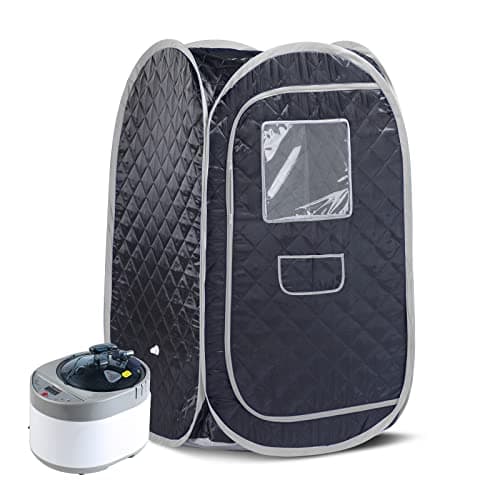
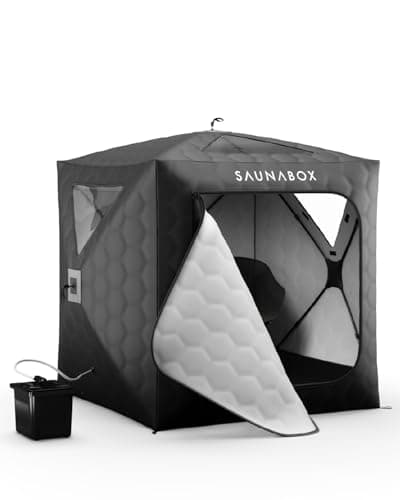
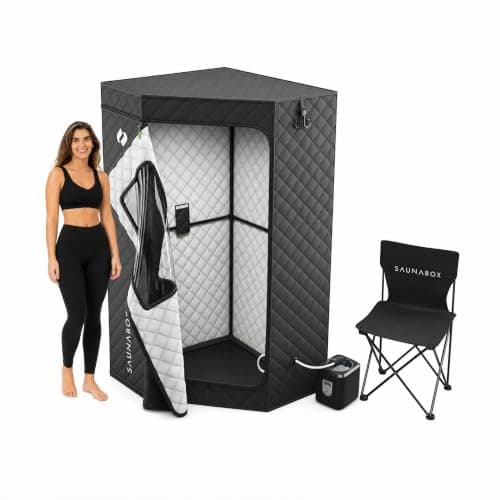
Buy the SAUNABOX SmartSteam Kit Pro. It is the only steam tent here tall enough — a stated 6ft 2in — to sit upright with your head and shoulders inside the humid air, which is the difference between a steam room and a sweat bag, and it is for anyone who wants a real session rather than a novelty. If you need two seats, the 2-person SAUNABOX trades that height away (53 inches, so you sit low) for 56 inches of width. If you only want to find out whether home sweating is for you, the FniOk does it for less than a pair of shoes. Everything else on this page is detail.
What a portable steam sauna actually is
A steam tent is three things: a collapsible frame with an insulated fabric shell, a small electric boiler that pumps steam into it through a hose, and a chair. You sit inside, the boiler turns a couple of liters of tap water into vapour, and the enclosure holds it around you at something like 130-140F and near-saturated humidity. That combination — moderate temperature, very high humidity — is a steam room, not a Finnish sauna. The Finnish convention is dry air at 150-195F with intermittent bursts of humidity from water on hot stones; a steam tent runs cooler and wetter all the way through. Our sauna vs steam room comparison is the full version of that distinction, and it matters here because it is the main reason people are disappointed: they bought one expecting the other.
What a steam tent is genuinely good at is being cheap, being storable and being plug-in. There is no 240V circuit, no permit, no slab, no electrician, and when you are done it goes in a closet. For an apartment, a rental or a first experiment, that is an unanswerable set of advantages — see best portable saunas for apartments.
The spec that decides it: height
Almost every steam tent on the market is a head-out box. You sit on a chair inside a zip-up enclosure that comes up to your neck, with your head in the room air. It works — your body sweats — but it does not feel like a sauna, because the part of you that registers heat most strongly is outside the heat. The SAUNABOX Kit Pro is on this list at number one because it is 6ft 2in tall: you are inside it, not wearing it. That one dimension changes the experience more than wattage, reservoir size or heat levels do.
After height, the specs worth comparing are the steamer's wattage (how fast it makes steam), the reservoir volume (how long before a refill ends the session), and the published temperature ceiling. Here is how the five compare on the figures their makers publish.
| Pick | Erected size | Steamer | Published temp | Who it is for |
|---|
| SAUNABOX SmartSteam Kit Pro | 6ft 2in x 35in x 35in | 1,600W, 3.6L stainless | 130-140F, 7 levels | Most people buying their first steam tent |
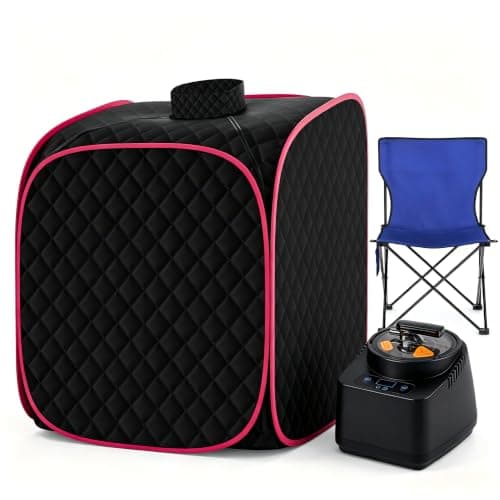
| Smartmak Steam Sauna Set | 28.7 x 28.7 x 48.8 in | 1,600W, 4L | 16 heat settings | Longer sessions between refills |
| SAUNABOX SmartSteam 2-Person | 56in W x 49in L x 53in H | 1,600W, 3.6L | Up to 130F, 15 levels | Two people, sitting low |
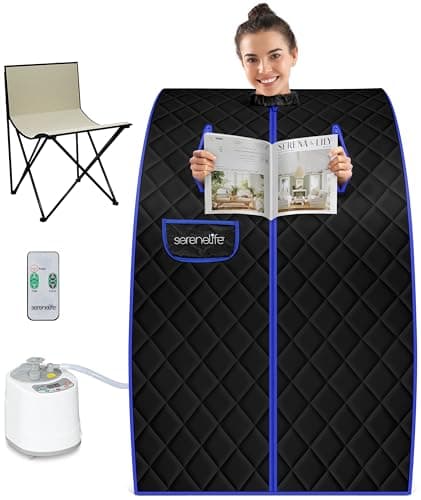
| SereneLife Portable Steam Sauna | Folds flat; 1-person seated | Included generator | Not published | A well-reviewed basic steam tent |
| FniOk Portable Steam Sauna | 31.5 x 31.5 x 40.5 in | 1,000W, 2.6L | Max 140F, 9 levels | The cheapest way to try it |
Those are manufacturer-published figures, including SAUNABOX's own specification page, not measurements of ours — we do not have a lab, and our methodology says so. Where a listing publishes no temperature figure, we have left the cell honest rather than filling it in.
What to look for, if you are not just taking our ranking
- Interior height, first. Anything under about 50 inches is a seated box with your head outside. That is a legitimate product at a legitimate price, but know which one you are buying.
- Reservoir volume, because it is your session timer. When the water is gone the steam stops. A 2.6L boiler at 1,000W and a 4L boiler at 1,600W are different session lengths, and a mid-session refill means climbing out of a wet tent.
- What the water touches. A stainless chamber with food-grade silicone tubing is worth asking about, because the alternative in this price band is an unspecified plastic boiler that you will be inhaling the output of. SAUNABOX publishes theirs; most do not.
- Whether the controller is remote or handheld. You are inside a sealed tent with wet hands. Being able to drop the steam a level without getting out is worth more than it sounds.
- How it dries. Every steam tent is a damp fabric enclosure after use. The ones that last are the ones you can open fully and hang to dry; the ones that mildew are the ones folded away wet. Our how to clean a portable sauna guide is the five-minute routine that doubles the life of one of these.
Steam tent, infrared tent, or blanket?
These three are the whole portable category and they are not interchangeable.
A steam tent gives wet heat at a moderate temperature. Many people find humid air easier to sit in than dry radiant heat, it is good for the sinuses, and it is the closest cheap approximation of a commercial steam room. The cost is moisture management.
An infrared tent like the SereneLife infrared gives dry heat, warms up faster, and has nothing to dry out afterwards — but your head is out and there is no humidity at all.
A sauna blanket is the lowest-fuss of the three: you lie in it, it heats you, it stores flat. It is also the least like a sauna, since you are enclosed rather than sitting in hot air. Compare in sauna tent vs sauna blanket and best sauna blankets.
If what you actually want is a room at 180F with stones you can throw water on, none of the three will satisfy you and you should price a cabin kit instead. A steam tent is a genuinely good $200-400 purchase and a bad $4,000 substitute.
Running cost and practicalities
A 1,600W steamer is roughly a hair dryer. Run it for 30 minutes and you have used about 0.8 kWh, so at typical U.S. residential rates published by the EIA that is small change per session — pennies, not dollars. The real costs of a steam tent are non-financial: somewhere to put it while it dries, and the discipline to actually dry it. Our home sauna running cost guide puts that next to a cabin.
Two safety notes that apply to all five. Steam at 130-140F with near-total humidity suppresses evaporative cooling, so you will feel the heat load sooner than the thermometer suggests — start at 10-15 minutes, not 30, and read sauna safety if you have a heart or blood-pressure condition or are pregnant. And drink water: the CDC's hydration guidance is the baseline, and our sauna and dehydration guide covers what a long session actually costs you.