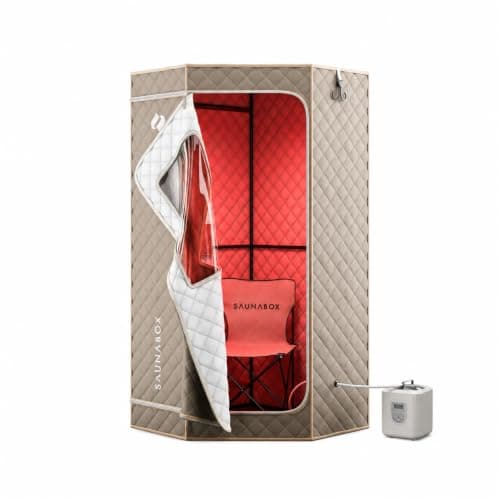
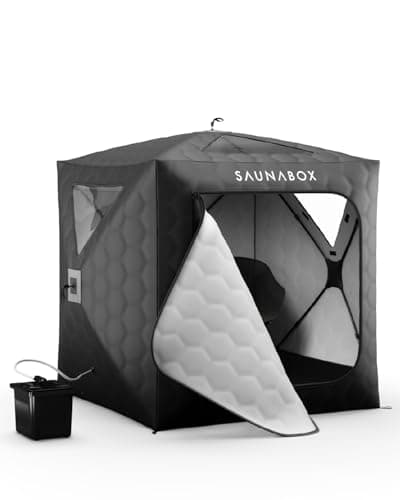
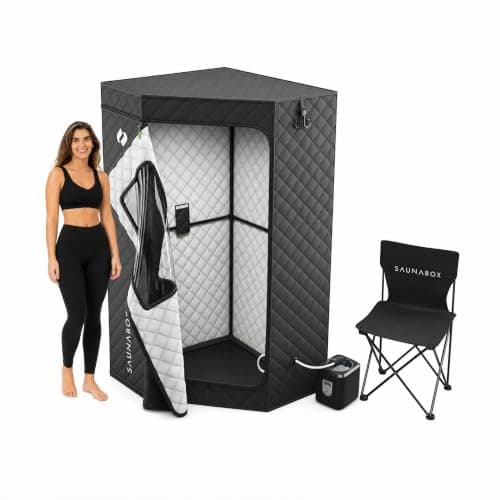
Buy the 1-person SmartSteam Kit Pro. It is the tallest, the hottest, the cheapest and the one whose single best spec — a 6ft 2in tent — is the reason to choose SaunaBox over the dozens of near-identical steam tents sitting next to it. The red-light version is the same steam session with a panel bolted on, at a meaningful premium. The 2-person is wider but only 53 inches tall, which changes the experience more than the extra seat does. Below is the case for each, built entirely on the brand's published figures — and if you want these three set against the cheaper SereneLife, Smartmak and FniOk tents, that is best portable steam saunas.
How we reviewed this, in plain terms. We have not personally used a SmartSteam. Everything below comes from SaunaBox's own published specifications, the live Amazon listings for the three models, and comparison against the steam and infrared units already in our
portable sauna roundup. Where a number is a manufacturer claim we say so. We do not have a lab and we are not going to pretend we measured a tent's interior temperature. Our
methodology page spells out the rubric.
What SaunaBox actually sells
SaunaBox is a US-based brand whose range runs from cabinet saunas at several thousand dollars down to the SmartSteam line, which is where almost all the search interest sits. A SmartSteam is a portable steam sauna: a 1,600 W electric steam generator with a 3.6 L stainless steel chamber, feeding a fabric tent on a fiberglass frame through food-grade silicone tubing. You sit inside on an included chair, the steamer fills the enclosure with wet heat, and a handheld controller sets a heat level and a timer.
Three variants are currently on sale through Amazon, and they are easy to confuse because the names overlap. The SmartSteam Kit Pro is the 1-person unit. The SmartSteam Pro with Red-Light Therapy is the same 1-person unit with an LED panel added. The SmartSteam 2-person is a wider, lower, pop-up tent on the same steamer. All three draw 1,600 W from a standard 110 V outlet and all three use the same 3.6 L reservoir — which, as we will get to, is the most important thing to understand about the 2-person.
The spec that actually matters: height
The portable steam category is full of what are politely called head-out units — boxes and tents with a zippered collar that your head pokes through, so your body steams while your face sits in room air. They are cheaper and they work, after a fashion, but they do not feel like a sauna. They feel like being in a bag.
The 1-person SmartSteam Kit Pro is published at 6ft 2in tall, 35in wide and 35in deep. That matters because it means you sit fully inside with your head in the humid air, which is the entire experiential difference between a steam tent and a sweat bag. It is also the specific reason this model is worth more than the $120-ish generic steam tents it competes with on the same search page — not the branding, not the app, the height.
The 2-person is the opposite trade. It is 56 inches wide and 49 inches deep so two adults genuinely fit side by side, but it is only 53 inches tall. That is 4ft 5in: you sit with your head low, under the ceiling rather than in the middle of the space. If you are buying a 2-person because two of you will actually use it together, fine. If you are buying it for "more room" and will mostly go in alone, the 1-person unit is taller, hotter and cheaper, and the decision is not close.
Heat: what 130-140F means and does not mean
SaunaBox publishes a 130-140F range on the 1-person units with seven heat levels and a 0-60 minute timer. Take that number seriously and in context. A traditional Finnish rock stove runs 150 to 195F at bench height, bone dry. A SmartSteam runs 30 to 60 degrees cooler than that — but at close to saturated humidity, which changes how heat transfers to your skin entirely. Wet heat at 135F is a real, sweating, uncomfortable-in-a-good-way session; dry heat at 135F is a warm room.
So the honest framing is not "this is a weak sauna." It is "this is a steam room, not a sauna," and those are different products with different appeal. If what you want is the dry Finnish experience — löyly, a ladle, rocks hissing — no steam tent will ever give it to you, and you should be reading our indoor sauna kits page instead. If what you want is heat, sweat and humidity in an apartment without touching the electrical panel, this category is the answer and the SmartSteam is among its better-specified members. We walk through the difference in detail in sauna vs steam room.
The 2-person listing quotes up to 130F rather than 140F, with 15 heat levels and app control. That lower ceiling is not a defect, it is physics: the same 1,600 W steamer is being asked to heat roughly twice the enclosed volume. Expect it to run cooler and to empty the 3.6 L reservoir faster with two people in it.
The 3.6 L reservoir is your session timer
This is the practical limit nobody mentions in the listings. A steam generator makes steam out of water, and when the water is gone the steam stops. All three SmartSteam units share a 3.6 L chamber. On the 1-person unit at a mid heat level that is a comfortable single session with headroom; at level seven, or with two people in the larger tent, it is less. Plan on a refill if you want a long multi-round session, and note that refilling means waiting for the chamber to be safe to open.
That has a knock-on effect on contrast bathing. If your routine is hot-cold-hot-cold, a reservoir unit is a worse fit than a cabin that just stays hot while you step out. Not a dealbreaker — just something to know before you build a protocol around it.
Build and materials
SaunaBox is unusually forthcoming here, which counts for something in a category where most listings describe the fabric as "premium." The brand publishes a stainless steel steam chamber, a BPA-free polycarbonate lid, food-grade FDA-approved silicone tubing, a fiberglass frame and a polyester-cotton blend cover it calls ThermoShield, and states the package is certified free of BPA, phthalates, formaldehyde and VOCs.
Those are the right things to disclose. A steam unit puts hot water and hot vapor through plastic and then you breathe the result for 30 minutes, so what the water touches is a legitimate concern and "we do not say" is the wrong answer to it. Stainless and food-grade silicone is the correct spec, and the fact that cheaper tents in the same aisle will not tell you what their chamber is lined with is itself informative.
The frame is the usual soft-good caveat. Fiberglass poles and a fabric cover are consumables on a decade timescale, not furniture — this is a multi-season product you store in a bag, not an installation. Warranty is published as one year. Setup is stated at 10-15 minutes, which is credible for a pole-and-sleeve frame, and the 2-person is a pop-up with a stated 15-minute heat-up.
The red-light version: what you are paying for
The red-light SmartSteam Pro adds an IP65-rated panel at 660 nm and 850 nm, published at 80.43 mW/cm² at the surface. Two things to say about that, one good and one less so.
The good: publishing an irradiance figure and a wavelength pair at all puts SaunaBox ahead of most red-light add-ons, which say "red light therapy" and stop. And the IP65 rating is the spec that actually matters here — an unrated LED array inside a tent running at near-100% humidity is a failure waiting to happen, and most bundled panels do not publish one.
The less good: the steam is identical, the premium is not small, and "at the surface" irradiance drops off sharply with distance in a way that a seated 35-inch footprint does not let you optimize. You are getting a partial-body dose from a fixed panel, not the coverage a large standalone array gives. If red light is something you actively want and you do not own a panel, the integrated version is a reasonable way to get both in one box. If it is a feature you would never have shopped for, buy the plain Kit Pro and keep the difference. We cover the broader question in infrared sauna vs red light therapy.
Who should skip all three
We would rather send you away than sell you the wrong thing, so:
- You want dry Finnish heat. No steam tent will do it. Read the sauna buying guide and budget for a room.
- You want to stand, stretch or lie down. Every unit here is a seated, chair-in-a-tent experience. A cabin is a different product.
- You are chasing a specific medical outcome. The strong observational evidence for sauna bathing — including the 20-year Finnish cohort in JAMA Internal Medicine — was collected on traditional hot, dry Finnish saunas, not on 135F steam tents. It is not obviously transferable and nobody has shown that it is. Buy this because you will use it and enjoy it.
- Humidity in your home is already a problem. You are releasing warm vapor into a room. Ventilate, and do not run it in a space with a mold history.
If you are still weighing wet against dry portables, our best portable saunas roundup ranks the infrared tents against the steam boxes, and the apartment-specific picks covers the 120 V and landlord constraints.
SmartSteam Kit Pro vs red-light Pro vs 2-person
The three models share a steamer and differ on exactly three axes. Decide in this order.
1. Will two people use it at the same time?
If genuinely yes, the 2-person is the only option and the 53-inch height is the price of admission. If the honest answer is "probably not, but it would be nice," buy the 1-person. It is taller, its published ceiling temperature is higher, the same reservoir has half as much air to humidify, and it costs less. The number of 2-person recovery devices bought for two people and used by one is very large.
2. Do you want red light badly enough to pay for it?
If you already own a panel: no. If red light is a feature you have never sought out: no. If you actively want it and like the idea of one device: the integrated version is fairly specified and the IP65 rating is the right spec for the environment. There is no steam difference either way, so this is purely a light purchase at a light-purchase price.
3. Where will it live when it is not up?
All three pack to a bag, but a 6ft 2in frame and a 35-inch footprint is a closet commitment, and the 2-person's 56-inch width is more. If storage is the binding constraint, that is a real argument for a sauna blanket instead — it rolls up to the size of a yoga mat, costs about the same, and gives you dry infrared rather than wet steam. We compare the two directly in sauna tent vs sauna blanket.
Buying it without overpaying
One specific thing to know: SaunaBox sells direct from its own site as well as through Amazon and several retailers, and the prices on those channels move independently and are frequently not the same. We show the live Amazon price above, stamped with the date it was pulled, and it vanishes rather than going stale when our feed is older than 48 hours. Before you buy, it costs you nothing to open the brand's own product page in another tab and compare — sometimes direct is cheaper, sometimes Amazon is, and we would rather you paid less than clicked our link. Whichever is cheaper on the day is the right purchase. The same logic applies across the whole category, and we break the channels down properly in where to buy a sauna.
Also worth checking which SKU a given price belongs to. The three models have overlapping names, the red-light version and the 2-person have historically sat at similar prices despite being completely different products, and more than one retailer lists the 1-person unit under a renamed house brand. Match the model by its dimensions — 6ft 2in tall means the 1-person, 53 inches tall means the 2-person — rather than by the name on the box.
What we would need to change our minds
We are ranking on published specs, so it is only fair to say what would move us. A measured interior temperature at bench height on the 2-person would either confirm or kill the "up to 130F" claim, and that is the number we are least confident in. A long-run report on the fiberglass frame past the one-year warranty would tell us whether this is a three-season product or a five-year one. And an independent irradiance reading on the red-light panel at actual seated distance, rather than at the surface, would tell us whether the premium buys a useful dose. None of those exist publicly yet. When they do, this page changes.