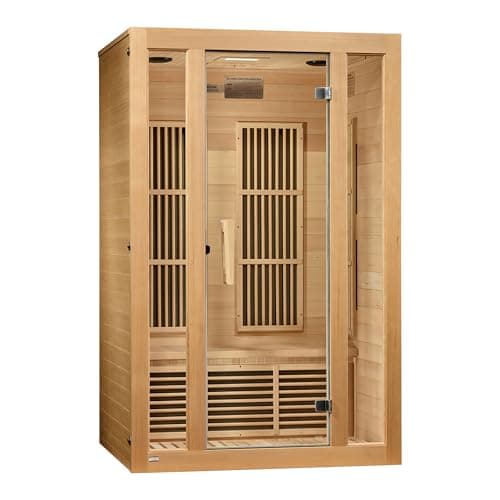
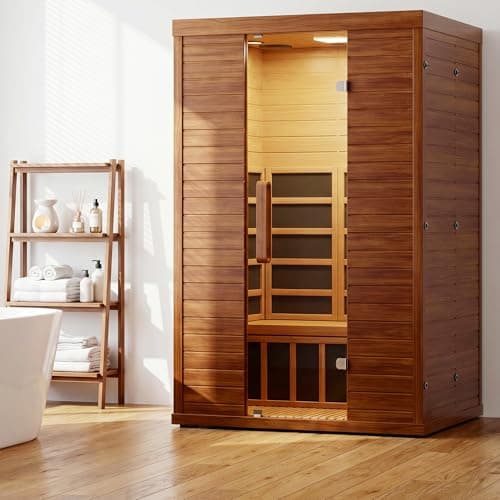
Update: the JNH Joyous keeps selling out on Amazon. It went unavailable in August and has come back as a single low-stock listing, so we removed its buy link rather than send you to a page you may not be able to order from. The cabin that now fills the independent-brand side of this matchup is the EASYHAWK 2-person, and that is what we compare against the Maxxus Seattle below.
Buy the EASYHAWK if price and cabin size decide it; buy the Maxxus Seattle if you want a named wood, a published EMF rating and the Golden Designs support platform behind you. Both are 2-person far-infrared cabins that plug into a standard 120V outlet, so this is a close, sensible pairing rather than a mismatch. Neither is a mistake.
What they share
Start with the common ground, because it is most of the product. Both are 2-person far-infrared cabins using carbon panels described as low-EMF, and both run on a standard 120V household outlet — no electrician, no dedicated circuit. Both deliver the same core thing: a genuine dry infrared sweat with your whole body inside the cabin, at a price far below a traditional build. Assembly on either is a two-person job with heavy panels. If you want the wider field, our 2-person infrared saunas roundup ranks these against the rest of the size class, and the best infrared saunas roundup covers the whole category.
Where the EASYHAWK wins
Two things put the EASYHAWK ahead. First, price: it undercuts the Seattle by a wide margin, which is the whole reason it is here. Second, room: at 47.2 x 39.3 x 72.8 inches it is a genuinely spacious 2-person cabin, with six low-EMF carbon far-infrared panels, a 1,500W heating system and an adjustable 64-149F range. It adds an LCD panel, Wi-Fi app control, Bluetooth, FM radio, a 7-color light, a reading light and cup and towel holders, runs on a standard 15A / 120V plug, sits on any indoor surface including carpet, and carries a 5-year limited warranty.
The honest cons are what the listing withholds. It never names a wood species, so you cannot compare it against the Seattle's hemlock, and its "low EMF" wording carries no published figure. It is also a newer, Amazon-direct name with nothing like the Golden Designs parts and manuals network. It ships in three separate packages that may arrive on different days.
Where the Maxxus Seattle wins
The Seattle's case is finish, features and disclosure. It is built on the Golden Designs platform — the same engineering and support that sits behind the Dynamic line — in a more finished cabin, and chromotherapy lighting and Bluetooth are standard on most Seattle listings. It states Canadian hemlock and carries a published low-EMF rating on its carbon far-infrared panels, which is more than the EASYHAWK tells you. Same 120V plug-in convenience either way.
The honest cons: it is far-infrared only, it usually costs considerably more, and it is genuinely hard to separate from its own Dynamic Andora sibling — we cover that in Maxxus vs Dynamic. Buy the Seattle for the finish, the documented specs and the support platform, not because it heats dramatically differently.
EMF: the gap has changed direction
This page used to turn on JNH's published ultra-low-EMF rating, which beat the Seattle's low-EMF one. That has flipped: the Seattle now carries the only published rating in the pair, because the EASYHAWK says "low EMF" without a number behind it. Keep it in proportion — both use modern carbon heaters designed to cancel much of the field, every electric heater produces some low-frequency EMF, and the fields involved sit in the range of everyday household appliances, where the science remains unsettled rather than alarming (NIEHS). Treat any rating as a manufacturer claim, not a measurement we took. If EMF is the single thing you care about most, our best low-EMF infrared saunas roundup puts the ultra-low-EMF-rated Dynamic Saunas Elite at the top for exactly that reason.
Cabin size vs the finished box
The clearest split on the spec sheets is space versus trim. The EASYHAWK gives you a bigger cabin and more wattage for less money. The Seattle answers with a more finished cabin and standard chromotherapy-and-Bluetooth — colored mood lighting and audio that are pleasant but decorative, changing nothing about the infrared sweat itself. Neither is a reason to overpay: the EASYHAWK's edge is practical (room and price), the Seattle's is a mix of cosmetic (fit and features) and informational (what the listing actually tells you). Decide which kind of advantage you value.
Buying from an independent vs a group badge
A quieter difference is what stands behind the cabin. EASYHAWK is an Amazon-direct independent offering a 5-year limited warranty on paper. The Seattle is a Maxxus-badged cabin on the Golden Designs platform — well-supported, widely stocked and backed by the largest mid-market group in the category, with the parts, manuals and third-party reviews that follow from volume. A warranty is a promise; a large installed base is evidence. If you want the reassurance of the biggest group's support network, that is a point for the Seattle; if you would rather keep the money, that is a point for the EASYHAWK.
Who each one is for
Buy the EASYHAWK if you are the value-first buyer this pairing is really aimed at — you want the most 2-person cabin per dollar and a long stated warranty, and you accept a listing that tells you less. Buy the Seattle if you cross-shop on finish, want the nicer cabin with chromotherapy and Bluetooth as standard, and value a named wood, a published EMF rating and the Golden Designs support platform. Both suit the same core buyer: someone who wants a plug-in 2-person far-infrared cabin and is not chasing full-spectrum heat.
Install and living with either is identical
There is no install advantage between them. Both are 2-person cabins that plug into a standard 120V outlet, both assemble as a two-person job with heavy panels, and both run the cooler, sustainable far-infrared heat you can sit in regularly. You sweat onto the bench and wipe it down after each session, same either way — see our infrared sauna maintenance guide for the routine. In other words, the ownership experience is a wash, which is exactly why this comes down to price, disclosure and finish rather than anything structural.
The verdict
Buy the EASYHAWK for the bigger cabin, the 5-year limited warranty and — by a wide margin — the lower price. It is the value winner. Buy the Maxxus Seattle if the more finished cabin with standard chromotherapy and Bluetooth appeals, or if you want a listing that names its wood and publishes an EMF rating. Both plug into the wall, both deliver a real infrared sweat, and the regular heat habit either supports is the part with a genuine health association behind it (JAMA Internal Medicine) — general information, not medical advice. If you are weighing the other big-brand pairing instead, our Dynamic vs JNH comparison settles that one, and on a tight budget the best infrared saunas under $2,000 is where to start.
How to choose between them
Lead with price and space — that points to the EASYHAWK
If you want the most 2-person cabin for the money, the EASYHAWK is the answer: a bigger box, six low-EMF panels, 1,500W and a 5-year limited warranty, for well under the Maxxus equivalent. Just make the information trade knowingly.
Choose the Seattle for finish, documentation and standard extras
The Seattle's reason to exist is the more finished cabin, the chromotherapy-and-Bluetooth that come standard, and a listing that actually states its wood and its EMF rating. If those matter more to you than the saving, it is a fair pick.
Both plug in — so wiring doesn't decide it
Neither cabin has a wiring advantage: both are far-infrared, both on a standard 120V outlet. That narrows the real decision to price, cabin size, disclosure and brand support.
Don't pay a premium for mood lighting alone
Chromotherapy and Bluetooth are cheap for a brand to include and change nothing about the infrared sweat — and the EASYHAWK has its own 7-color light and Bluetooth anyway. If the Seattle costs meaningfully more when you look, make sure you are paying for the documented specs and the support network rather than for decoration.
Size the cabin to the people first
Both are genuine 2-person cabins, so start by confirming two adults will actually use it — if it is really a solo cabin, a 1-person model saves money and floor space, and if you want room to recline, size up. Get the capacity right, then let price, finish and disclosure choose between these two.