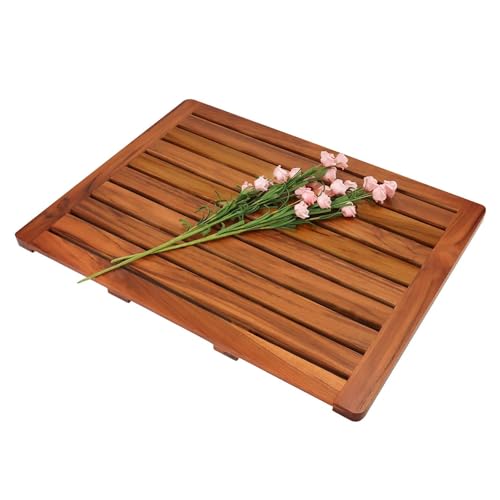
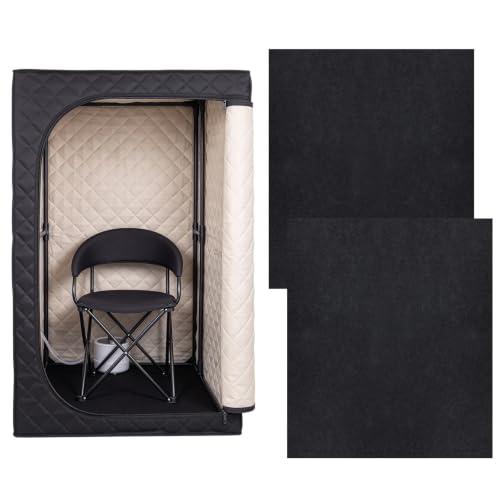
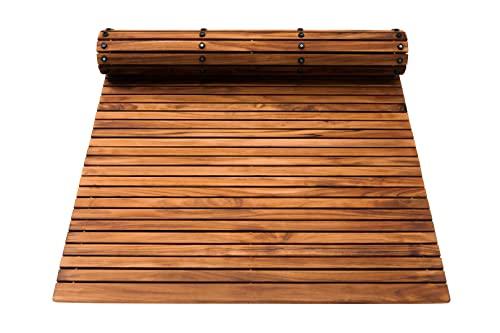
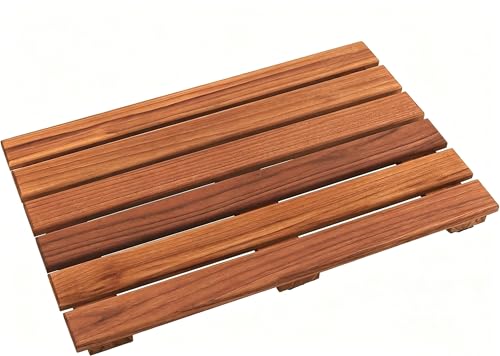
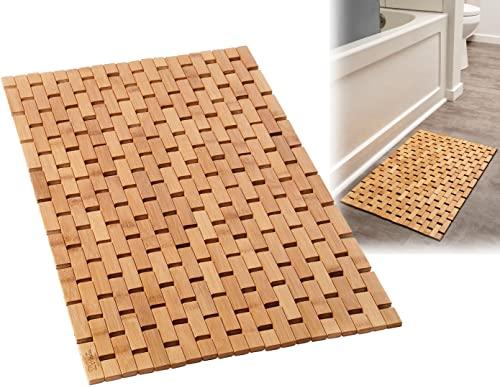
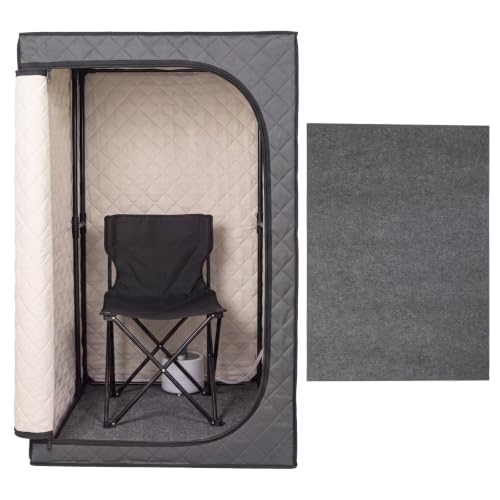
For most home saunas the right first purchase is the Hahafelt 47-inch felt mat: one piece big enough to cover the standing area of a two-to-four-person room, insulating underfoot, and cheap enough to replace when it has had enough. If your problem is standing water rather than a hot floor, buy teak instead — the Utoplike duckboard drains through its slats and never has to be carried out and dried. The budget pick is the bamboo roll-up mat, which does the draining job for well under half the price of teak. Prices in the table are live and carry their own as-of date.
Absorb or drain: the only real decision
Every sauna floor mat is one of two things, and they solve opposite problems. Our do you need a sauna floor mat page argues the case for having one at all; this page is about which kind.
Felt absorbs and insulates. It is the traditional Nordic answer. A felt mat soaks up the water and sweat that would otherwise go into your floor, and — more immediately — it puts a layer between the soles of your feet and a floor that in a hot room can be genuinely uncomfortable. It is not slippery when wet. The cost is a routine: it has to come out and dry.
Teak drains and does not insulate. A slatted duckboard sits on little feet and lets water fall straight through to the floor below, where it evaporates. Nothing to carry out, nothing to dry, nothing to smell. The cost is that your feet are now on wood that has been sitting in a 180F room, and in a winter outdoor sauna the difference between teak and felt underfoot is immediate.
Bamboo is the cheap version of the teak argument. Microfiber and rubber bath mats are neither, and we have not put any on this page.
How we ranked them
Judgments from documented research — listing specifications, published wood-property references and aggregated owner reports — not lab testing. See our methodology.
- Does it survive repeated wet heat? The thing this category is for. Teak and wool-type felt both do; a glued, coated or MDF-backed mat does not.
- How much floor does it actually cover?Many “sauna mats” are 20 by 13 inches, which is a tile. We state coverage on every pick, because two small mats often cost more than one large one.
- What does ownership look like? Felt has a drying routine; teak has an oiling routine; bamboo has a lifespan. None of them are maintenance-free, and the listings do not say so.
- Is it safe underfoot wet? Grip pads, slats, or a felt surface that does not go slick. A smooth sealed mat in a wet room is the wrong product.
- Does the listing know what it is for? Most of this category is bathroom product with sauna in the keyword list. One pick here is actually sold as sauna flooring, and we rank that honestly.
Why teak, specifically
Teak is the standard wood for shower benches, boat decks and spa duckboards, and the reason is documented rather than folklore: the USDA Forest Service Wood Handbook groups teak among the timbers rated highly for decay resistance and dimensional stability, which in plain terms means it does not rot quickly and it does not move much as it wets and dries. In a room that goes from cool and damp to 180F and back several times a week, movement is what destroys wooden products.
That matters more than finish or brand. An oiled teak mat will gray over a year or two if you do not re-oil it, and that is cosmetic. A bamboo mat on a cord or fabric backing will usually fail at the backing rather than the slats. A pine duckboard will cup. This is the same argument we make about cabin construction on best wood for a sauna.
One honest caveat about this whole category
Of the six products here, exactly one — the Nordic Teak string mat — is sold as sauna flooring by a maker that says so. The rest are bathroom and shower mats whose listings mention saunas. We have not pretended otherwise on any pick, and it affects two things you should know.
First, nothing in this category publishes a temperature rating, so the relevant judgment is the material rather than the marketing: solid teak and natural felt are both fine in a hot room, and anything glued, coated or foam-backed is a question mark. Second, the non-slip pads underneath every teak mat here are unspecified rubber or silicone, which is the part of a teak duckboard most likely to harden or mark a floor over time. Check them occasionally; they are also the part you can replace.
Which one is for you
- You want one mat to cover the floor — the overall pick: the Hahafelt 47-inch felt square. One piece, no seam, insulates, and doubles as a bench pad if you change your mind.
- Standing water is the problem: the Utoplike teak duckboard, 24 by 18 inches of solid teak on non-slip feet. Water goes through it; nothing has to be carried out.
- You sauna most days: the HFYZZ two-mat set. Two felt mats for roughly the price of one solves felt's actual weakness — one dries while the other is in use.
- You want it done properly, once: the Nordic Teak 59-inch string mat, the only pick here sold as sauna flooring. It rolls up so the floor underneath dries. It is also several times the cost of felt.
- You only need the footwell covered: the VaeFae teak pad, 20 by 13 inches. Cheapest way into teak, and the footwell is where the water is. Also good immediately outside the door.
- You want slats for the least money — the budget pick: the bamboo roll-up mat. Drains like teak, rolls up to dry, and belongs in an infrared cabin or outside the door rather than next to a rock stove.
Measure the floor you can actually stand on
The usable floor of a sauna is much smaller than its footprint. A two-tier bench eats most of the room; what is left is a strip in front of the lower bench and a patch in front of the stove you should not be standing on anyway. In a typical four-person cabin that strip is often around three feet by four.
This is why a single 47-inch mat covers more of a real sauna than it sounds like it should, and why buying three 20-inch bath pads to tile the same area is both more expensive and worse. Measure before ordering, and measure the bit you walk on rather than the room. Our bench guide has the usual bench depths if you are working it out from a floor plan.
One thing not to do: cover the floor wall to wall. A sauna floor needs to dry, and whichever format you choose, leaving the perimeter clear is how it does.
A mat is not a sauna floor
If water is pooling in your sauna rather than merely landing in it, a mat is the wrong fix. The floor itself should shed water — a sealed, sloped surface or tile with a drain in a built room, and a solid, level, moisture-tolerant base under a kit cabin. That is a build question, and it is the one covered on indoor sauna flooring.
What a mat does is handle the water that lands on a floor already able to cope: ladle spill, melt from a cold rinse, sweat, and whatever you track in on your feet. Used that way it protects the floor and your soles. Used as a substitute for drainage, it becomes a wet thing sitting on a wet thing.
Felt: the routine that decides whether it lasts
Felt in a sauna is entirely about drying. The routine is three steps and takes ten seconds: lift the mat out on your way past, hang or stand it somewhere with air, and leave the sauna door ajar so the room itself dries too. Do that and a felt mat lasts years. Leave it on the floor of a closed sauna every day and it will smell within a month, and no amount of washing afterwards really fixes it.
Two more notes. Felt mats are usually machine washable on a cool wash but will shrink and harden if you wash them hot or tumble them, so cool and flat-dry. And where a listing says only “natural felt,” the fiber may be wool, a wool blend, or recycled polyester — the thermal behavior is similar, but wool tolerates damp far better, so if a listing does name wool it is worth a small premium. The Finnish Sauna Society is the reference on traditional room practice, and felt seat and floor covers are part of it.
Teak: the routine, and the pads underneath
Teak asks almost nothing of you. Rinse it occasionally, let it dry — which it does on its own, raised on its feet — and re-oil it once or twice a year if you want it to stay honey-colored instead of silvering. Silvering is cosmetic; the wood is fine either way.
The part that does wear is the non-slip pads on the underside. They are unspecified rubber or silicone on every teak mat here, they are the component in contact with the hottest, wettest surface, and when they harden the mat starts sliding. Check them when you re-oil. Replacement self-adhesive pads cost a couple of dollars.
Mats that double as bench pads
Both felt picks here are sold for the floor or the bench, which is not marketing laziness — it is the same product doing two useful jobs. A felt pad on a bench insulates your skin from hot wood and absorbs less sweat into the timber, which is the same argument we make for a bench towel, with better insulation and a worse wash cycle.
If the hot bench rather than the hot floor is what makes your sauna uncomfortable, buy the two-piece felt set and put one on each. And if the complaint is a hot backrest, that is a different fix again — see do you need a sauna backrest.
What not to buy
Foam or PVC bath mats: they are the one material we would actively keep out of a hot room. Rubber gym tiles, for the same reason plus the smell. Memory-foam anything. Diatomaceous stone mats, which are excellent immediately outside the sauna door and brittle inside it. And a plush absorbent bath rug, which in a sauna becomes a permanently damp object.
For the rest of the fit-out, our accessories checklist sets out what a traditional room needs versus an infrared cabin, and accessories under $100 covers the step-up tier of everything else.