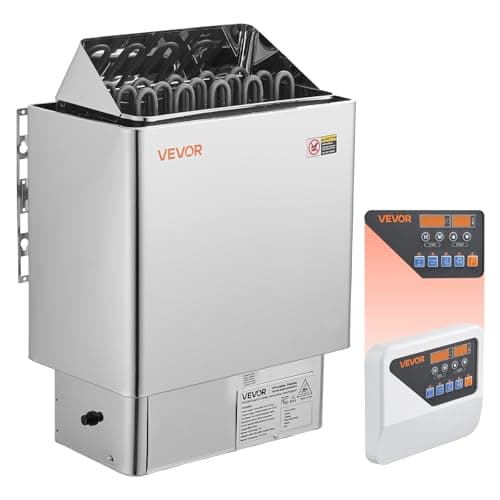
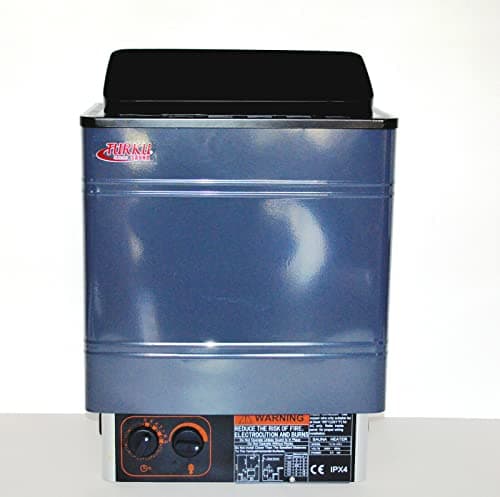
Both of these are 9kW stoves built to heat the same big room — the decision is build quality, controls and price, not heat. The Turku 9kW is the better-reviewed residential unit and the one we rank first: a wet/dry stove with built-in controls that undercuts the premium brands while doing the same job. The VEVOR 9kW is the cheaper alternative — the lowest price at this power, with an external digital controller as its calling card. Neither is a bad buy. But before you weigh either, understand the part that's identical: a 9kW heater is a heavy 240V load that needs a dedicated circuit and a licensed electrician to install, permit and inspect. That is not optional on either stove.
Get the kW right before you pick the brand
Both units are 9kW, and that number is the real decision — bigger than which badge is on the box. A 9kW stove is a large-room heater, suited to roughly a 450-550 cubic-foot sauna, which is a genuine 5-6 person room. Put a 9kW stove in a 2-person cabin and it will overshoot, cycle hard and waste energy heating a box that was already hot. So the first job is to measure your room — length by width by height for the cubic feet — and confirm 9kW is actually the size you need before you compare these two at all. Our sauna heater size guide walks the cubic-feet math, and the wider best sauna heaters ranking files every stove under the room size it actually suits. If your measurements land below about 450 cubic feet, the honest answer is a smaller heater, not one of these.
Where the Turku pulls ahead
The Turku 9kW is our winner because it is the more complete stove for a permanent install. It is wet/dry rated, so you can ladle water on the stones for loyly — the burst of steam that is the entire point of a traditional sauna — where a dry-only heater's elements can be damaged by water. It handles a large room the 8kW premium stoves would be stretched by, for meaningfully less money, which is exactly why it sits between Harvia and VEVOR on value. Its built-in controls keep the wiring straightforward for your electrician. The honest cons are real, though: Turku's parts and replacement-stone network is not as deep as Harvia's, so if a part fails years from now it may be harder to source, and 9kW is a heavy electrical load you must confirm your panel can carry. It is the value pick, not the buy-forever one — and if you want to weigh it against the true benchmark brand, that is the Harvia vs Turku comparison.
Where the VEVOR makes its case
The VEVOR 9kW earns its place on two things: price and controls. It is by a distance the cheapest way to get 9kW of heat, and it ships with an external digital controller— you mount it outside the hot room and set a target temperature and a start timer without opening the door, then walk in to a room that's already hot. That is a genuinely nicer daily experience than reaching for a knob inside a 190F cabin, and it is a feature the pricier stoves often make you pay extra for. The trade-offs are the ones you would expect from a budget unit: the build and long-term support are the price you pay for the low sticker, so it is the buy-cheap option rather than the buy-once one, and stones are frequently notincluded — budget for a separate bag so the "cheaper" stove is actually cheaper once it can run. If your priority is the lowest possible outlay at 9kW and you accept a shorter expected life, the VEVOR is honest about what it is. To pit it against the benchmark brand instead, see Harvia vs VEVOR.
Neither is a plug-in — the 240V install is the real project
This is the part that matters more than the price gap, and it is identical for both stoves. A 9kW sauna heater draws far more current than any standard outlet can supply. It needs a dedicated 240V circuit, with the breaker and cable sized to the heater's rated load, a disconnect, and — in most jurisdictions — a permit and an inspection. That is licensed-electrician work, governed by the National Electrical Code and the local rules your inspector enforces (NFPA). It is not a weekend DIY job, and the cost of the electrician and the circuit is a real line item on top of whichever heater you choose — often enough to shrink the price gap between these two. Before you order either stove, confirm your electrical panel can spare the load, and read our how to wire a sauna heater orientation so you know what to hand your electrician. The install is the same on both; only the stove changes.
The verdict
Buy the Turku 9kW if you want the better-reviewed residential stove, real wet/dry loyly, and a sensible middle price for a large room — for most buyers at this power, it is the smarter money and our pick. Buy the VEVOR 9kW if the absolute lowest price is the priority, you like the convenience of the external digital controller, and you accept the budget build and buying stones separately. Whichever you pick, the deciding factor is the same as the deciding work: size the 9kW to a genuinely large room, and budget the licensed 240V install as part of the purchase, not an afterthought. Still deciding on power at all? Start on the best sauna heaters ranking.
How to choose between the Turku and the VEVOR
Confirm 9kW is the right size first
Both are 9kW, so this comparison only makes sense if your room actually needs that much heat. Measure length by width by height for the cubic feet and allow roughly 1kW per 45 cubic feet of well-insulated space; 9kW suits a large room of about 450-550 cubic feet. If your room is smaller, neither of these is your heater — size down. The full method and a room-size-to-kW table are on the size guide.
Built-in controls vs an external digital controller
This is the clearest split between the two. The Turku uses built-in controls you set inside the room; the VEVOR comes with an external digital controller you mount outside, so you can set a temperature and a start timer and walk in to a hot sauna without opening the door. If pre-heating from outside matters to you, that is a point for the VEVOR; if you would rather have the better-built stove and don't mind a knob, the Turku is the pick.
Wet/dry rating, if you want loyly
Loyly — the steam from throwing water on hot stones — is the heart of a traditional sauna, and only a stove rated wet/dryis designed for it. The Turku is wet/dry rated. Pouring water over a heater that isn't rated for it can damage the elements, so if you plan to ladle water, confirm the rating on the exact listing before you buy, and lean toward the Turku.
Budget the 240V install and the stones
The heater is only part of the spend. Both need a dedicated 240V circuit and a licensed electrician, so fold that cost in from the start — it is often enough to narrow the price gap between these two. Then check the stones: budget stoves like the VEVOR frequently ship without them, so add a bag of sauna stones to the VEVOR's price before you call it the cheaper option. A stove that can't run until you buy stones isn't finished.